
AI is no longer a future experiment for enterprise leaders. It is already shaping customer experience, pricing, forecasting, risk management, and operational planning. However, many AI projects fail to move beyond pilots because the data foundation is weak. Before leaders invest heavily in artificial intelligence, they need to ask a sharper question: is our data ready to support AI at scale?
“Businesses need data engineering before AI because models cannot outperform the quality of their inputs.”
For CEOs, CXOs, and business heads, this is not only a technical concern. It is a growth, risk, and ROI concern. If business data is scattered, duplicated, outdated, or poorly governed, AI will only amplify those problems. Therefore, data engineering before AI is not an optional phase. It is the foundation that makes AI accurate, trusted, scalable, and useful.
The AI Hype Meets a Hard Reality
Many organizations assume AI can solve poor reporting, disconnected systems, or slow decision-making on its own. However, AI depends on the quality of the data it receives. If the input data is inconsistent, the output will also be unreliable. As a result, teams may get confident-looking insights that are actually based on weak evidence.
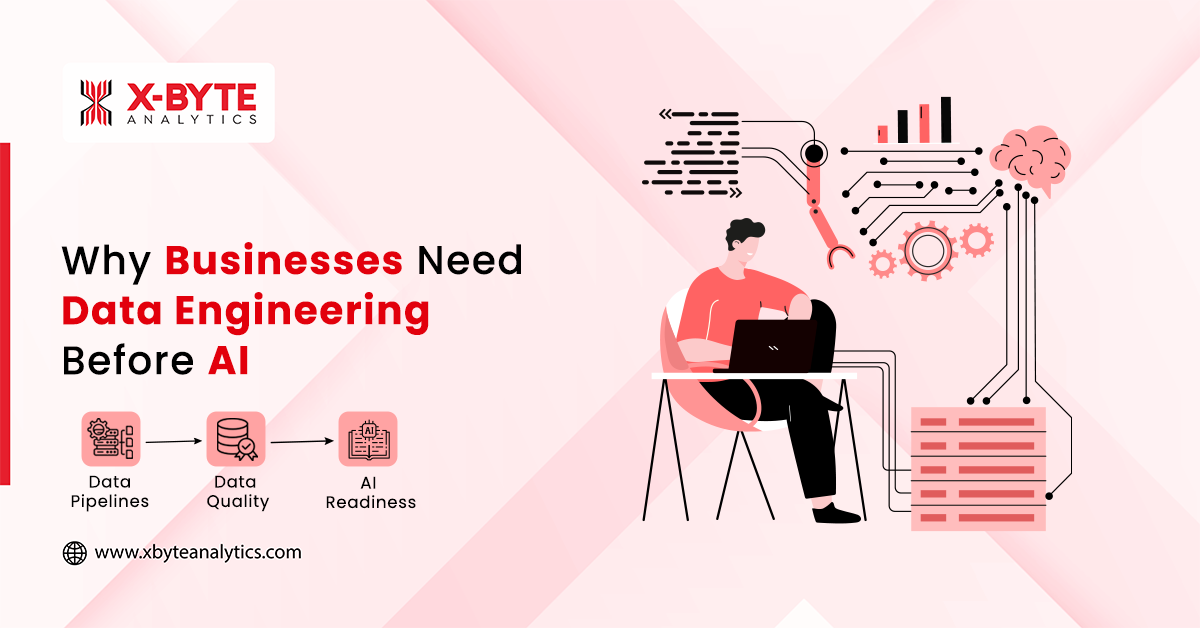
This is where data engineering services become essential. Data engineers collect, clean, structure, validate, and move data from multiple systems into usable pipelines. In simple terms, they prepare the business data so analytics, automation, and AI models can work with confidence. Without this layer, AI becomes expensive guesswork.
For leadership teams, the issue is clear. AI investment should not begin with tools alone. Instead, it should begin with data quality, ownership, accessibility, and governance.
“For enterprise AI, the biggest risk is not the algorithm. It is poor data quality, weak governance, and disconnected systems feeding the algorithm.”
Jay Bagtharia, Senior Data Engineering Consultant, X-Byte Analytics
What Data Engineering Really Does for AI
Data engineering builds the operational backbone for AI-ready data. It connects data from CRMs, ERPs, websites, mobile apps, databases, cloud platforms, APIs, and third-party sources. Then, it transforms raw information into structured, consistent, and usable datasets.
More importantly, it creates repeatable data pipelines. These pipelines ensure that AI systems receive fresh and reliable data without manual effort. Therefore, teams do not need to rebuild reports or clean spreadsheets every time they need insight. The process becomes automated, scalable, and measurable.
Modern data engineering also supports data governance. This includes access control, metadata, lineage, validation rules, and security standards. Consequently, leaders can understand where data came from, how it was changed, who can access it, and whether it can be trusted.
For enterprise AI, that visibility matters. It reduces operational risk and supports better compliance, especially in industries like healthcare, finance, retail, insurance, and manufacturing.
Why Executives Should Care Before AI Budgets Grow
AI failure is rarely caused by the model alone. Often, the real problem sits inside the data environment. Different teams may define the same metric differently. Customer records may be duplicated. Product data may be incomplete. Historical data may sit in systems that do not communicate.
Because of this, executives may face four common risks. First, AI models can produce inaccurate recommendations. Second, teams may lose trust in automated decisions. Third, compliance issues may increase when sensitive data is poorly governed. Finally, AI programs may become expensive without producing measurable business value.
Data engineering reduces these risks before they reach the boardroom. It gives the organization a single, cleaner, and more dependable version of business truth. As a result, leaders can make AI decisions based on readiness, not hype.
Data Engineering Before AI Improves ROI
Every AI initiative needs a business case. However, ROI becomes difficult when the data foundation is incomplete. Teams spend too much time preparing data, validating outputs, and fixing errors. Meanwhile, decision-makers wait longer for usable insights.
With a strong data engineering foundation, this changes. Data pipelines deliver information faster. Data quality rules reduce rework. Integration removes silos. Governance improves trust. Therefore, AI teams can focus on building models, improving decisions, and creating business outcomes.
For example, demand forecasting becomes stronger when sales, inventory, seasonality, pricing, and customer behavior data are connected. Fraud detection improves when transaction, KYC, customer, and risk data are available in a unified structure. Similarly, customer analytics becomes more useful when online and offline journeys are connected.
This is why data engineering is not a back-office activity. It directly influences margin, speed, customer experience, and competitive advantage.
Signs Your Business Is Not AI-Ready Yet
Before scaling AI, leaders should assess whether their data environment can support it. Several warning signs are easy to identify.
If teams still depend on manual spreadsheets for reporting, the foundation is weak. If different departments report different numbers for the same KPI, governance is missing. If data is stored across disconnected systems, integration is incomplete. Also, if analysts spend more time cleaning data than analyzing it, the business is not ready for AI at scale.
Another important sign is poor data ownership. When nobody is responsible for data accuracy, AI quality becomes difficult to manage. Therefore, each business function needs clear accountability for the data it creates and uses.
A practical next step is a data readiness audit. This helps leaders understand pipeline gaps, data quality issues, architecture weaknesses, and governance risks before investing in AI tools.
How Data Engineering Supports Scalable AI
Scalable AI needs more than a proof of concept. It needs a continuous flow of reliable data. Data engineering makes that possible through ETL and ELT pipelines, cloud data warehouses, data lakes, APIs, metadata systems, and automated validation.
In addition, scalable data engineering helps AI models stay useful over time. Business conditions change, customer behavior shifts, and market signals move quickly. Therefore, AI systems need updated data to remain relevant. A static dataset may support a demo, but it cannot support long-term enterprise intelligence.
This is especially important for real-time and near-real-time use cases. Dynamic pricing, fraud alerts, predictive maintenance, customer churn prediction, and supply chain planning all depend on timely data. Without strong pipelines, these AI use cases become slow, incomplete, or unreliable.
For this reason, leaders should treat data engineering as the first phase of enterprise AI transformation.
Where X-Byte Analytics Fits In
X-Byte Analytics helps businesses build strong data foundations before they scale AI. Through Data Engineering Services for AI Readiness, the team supports data pipeline development, data integration, ETL and ELT frameworks, scalable architecture, data governance, and analytics-ready infrastructure.
This matters because every business has a different data challenge. Some companies need to modernize legacy systems. Others need to unify cloud, SaaS, and database sources. Many need cleaner data for dashboards, predictive analytics, or machine learning models. Therefore, a customized engineering roadmap is usually more effective than a tool-first approach.
For leadership teams, the goal is simple. Build a reliable data layer that supports better reporting today and smarter AI tomorrow.
Case Study Angle to Strengthen This Blog
A relevant internal case study can make this blog more persuasive. For example, the AI-Powered Demand Forecasting Retail Dashboard case study is a strong fit because it shows how connected sales, inventory, and forecasting data can support smarter planning.
You can also reference the AI-Powered Dynamic Pricing Dashboard for E-commerce case study if the target audience includes retail and ecommerce leaders. Both examples connect data engineering, analytics, and AI outcomes in a business-friendly way.
A short case insert can be added after the ROI section. It should explain the business problem, the data challenge, the engineered solution, and the measurable outcome. This will improve E-E-A-T and support BOFU conversion.
A Practical AI Readiness Checklist for Leaders
Before approving a major AI budget, leadership teams should review five areas.
First, check data quality. Is the data accurate, complete, timely, and consistent? Second, review data integration. Are important systems connected, or are teams still working in silos? Third, assess governance. Are ownership, access, privacy, and compliance rules clearly defined?
Next, evaluate scalability. Can the current architecture handle growing data volume and new use cases? Finally, review business alignment. Does every AI use case connect to measurable outcomes such as cost reduction, revenue growth, risk control, or customer retention?
If the answer is unclear, the organization should strengthen data engineering first. This approach protects budgets, improves confidence, and creates better conditions for AI success.
Final Thoughts
AI can transform business decisions, but only when the data behind it is strong. Therefore, companies should not rush into AI without preparing their data foundation. Data engineering before AI helps leaders improve quality, connect systems, reduce risk, and build scalable intelligence.
For CEOs and CXOs, this is the real starting point. Strong data engineering turns fragmented business information into a trusted asset. Once that foundation is ready, AI becomes more than a technology investment. It becomes a practical engine for better decisions, faster operations, and measurable growth.
If your organization is planning AI, start by asking whether your data is ready. The right answer can save cost, reduce risk, and make every future AI initiative more valuable.