
Choosing the right data analytics consulting partner shapes how fast your business turns data into revenue. As a CEO or CXO, you own that decision personally.
Moreover, the wrong vendor drains budgets and erodes board confidence. Therefore, this guide gives you a clear scorecard instead of vague advice.
Above all, you will know which questions separate a true partner from a staffing agency in disguise.
Grab our Vendor Evaluation Scorecard — the same weighted framework in this guide.
Why the Right Data Analytics Consulting Company Matters
Most analytics projects miss their original goals. Usually, the cause is mismatched expertise, not technology.
Consequently, your vendor choice becomes a strategic risk decision. Furthermore, the right firm ties dashboards to P&L outcomes, while the wrong one ships charts nobody trusts.
You also face a credibility test internally. After all, you must defend the spend to a board that wants measurable returns.
So a partner who speaks in business metrics, not just code, protects your reputation. In short, fit matters as much as capability.
Define Your Outcomes Before You Shortlist Vendors
Start with outcomes, not technologies. First, write down the three decisions you want better data to improve.
Then attach a number to each, and share that list with every partner. Vendors who reframe goals into a roadmap understand value; those pitching tools sell licenses.
Additionally, clear outcomes let you compare proposals fairly. Without them, every deck looks impressive and nothing is comparable.
Audit Your Data Maturity First
Be honest about readiness. Without clean pipelines, advanced predictive analytics only amplifies bad inputs.
Hence, a strong partner audits readiness before promising models. That honesty signals integrity worth paying for.
Evaluate Real Experience and Domain Depth
Experience separates consultants who deliver from those who experiment on your budget. Look for depth, not years on a slide.
Specifically, ask for proof across these dimensions:
- Industry fit — projects in your sector, not just adjacent ones.
- Data volume — experience at your scale and complexity.
- Compliance — working knowledge of HIPAA, SOC 2, or GDPR.
- Named team — the pitch team must be the delivery team.
Notably, seasoned consultants probe your unit economics early. Generalists ask only about data sources, which reveals how they think.
Assess Technical Capability and Tooling Fit
Technical fit determines whether your stack scales or stalls. Ask which platforms a partner uses and why.
Ideally, they justify choices like Power BI, Snowflake, dbt, or Databricks against your needs. However, beware firms that force one tool onto every client.
Because tool-agnostic advice usually serves you better than vendor lock-in. In addition, probe how they handle data engineering, not just visualization.
After all, dashboards depend entirely on reliable pipelines beneath them. Consequently, architecture strength protects your long-term costs.
Don’t Overlook Data Security
Security deserves the same scrutiny as analytics skill. So ask how they manage access, encryption, and audit trails.
Furthermore, request their incident response approach in plain language. If answers feel vague, treat that as a warning sign.
Demand Proof Through Case Studies and References
Proof beats promises. Therefore, ask for case studies that match your problem, not just polished logos.
Strong examples show a baseline, an intervention, and a measurable result. Additionally, insist on speaking with at least two references directly.
For instance, a retail price-monitoring project might cite recovered margin in percentage terms. Genuine partners quantify impact in your language.
Meanwhile, pretenders hide behind dashboard screenshots. Because every project hits friction, recovery reveals character.
During those calls, focus on what really matters:
- What went wrong, and how the partner responded.
- Whether outcomes were tied to revenue, cost, or risk.
- Whether the same team stayed through delivery.
Scrutinize the Engagement Model and Pricing
Engagement structure quietly drives your total cost of ownership. Clarify whether the partner offers fixed-scope projects, retainers, or embedded teams.
Moreover, understand how change requests get priced before signing, because scope creep destroys fuzzy budgets.
Lock Down IP Ownership and Pricing
Ask who owns the code, models, and documentation at the end. Surprisingly, some firms retain IP that should belong to you.
Also, beware the lowest bid. Often, cheap proposals hide thin teams or offshore handoffs, so weigh value against measurable outcomes.
Watch for These Red Flags
Finally, scan every proposal for warning signs before you sign:
- Vague answers on security, ownership, or pricing.
- Vanity metrics like activity counts instead of business impact.
- A rotating cast with no single accountable lead.
Confirm Communication, Governance, and Culture Fit
Culture fit decides whether a smart team actually delivers inside your organization. Assess how a partner communicates during the sales process itself.
Because that behavior predicts the engagement. Ideally, you receive a single accountable lead, not a rotating cast.
Furthermore, governance matters once dashboards reach hundreds of users. So confirm how they manage versioning, access, and data quality at scale.
Subsequently, a partner who plans for adoption and governance at scale, not just delivery, earns long-term trust.
A Practical Scorecard for Your Final Decision
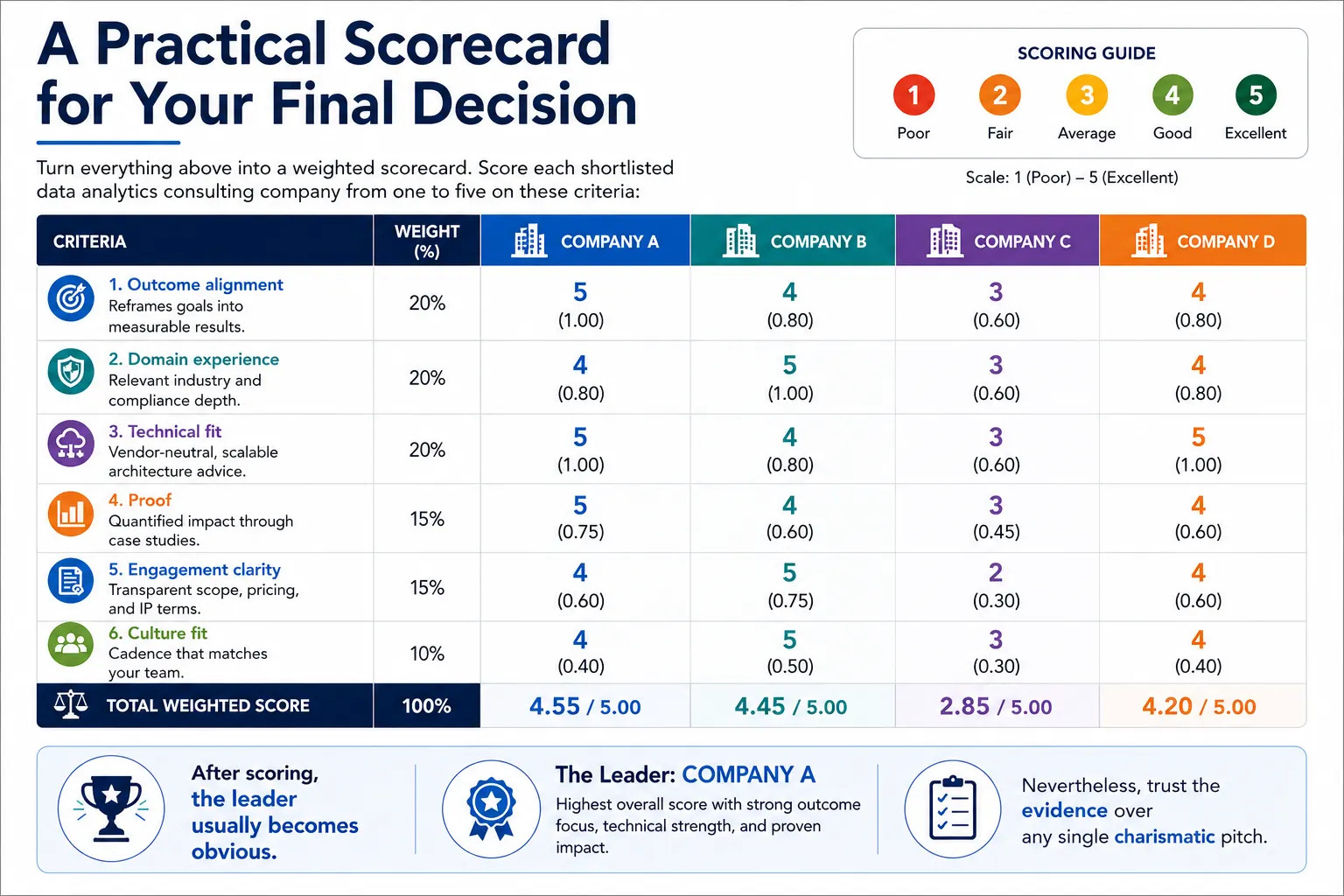
Turn everything above into a weighted scorecard. Score each shortlisted data analytics consulting company from one to five on these criteria:
- Outcome alignment — reframes goals into measurable results.
- Domain experience — relevant industry and compliance depth.
- Technical fit — vendor-neutral, scalable architecture advice.
- Proof — quantified impact through case studies.
- Engagement clarity — transparent scope, pricing, and IP terms.
- Culture fit — cadence that matches your team.
After scoring, the leader usually becomes obvious. Nevertheless, trust the evidence over any single charismatic pitch.
Partner With X-Byte Analytic
X-Byte Analytics helps CEOs and CXOs turn data into measurable outcomes. Specifically, we combine domain depth, secure engineering, and outcome-led delivery.