
Grab our Vendor Evaluation Scorecard — the same weighted framework in this guide.
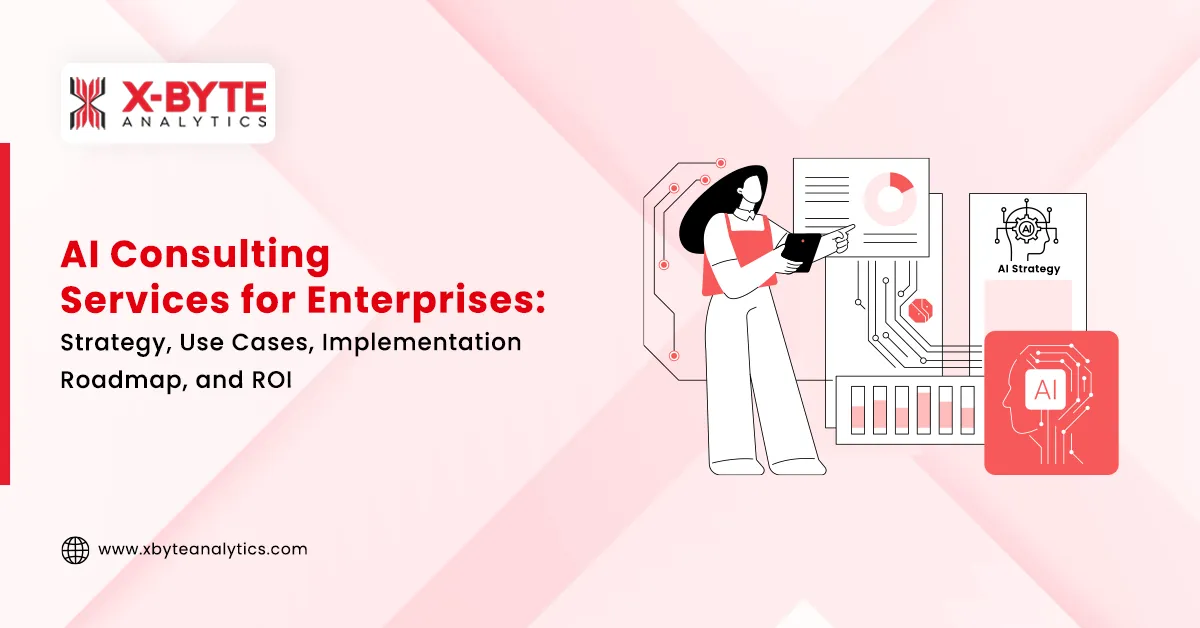
Enterprise leaders are past the “AI experiment” stage. However, many still need a clear path from scattered pilots to measurable business value. AI consulting services help CEOs, CXOs, and senior teams identify where teams should apply artificial intelligence, how leaders should govern it, and which initiatives deserve investment first. The goal is not to add another tool. Instead, the goal is to redesign decisions, workflows, and data systems so AI creates practical business outcomes.
Recent enterprise AI research supports this shift. McKinsey reports that 88% of organizations now use AI in at least one function, yet only about one-third have begun scaling AI programs across the enterprise. Therefore, the real competitive gap is no longer adoption. It is execution, governance, integration, and ROI discipline.
What Are AI Consulting Services for Enterprises?
AI consulting services for enterprises combine business strategy, data engineering, AI solution design, model deployment, governance, and change management. In simple terms, consultants help leadership teams decide where AI can improve revenue, cost, risk, productivity, and customer experience. Then, that strategy is converted into a practical AI implementation roadmap.
A strong enterprise AI consulting engagement usually starts with an AI readiness assessment. This assessment reviews data quality, technology stack, workflow maturity, security requirements, skills, compliance needs, and measurable business goals. As a result, executives avoid random pilots and focus on high-value AI use cases that match business priorities.
For X-Byte Analytics, this approach connects AI strategy with data analytics, cloud platforms, BI systems, and scalable data pipelines. That matters because AI performance depends on trusted data, clear ownership, and operational adoption. Without those foundations, even powerful models can produce limited value.
Why Enterprises Need an AI Strategy Before Implementation
Many companies start with a model, vendor, or chatbot idea. However, enterprise AI success starts with a business question. Which margin leak needs reduction? What manual process slows growth? Where does the customer journey need better personalization? Which decision needs faster insight?
An AI strategy consulting approach helps leaders answer these questions before leaders commit budget. Moreover, it defines the operating model, data foundation, governance rules, success metrics, and implementation sequence. IBM’s AI research notes that leading organizations build AI roadmaps around strategy, toolkits, data management, and applications. That same research also highlights C-suite and IT alignment as a key maturity factor.
Therefore, executives should treat AI as a transformation program, not a technology purchase. Companies achieve the strongest outcomes when they embed AI into daily workflows, leadership reviews, reporting cycles, and decision systems. In addition, employees must understand when to trust AI, when to validate outputs, and when to escalate decisions.
High-Value Enterprise AI Use Cases That Support ROI
Leaders should select AI use cases based on business value, feasibility, data readiness, and risk. For example, a retailer may prioritize demand forecasting, customer segmentation, and AI-powered product recommendations. Meanwhile, a healthcare group may focus on patient flow forecasting, AI-assisted scheduling, revenue cycle analytics, and operational risk alerts.
For finance, AI can support fraud detection, credit risk scoring, cash flow forecasting, and automated reporting. In manufacturing, it can improve predictive maintenance, defect detection, production planning, quality analysis, and supply chain visibility. Additionally, executives can use generative AI consulting to automate document review, enterprise search, proposal support, knowledge discovery, and conversational BI.
Case Study Proof: AI-Driven Recommendation Ecommerce Dashboard
X-Byte Analytics’ AI-driven recommendation ecommerce dashboard is a relevant proof point for enterprise AI consulting. The project used AI models, SQL data integration, and Power BI dashboards to improve personalization and track recommendation performance. According to the case study, the solution contributed to a 20% increase in online sales, 18% higher average order value, and improved repeat purchase rate.
AI Implementation Roadmap for CXOs
A practical AI implementation roadmap should move in phases. First, business objectives, budget expectations, risk appetite, and ownership should be defined by leadership. This phase should include the CEO, CFO, CIO, CDO, and department heads because AI value crosses functions.
Next, the organization should complete data discovery and AI readiness scoring. Teams should review data sources, pipelines, access rules, security controls, and quality issues. This is where AI-ready data engineering services become critical. Clean, connected, and governed data is the foundation for machine learning, RAG systems, predictive analytics, and AI dashboards.
After that, use cases are prioritized with a value-feasibility matrix. Quick wins may include reporting automation, forecasting, recommendation engines, or document intelligence. More complex initiatives may involve custom models, agentic workflows, or enterprise-wide AI platforms. However, each initiative should have a business owner, baseline metric, target outcome, and adoption plan.
Finally, implementation should include pilot design, model development, integration, monitoring, and scale planning. Governance should be defined before production release. Also, teams should include human review, audit trails, model performance checks, and cost controls from the start.
Data Engineering and Governance: The Hidden AI Success Layer
AI is only as reliable as the data and process behind it. Therefore, enterprise leaders should evaluate data readiness before approving large AI programs. Poor data quality, fragmented systems, missing ownership, and weak metadata can reduce accuracy and trust. In addition, these issues increase implementation cost.
Data engineering services solve this by building scalable ETL or ELT pipelines, data warehouses, data lakes, data quality checks, and governance controls. X-Byte Analytics’ data engineering practice focuses on scalable data architecture, ETL pipelines, data transformation, integration, and governance. These capabilities create the dependable foundation required for AI model training, analytics, and automation.
Governance also protects enterprise value. Policies should define data usage, access levels, model validation, explainability, privacy, human oversight, and compliance reporting. Moreover, teams should monitor AI outputs for accuracy, drift, bias, latency, and cost. Gartner also emphasizes structured AI roadmaps and governance workstreams for scaling AI across organizations.
Measuring ROI from AI Consulting Services
Leaders should measure AI ROI before, during, and after implementation. First, leaders need a clear baseline. A baseline is documented across processing time, labor effort, revenue leakage, customer churn, forecast error, stockouts, downtime, claim denials, or reporting hours.
Next, teams should connect every AI use case to measurable financial or operational KPIs. For instance, leaders can measure a recommendation engine by revenue per visitor, conversion rate, average order value, and retention. Leaders can measure a forecasting solution by inventory turnover, waste reduction, service levels, and margin improvement. Meanwhile, teams can measure document automation by cycle time, error reduction, compliance risk, and employee productivity.
However, ROI should not be limited to cost savings. McKinsey’s 2025 survey found that high-performing AI organizations often combine efficiency goals with growth and innovation goals. As a result, executives should track both hard ROI and strategic value. Useful metrics include revenue uplift, cost reduction, risk reduction, decision speed, customer experience, adoption rate, and model reliability.
Ready to Build an AI Roadmap That Proves ROI?
Before investing in AI tools or custom models, enterprises need clarity on business value, data readiness, governance, and measurable outcomes. X-Byte Analytics helps leadership teams identify high-impact AI use cases, assess existing data systems, design implementation roadmaps, and build scalable AI-powered analytics solutions. Whether your goal is automation, forecasting, personalization, operational intelligence, or executive decision support, our team can help convert AI ideas into measurable business impact.
How to Choose the Right AI Consulting Company
The right AI consulting company must understand business strategy, data architecture, AI engineering, analytics, governance, and adoption. Therefore, executives should ask for more than model demos. They need proof of structured delivery, industry experience, scalable data systems, measurable KPIs, and post-launch support.
A qualified partner should also explain what will not work. For example, some use cases may lack clean data, clear ownership, or enough business impact. In those cases, a responsible consultant will recommend readiness work before implementation. This prevents wasted spend and protects stakeholder confidence.
X-Byte Analytics is positioned for enterprises that need AI connected with analytics, BI, cloud, and data engineering. Its portfolio includes AI-powered dashboards, healthcare analytics, manufacturing operations dashboards, and data analytics solutions across industries. Additionally, its listed delivery strengths include data pipelines, governance, Power BI, SQL, Python, Azure Machine Learning, and cloud-ready analytics architecture.
Enterprise AI Consulting: From Roadmap to Measurable Results
AI consulting services create the most value when they connect strategy with execution. Therefore, enterprises should start with a clear business case, validate data readiness, prioritize use cases, define governance, and measure ROI continuously. This approach reduces experimentation risk and improves the chance of scalable impact.
For CEOs and CXOs, the decision is not whether AI matters. The decision is where teams should apply AI first, how quickly they can integrate it, and how they will prove value. With the right roadmap, AI can improve decision intelligence, automate complex workflows, and unlock measurable growth.
If your organization is ready to move from AI interest to AI impact, X-Byte Analytics can help assess readiness, prioritize use cases, design the implementation roadmap, and build scalable AI-powered analytics solutions.