

Key Highlights:
- Data cleaning ensures analytics reflects accurate, reliable business realities. Without it, insights become misleading and risky.
- Poor data quality breaks trust in dashboards, forecasts, and KPIs. Clean data restores confidence in data-driven decisions.
- Continuous data cleaning enables scalable BI, accurate AI insights, and faster reporting. It turns analytics into a dependable decision tool.
Introduction
Enterprises today generate massive volumes of data from ERP systems, CRM platforms, marketing tools, financial software, operational systems, and external data sources. Yet despite this abundance, many organizations struggle to extract reliable insights from their analytics initiatives. According to Gartner, poor data quality costs the average enterprise between $12.9 million and $15 million annually, highlighting why clean data is essential for reliable analytics and decision-making.
Dashboards look impressive and reports are delivered on time, but leadership still questions whether the numbers truly reflect reality, a concern that often surfaces only after key decisions fail to deliver expected outcomes. At the heart of this problem lies data cleaning in data analysis.
Data analysis is only as strong as the quality of data feeding it. When data is incomplete, inconsistent, duplicated, or outdated, analytics outputs become misleading. Decisions based on such insights introduce risk rather than clarity. This is why the importance of data cleaning has moved beyond a technical concern and become a strategic priority for enterprises and business leaders.
This blog explores why data cleaning is important in data analysis, the business impact of poor data quality, and how clean data becomes the foundation for trustworthy analytics, business intelligence, and AI-driven decision-making.
What Is Data Cleaning?
Data cleaning refers to the process of identifying, correcting, standardizing, and validating data to make it accurate, complete, and consistent for analytical use. In practical terms, it transforms raw, unstructured data into clean data for analytics.
In enterprise environments, data rarely comes from a single system. Sales, finance, operations, marketing, and customer data are often stored across multiple platforms, each with its own structure and definitions. As a result, the same customer, product, or KPI is frequently represented differently across systems, creating inconsistencies, gaps, and errors that directly affect analytics outcomes. Without deliberate data cleaning in data analysis, analytics teams spend more time reconciling numbers than delivering insights.
Data cleaning in data analysis typically involves:
- Removing duplicate records that inflate metrics
- Handling missing values that distort trends
- Correcting incorrect formats and data types
- Standardizing naming conventions and units
- Ensuring data consistency across sources
For decision-makers, the key takeaway is simple: data cleaning is not about perfection; it is about reliability. Clean data enables analytics to reflect the true state of the business rather than an approximation distorted by errors.
Why Data Cleaning Is a Critical Step in Data Analysis
Data cleaning is a non-negotiable step in the analytics lifecycle. Without it, even the most advanced analytical models, dashboards, and AI systems fail to deliver value. IBM estimates that poor data quality costs businesses in the United States alone over $3.1 trillion every year, largely due to fragmented systems, manual data handling, and inconsistent data standards.
One of the core reasons data cleaning is critical is data accuracy. Analytics relies on patterns, trends, and relationships within data. Dirty data introduces noise that hides real signals and creates false ones, leading to incorrect conclusions and poor decision-making.
Another reason is trust. When stakeholders repeatedly see conflicting reports or unexplained anomalies, confidence in analytics erodes. Over time, analytics becomes a reporting exercise rather than a decision-making tool. Experienced analytics leaders understand that analytics maturity does not start with dashboards or AI, it starts with consistent, governed data foundations. Clean data restores trust by ensuring that metrics are stable, explainable, and aligned across teams.
From a strategic standpoint, data cleaning ensures that analytics investments deliver ROI. This is why experienced data Analytics Consulting partners emphasize data quality as the foundation of every successful analytics initiative. Without clean data, investments in analytics platforms, data teams, and BI tools fail to produce reliable outcomes, limiting overall business impact.
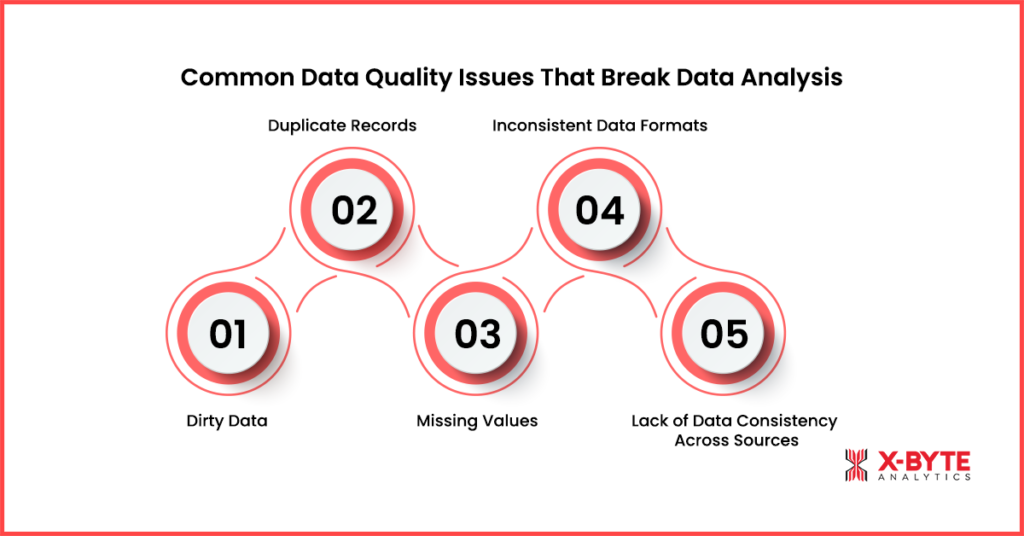
Common Data Quality Issues That Break Data Analysis
Poor data quality is one of the most common reasons analytics initiatives underperform. Understanding these issues helps enterprises appreciate the role of data cleaning in analytics success.
1. Dirty Data
Dirty data includes incorrect, outdated, or irrelevant information that accumulates over time. It often results from manual data entry errors, system migrations, or inconsistent processes. Dirty data skews analytics outputs and reduces confidence in insights.
2. Duplicate Records
Duplicate records are especially common in customer and product databases. They inflate counts, distort KPIs, and create misleading trends. Without data cleaning, duplicates can significantly impact revenue analysis, customer segmentation, and performance tracking.
3. Missing Values
Missing values reduce the completeness of datasets. When not handled correctly, they bias averages, trends, and predictive models. In enterprise analytics, missing values often result from disconnected systems or inconsistent data capture processes.
4. Inconsistent Data Formats
Different systems often store the same data in different formats. Dates, currencies, product names, and location identifiers may vary, making aggregation and comparison difficult. This lack of standardization undermines data quality in data analytics.
5. Lack of Data Consistency Across Sources
When metrics are defined differently across departments, analytics outputs become fragmented. Without data consistency, leadership sees multiple versions of the truth, slowing decision-making and increasing risk.
What Happens When Data Cleaning Is Ignored?
Ignoring data cleaning has far-reaching consequences that extend beyond analytics teams. The problems caused by poor data quality in analytics directly affect businesses. Enterprises often realize the impact only after decisions start producing negative outcomes.
- Forecasts become unreliable, leading to overstocking, stockouts, or missed revenue
- Executive dashboards present conflicting or misleading KPIs
- Business decisions are made on inaccurate assumptions
- AI and automation initiatives fail due to poor training data
- Teams spend more time questioning data than acting on insights
At this stage, organizations often face a critical realization that analytics issues are no longer technical problems but they are business risks.
How Data Cleaning Improves Data Analysis Accuracy
Clean data directly improves the reliability of analytics outputs by removing ambiguity, noise, and inconsistencies that distort insights. When enterprises invest in data cleaning, analytics shifts from surface-level reporting to meaningful, decision-ready intelligence, proving that small businesses can leverage data analytics just as effectively as large enterprises when data quality is handled correctly.
- Analytics outputs become more stable and consistent across reports and dashboards
- Trends and patterns are identified more accurately without distortion from errors
- Forecasts and performance metrics reflect actual business conditions
- Decision-makers gain greater confidence in insights used for strategic planning
From a decision-making perspective, clean data reduces uncertainty. Leaders can act with confidence, knowing that analytics reflects reality. This is the true impact of data cleaning on business decisions and it transforms analytics from a reporting function into a trusted decision-support system.
Role of Data Cleaning in Business Intelligence and AI
The role of data cleaning in business intelligence is fundamental to delivering accurate, trusted, and scalable BI insights. Without clean and standardized data, BI dashboards and AI models amplify inconsistencies instead of providing clarity. For enterprises, data cleaning determines whether BI drives confident decisions or creates operational risk.
1. Reliable BI Dashboards:
Data cleaning standardizes data from multiple systems, ensuring dashboards reflect a single, accurate version of business performance across teams.
2. Accurate AI & Predictive Insights:
Clean historical data reduces bias and noise, improving AI model accuracy and increasing trust in predictive analytics outcomes.
3. Scalable Enterprise Analytics:
Validated and consistent data enables BI platforms to scale across departments without performance issues or reporting conflicts.
4. Consistent Executive KPIs:
Data cleaning ensures key metrics remain comparable and stable across dashboards, supporting faster and more confident leadership decisions.
5. Faster Reporting & Reduced Rework:
Clean data minimizes reconciliation efforts, allowing analytics teams to focus on insights instead of fixing data issues.
Data Cleaning Challenges at Enterprise Scale
As organizations scale, data cleaning in data analysis becomes more complex due to growing data volume, speed, and source diversity. A KPMG survey found that 94% of companies acknowledge their data isn’t completely accurate, underlining how pervasive data quality issues like duplication, inconsistency, and missing records are in analytics environments.
Without structured data cleaning processes, inconsistencies multiply and analytics accuracy declines. For enterprises, overcoming these challenges requires strategic planning rather than reactive, manual fixes.
1. Data Fragmentation Across Systems:
Data scattered across multiple platforms like ERP, CRM, and marketing tools creates inconsistencies in definitions, formats, and reporting views. This fragmentation results in conflicting data, making it difficult to get a unified understanding of business performance. It slows down decision-making and complicates accurate reporting. Integration of these systems is key to ensuring consistent data.
2. Scalability Limitations:
Manual data cleaning processes struggle to keep up with the growing volume of data. As data increases, cleaning tasks become slower and error-prone, leading to delays and reduced reliability. This inefficiency hampers real-time decision-making and analytics accuracy. Automated cleaning tools and scalable systems are necessary to address these challenges.
3. Real-Time Data Complexity:
Streaming and real-time analytics introduce the challenge of maintaining data accuracy as data rapidly changes. Continuous validation is required to ensure data remains correct, but without it, real-time insights can become unreliable. Automating data validation processes is crucial for maintaining accurate analytics in fast-moving environments.
4. Ownership & Governance Gaps:
When data quality lacks clear ownership, it leads to fragmented responsibility and inconsistent standards across teams. Different departments may follow their own data handling processes, resulting in discrepancies. A clear governance framework and designated accountability are essential to ensure consistent, high-quality data across the organization.
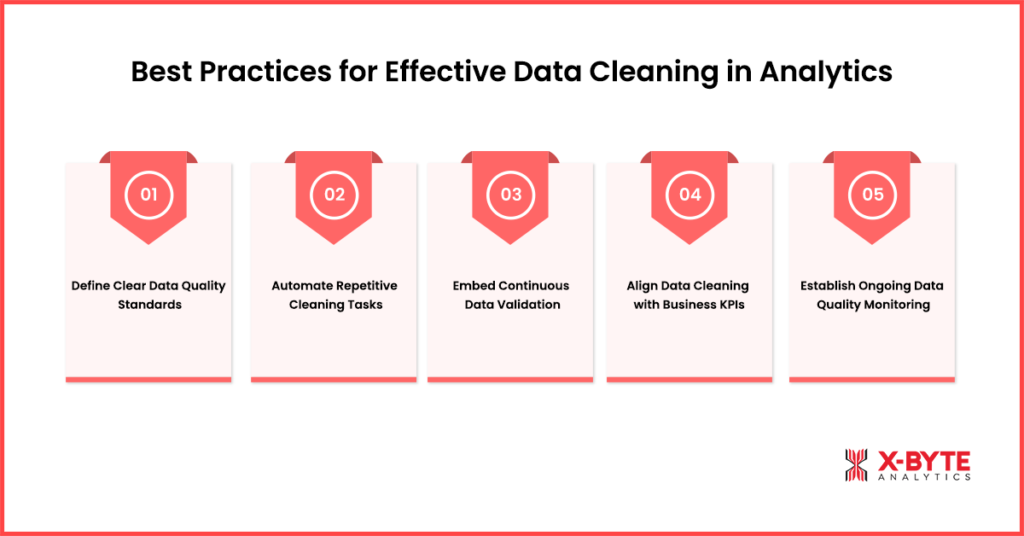
Best Practices for Effective Data Cleaning in Analytics
Enterprises that succeed with analytics treat data cleaning as a continuous discipline aligned with business outcomes, reinforcing the broader role of data analytics in businesses as a driver of accurate insights and confident decision-making. Rather than relying on reactive fixes, they adopt structured practices that ensure clean data for analytics at scale. High-performing analytics organizations typically follow a data quality maturity approach and moving from ad-hoc corrections to governed, automated, and continuously monitored data environments. These best practices allow analytics teams to focus on insights instead of data correction.
1. Define Clear Data Quality Standards:
Establishing clear data quality standards ensures consistency across all business-critical datasets. By defining accuracy, completeness, and consistency expectations, you create a unified approach to data management. This helps reduce errors and provides a solid foundation for trustworthy business insights. Clear standards enable teams to align on data quality, improving overall analytics outcomes.
2. Automate Repetitive Cleaning Tasks:
Automating data cleaning tasks streamlines the process, reduces manual effort, and ensures consistent results. With increasing data volumes, automation becomes crucial for maintaining high-quality data at scale. Automated cleaning improves efficiency, speed, and accuracy, allowing businesses to process data more effectively while reducing the risk of human errors. It ensures that clean data is always ready for analysis.
3. Embed Continuous Data Validation:
Continuous data validation at every stage of data ingestion and transformation prevents errors from impacting analytics. By validating data early in the process, you ensure that only reliable data reaches your reporting systems. This ongoing validation improves the accuracy and integrity of the data used for business intelligence, making decision-making more informed and reliable.
4. Align Data Cleaning with Business KPIs:
Aligning data cleaning processes with business KPIs helps track and monitor data quality in relation to performance goals. By integrating data quality metrics with key business objectives, accountability becomes visible to leadership. This approach ensures that clean data supports informed decision-making and aligns with overarching business goals, driving better outcomes across the organization.
5. Establish Ongoing Data Quality Monitoring:
Ongoing monitoring of data quality helps detect issues as data systems, sources, and business needs evolve. Continuous monitoring ensures that data remains clean and accurate, which is crucial for reliable analytics and decision-making. It allows businesses to maintain high-quality data over time, ensuring consistency and accuracy in every stage of the data lifecycle.
For enterprises struggling with inconsistent analytics, a structured data quality assessment is often the fastest way to restore confidence.
When Businesses Should Seek Data Cleaning & Analytics Expertise?
As data ecosystems grow, internal teams often struggle to maintain consistent data quality at scale. Analytics outputs lose credibility, BI dashboards conflict, and AI initiatives fail to deliver ROI. This is where specialized expertise becomes a strategic advantage.
- When leadership no longer trusts analytics reports
- When dashboards show conflicting KPIs across teams
- When AI or predictive models underperform despite investment
- When internal teams spend excessive time fixing data instead of analyzing it
- When scaling analytics across departments becomes slow and risky
At this point, organizations are no longer choosing between tools, as they are choosing between continued risk or restoring confidence in data-driven decisions.This is where working with the best data analytics consultant becomes a strategic decision rather than a tactical one. The right expertise helps organizations restore confidence in their data, streamline analytics workflows, and ensure insights support faster, more accurate business decisions as data complexity grows.
Final Thoughts
Data cleaning in data analysis is not a technical detail; it is a strategic necessity. Poor data quality undermines analytics accuracy, erodes trust, and introduces business risk. Clean data, on the other hand, enables reliable insights, confident decision-making, and scalable BI and AI initiatives.
For decision-makers, the question is no longer whether data cleaning matters but how quickly it can be addressed before analytics risk compounds.
Enterprises that prioritize data cleaning build analytics systems they can trust. They move faster, make better decisions, and extract real value from their data investments. In a world where data drives strategy, clean data is the foundation of competitive advantage.