
Quick Summary:
- Data analytics helps businesses transform raw data into actionable insights that improve decision-making, operational efficiency, and strategic planning.
- By leveraging predictive analytics, real-time monitoring, and data visualization, organizations can enhance customer experiences and drive sustainable revenue growth.
- Analytics has become a strategic necessity for modern enterprises seeking agility, risk reduction, and competitive advantage in a data-driven economy.
Introduction
In today’s highly competitive digital economy, businesses generate vast amounts of data across operations, marketing, sales, finance, and customer engagement. However, data alone does not create value. The real advantage comes from the ability to analyze, interpret, and act on data effectively.
Organizations that leverage data analytics for business decision-making consistently outperform competitors by responding faster to market changes, optimizing resources, and delivering personalized customer experiences. According to industry studies, data-driven organizations are significantly more likely to improve profitability, customer retention, and operational efficiency.
At X-Byte Analytics, we help enterprises build scalable, business-focused analytics frameworks that transform fragmented data into insights that drive measurable outcomes, not just reports.
What Is Data Analytics in Business?
Data analytics is the systematic process of collecting, processing, analyzing, and visualizing data to uncover meaningful patterns, trends, and correlations. It enables organizations to convert raw data into actionable insights that support informed decision-making. By combining historical, real-time, and predictive data, businesses can improve accuracy, agility, and strategic alignment across functions.
In a business context, analytics integrates data from:
- Sales and revenue systems
- Marketing and customer engagement platforms
- Operations and supply chain tools
- Financial and performance management systems
By combining business data analytics, predictive modeling, and visualization, organizations gain a single source of truth across departments, enabling strategic alignment and faster decision-making.
Role of Data Analytics in Businesses
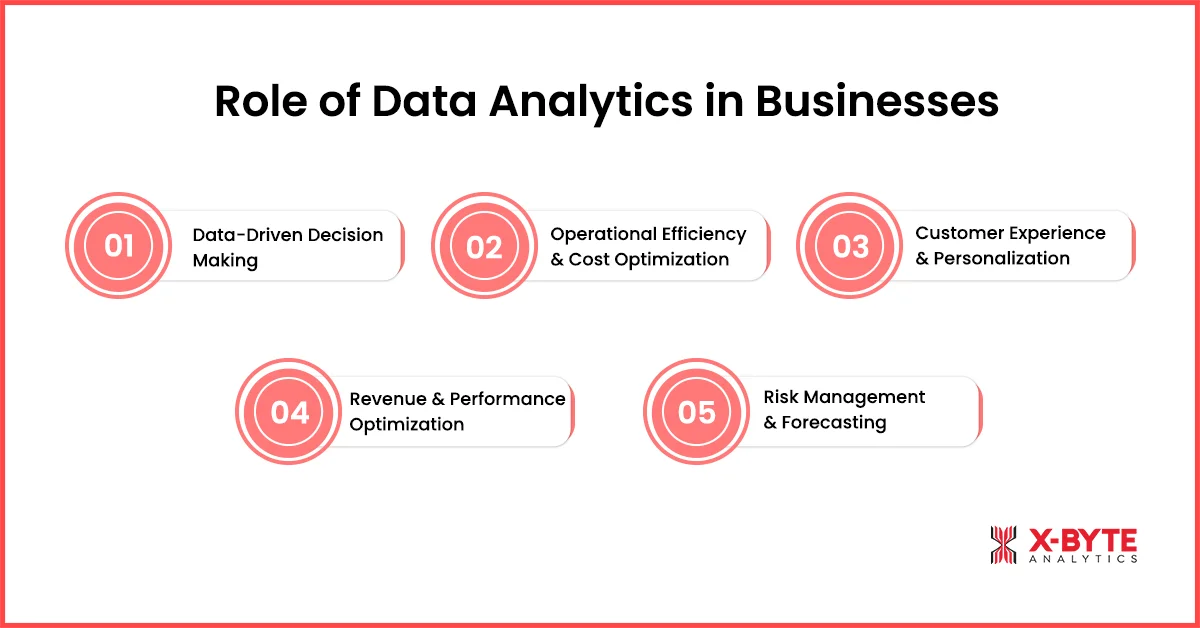
Data analytics plays a critical role in improving performance across every business function. When implemented with the right strategy and governance, analytics enables organizations to move from reactive reporting to proactive, insight-driven decision-making. Understanding the importance of data analytics in today’s business landscape is crucial, as it allows businesses to uncover hidden insights and drive strategic decisions.
Modern enterprises use analytics to unify data across departments, monitor performance in real time, and identify opportunities before competitors do. In practice, organizations that embed analytics into daily workflows achieve faster decision cycles, improved forecasting accuracy, and stronger operational resilience.
1. Data-Driven Decision Making
Analytics replaces intuition-based decisions with evidence-backed insights. Leaders gain real-time visibility into performance metrics, trends, and risks, allowing faster, more confident decisions aligned with business goals.
Business impact:
- Reduced decision latency
- Improved forecasting accuracy
- Lower operational risk
2. Operational Efficiency & Cost Optimization
By analyzing operational data across supply chains, production systems, and workforce performance, businesses can identify inefficiencies, bottlenecks, and hidden cost drivers. Analytics enables leaders to prioritize high-impact improvements rather than relying on assumptions.
In real-world deployments, analytics-driven optimization helps organizations reduce waste, improve resource utilization, and automate manual processes, directly improving margins and operational scalability.
Key outcomes:
- Reduced operational costs
- Improved productivity
- Optimized workflows
3. Customer Experience & Personalization
Customer analytics enables businesses to move beyond generic engagement toward personalized, data-driven experiences. By analyzing behavioral, transactional, and engagement data, organizations gain a deeper understanding of customer intent and lifecycle value.
These insights support personalized marketing, targeted offers, and proactive retention strategies, helping businesses increase customer lifetime value while reducing acquisition and churn costs.
Analytics enables:
- Customer segmentation
- Personalized marketing campaigns
- Higher customer lifetime value (CLV)
4. Revenue Growth & Performance Optimization
Sales and revenue analytics uncover opportunities for pricing optimization, cross-selling, upselling, and demand forecasting across products and markets. By analyzing customer behavior, sales performance, and revenue trends, businesses can proactively adjust strategies to maximize profitability. These insights help improve conversion rates, revenue predictability, and overall sales effectiveness.
Results include:
- Higher conversion rates
- Improved revenue predictability
- Better sales performance
5. Risk Management & Forecasting
Predictive analytics identifies emerging trends, anomalies, and potential risks before they impact business performance. By leveraging statistical models and machine learning, organizations can anticipate disruptions, forecast demand fluctuations, and mitigate financial or operational risks. This proactive approach strengthens strategic planning and long-term business resilience.
Analytics supports:
- Financial risk forecasting
- Fraud detection
- Market demand prediction
Discover How X-Byte Analytics Can Help You Transform Data Into Actionable Insights.
Key Benefits of Data Analytics for Businesses
Organizations that embed data analytics into core decision-making gain deeper visibility into performance, risks, and opportunities. This enables faster responses to market changes, improved operational efficiency, and sustainable long-term growth. Data-driven businesses consistently outperform competitors in agility and profitability.
1. Improved Strategic Planning
Analytics provides leadership with real-time insights, forecasting models, and scenario analysis to support long-term planning and investment decisions. Leaders gain better visibility into risks, opportunities, and performance drivers, enabling more confident strategic choices.
2. Higher Marketing ROI
Data analytics connects marketing performance directly to revenue outcomes, helping teams optimize campaigns, attribution models, and customer acquisition strategies. This ensures marketing budgets are allocated to high-performing channels and initiatives that deliver measurable returns.
3. Enhanced Operational Visibility
Unified analytics dashboards provide cross-functional visibility into critical KPIs across departments. This enables faster issue identification, quicker corrective actions, and stronger collaboration between teams to improve operational efficiency.
4. Competitive Advantage
Organizations that leverage analytics respond faster to market changes, customer expectations, and competitive pressures. Data-driven agility helps businesses innovate quicker, improve customer experiences, and sustain long-term competitive differentiation.
Industry-Wise Use Cases of Data Analytics
Across industries, data analytics supports faster, more accurate decision-making in complex and high-volume environments. Industry-specific analytics models help organizations respond to demand variability, regulatory requirements, and operational risks with greater precision.
From retail demand forecasting to predictive maintenance in manufacturing, analytics delivers measurable value by aligning operational actions with real-time data insights.
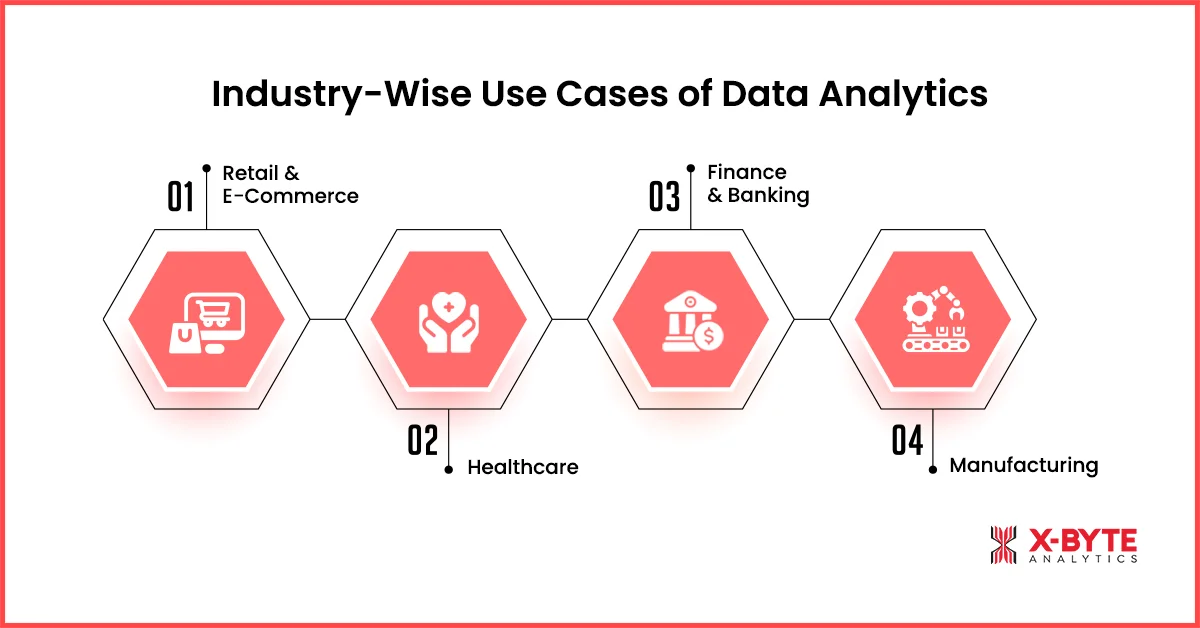
Retail & E-Commerce
- Demand forecasting and inventory optimization
- Customer segmentation and personalization
- Pricing and promotion analysis
Healthcare
- Patient outcome analysis
- Resource utilization optimization
- Predictive analytics for treatment planning
Finance & Banking
- Fraud detection and risk assessment
- Customer behavior analysis
- Regulatory reporting and compliance
Manufacturing
- Predictive maintenance
- Supply chain optimization
- Production efficiency analysis
Data Analytics Methods Used in Businesses
Organizations leverage types of data analytics, like descriptive, diagnostic, predictive, and prescriptive analytics to transform raw data into actionable insights. These methods help businesses understand past performance, predict future outcomes, and recommend optimal actions.
1. Descriptive Analytics
Descriptive analytics analyzes historical data to understand what happened in the past and identify performance trends. It forms the foundation of reporting and performance monitoring.
2. Diagnostic Analytics
Diagnostic analytics examines data to understand why certain outcomes occurred. It helps identify root causes behind performance changes, inefficiencies, or anomalies.
3. Predictive Analytics
Predictive analytics uses statistical models and machine learning algorithms to forecast future outcomes, demand patterns, and customer behavior. This enables proactive decision-making and risk reduction.
4. Prescriptive Analytics
Prescriptive analytics recommends optimal actions by combining predictive insights with business rules and constraints. It supports decision automation and strategic optimization.
How to Implement Data Analytics in Businesses Successfully
True analytics success starts with clear business objectives, aligned KPIs, and a strong data foundation. Without strategy, governance, and integration, even advanced analytics tools fail to deliver value. A business-first analytics framework ensures insights directly support revenue, efficiency, and strategic outcomes.
Step 1: Define Clear Business Objectives
Align analytics initiatives with measurable goals such as revenue growth, operational efficiency, risk reduction, or customer retention. Clear objectives ensure analytics efforts deliver business value.
Step 2: Centralize Data Sources
Integrate data from multiple systems such as CRM, ERP, marketing platforms, and operations, into a unified analytics foundation using secure data integration solutions.
Step 3: Focus on Actionable KPIs
Track KPIs that directly impact business outcomes and strategic priorities. Avoid vanity metrics that do not support decision-making or performance improvement.
Step 4: Build Scalable Dashboards
Develop role-based dashboards for executives, managers, and teams to enable real-time monitoring and faster decisions across the organization.
Step 5: Apply Advanced Analytics
Incorporate predictive analytics, AI, and automation to move from reactive reporting to proactive, insight-driven decision-making.
Future Trends in Data Analytics
The future of data analytics is centered on automation, intelligence, and speed. As AI-driven analytics matures, businesses are shifting from manual analysis to automated insight generation that supports faster and more consistent decision-making.
Real-time analytics, augmented analytics, and advanced data visualization are enabling non-technical users to interact with insights directly, making analytics a core component of enterprise decision-making rather than a back-office function.
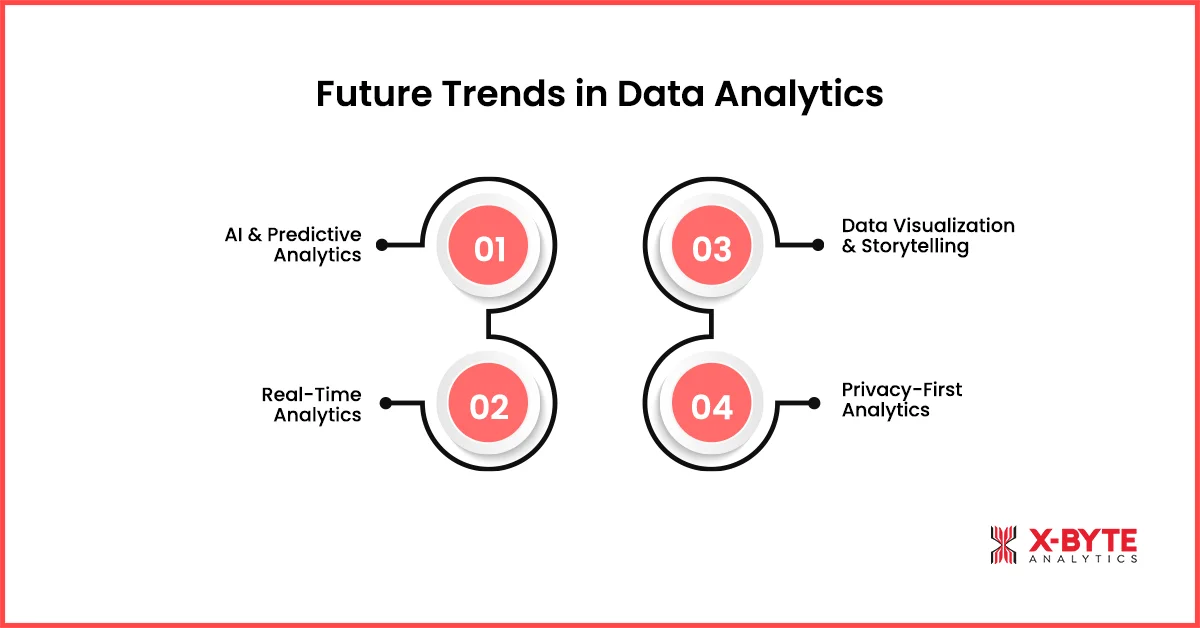
1. AI & Predictive Analytics
AI-driven analytics models improve forecasting accuracy, demand planning, churn prediction, and operational optimization. Businesses increasingly rely on automated insights rather than manual analysis.
2. Real-Time Analytics
Real-time analytics enables organizations to act immediately on operational changes, market shifts, and customer behavior, improving agility and responsiveness.
3. Data Visualization & Storytelling
Advanced visualization tools transform complex data into intuitive dashboards and narratives, making insights easier for decision-makers to understand and act upon.
4. Privacy-First Analytics
As data regulations evolve, organizations adopt ethical, secure, and compliant analytics practices to protect customer data while maintaining insight quality.
Why Choosing the Right Data Analytics Partner Matters?
Choosing a data analytics partner is a business decision with long-term impact, not a short-term technology choice. When analytics initiatives fail, it’s rarely due to tools—it’s because execution lacks business alignment, scalability, and ownership.
The wrong partner often delivers dashboards that look polished but don’t change decisions. Data stays fragmented, insights arrive late, and leadership gradually loses confidence in analytics. This leads to rising costs, repeated rework, and analytics programs that struggle to scale.
When hiring a data analytics partner, it’s essential to ensure they align with your business goals and can scale with your organization’s growth.
The right partner treats analytics as an operating capability, not a reporting exercise—aligning insights with business goals, building architectures that scale with growth, and ensuring security, performance, and governance are embedded from day one. The outcome is faster decisions, stronger forecasting, and analytics that actively support execution.
This is where X-Byte Analytics fits. We help organizations build scalable, secure, and business-aligned analytics solutions by combining data engineering, BI, and advanced analytics. Our focus is on measurable operational and financial impact and not just dashboards, so analytics becomes a reliable driver of long-term competitive advantage.
Partner With X-Byte Analytics To Unlock The Full Potential Of Your Data Analytics Service Today.
Conclusion: Turning Data into Business Value
Data analytics is no longer optional for businesses operating in a competitive, data-driven economy. Organizations that invest in analytics gain greater clarity into their operations, improved agility in responding to market changes, and stronger confidence in strategic decision-making. By embedding data-driven insights across functions, businesses can reduce uncertainty, optimize performance, and drive consistent growth.
With the right analytics strategy and an experienced analytics partner, data transforms from a passive asset into a powerful driver of sustainable business success. Advanced analytics, predictive insights, and scalable data platforms enable organizations to innovate faster, improve customer experiences, and build long-term competitive advantage in an increasingly digital marketplace.