
Quick Summary:
- Predictive analytics enables businesses to forecast future trends, optimize operations, and make proactive data-driven decisions using advanced modeling techniques and intelligent analytics tools.
- The blog explores various types of predictive analytics models, practical predictive analytics use cases across industries, and the measurable benefits of predictive modeling for growth and efficiency.
- It also highlights how modern predictive analytics tools and evolving technologies are shaping the future of strategic decision-making and driving long-term competitive advantage.
Every business aims to stay ahead of the curve, anticipating market shifts, optimizing investments, and making informed decisions that drive long-term success. In today’s data-driven landscape, this need has accelerated the adoption of advanced technologies like predictive analytics.
Predictive analytics enables organizations to leverage the vast volumes of data they generate daily to uncover patterns, forecast trends, and anticipate future outcomes. Rather than relying on intuition alone, businesses can use data-backed insights to make smarter, more strategic decisions.
By combining statistical techniques, machine learning algorithms, and advanced modeling methods, predictive analytics transforms raw data into actionable intelligence. It not only helps forecast what may happen next but also supports better planning through informed recommendations.
In this blog, we will explore what is predictive analytics, how it works, the types of predictive analytics models available, key predictive analytics use cases, and the benefits of predictive modeling for modern businesses.
What is Predictive Analytics and How Does It Work?
Predictive analytics is a branch of advanced analytics that focuses on using historical and current data to forecast future events. By applying statistical models, data mining techniques, and machine learning algorithms, businesses can estimate the likelihood of specific outcomes and make informed decisions before events unfold.
How Predictive Analytics Works
Predictive analytics follows a structured process to ensure accurate and reliable results:
- Data Collection: Relevant data is gathered from multiple sources such as CRM systems, ERP platforms, transaction databases, IoT devices, and external market data.
- Data Preparation: Raw data is cleaned, organized, and transformed to eliminate inconsistencies and ensure quality. High-quality data is essential for building reliable predictive models.
- Model Selection and Development: Analysts choose appropriate predictive analytics tools and techniques, such as regression models, decision trees, clustering, or neural networks, depending on the business objective.
- Model Testing and Validation: The model is tested using historical datasets to measure its accuracy and performance before deployment.
- Deployment and Monitoring: Once validated, the model is integrated into business systems to generate real-time insights. Continuous monitoring ensures the model adapts to new data and changing conditions.
Why Predictive Analytics Matters
Predictive analytics enables businesses to move from reactive decision-making to proactive strategy development. Instead of responding to problems after they occur, organizations can anticipate risks, optimize operations, and identify growth opportunities in advance.
By leveraging predictive analytics use cases across marketing, finance, healthcare, retail, and supply chain management, businesses gain a competitive advantage through smarter forecasting, improved efficiency, and data-backed decision-making.
Benefits of Predictive Modeling
The benefits of predictive modeling go far beyond simple forecasting. By leveraging advanced Ai predictive analytics tools and data-driven insights, businesses can make smarter decisions, reduce uncertainty, and unlock new growth opportunities. Here are the key advantages organizations gain when implementing predictive analytics:

1. Improved Decision-Making
Predictive models provide data-backed insights that reduce guesswork. Leaders can evaluate potential outcomes before making strategic decisions, leading to more confident and accurate planning.
2. Enhanced Operational Efficiency
By forecasting demand, equipment performance, or supply chain disruptions, businesses can streamline operations, reduce downtime, and optimize resource allocation.
3. Better Risk Management
Predictive analytics identifies potential risks, such as fraud, loan defaults, or customer churn-before they escalate. Early detection enables proactive mitigation strategies that protect revenue and reputation.
4. Personalized Customer Experiences
One of the most impactful predictive analytics use cases is customer behavior analysis. Businesses can anticipate preferences, recommend products, and deliver targeted campaigns that increase engagement and loyalty.
5. Revenue Growth and Cost Reduction
Accurate forecasting helps organizations optimize pricing strategies, inventory management, and sales planning. This reduces waste, prevents stockouts, and maximizes profit margins.
6. Competitive Advantage
Companies that adopt predictive analytics gain forward-looking insights that allow them to stay ahead of market trends and evolving customer expectations.
By understanding the benefits of predictive modeling, businesses can see how predictive analytics transforms data into strategic value, driving efficiency, innovation, and long-term success.
Turn Data Into Smarter Decisions With Expert Predictive Analytics Solutions.
Types of Predictive Analytics Models
Understanding the types of predictive analytics models helps businesses choose the right approach for their data, objectives, and industry requirements. Different models are designed to solve different problems, whether forecasting sales, detecting fraud, or predicting customer churn. Below are the most commonly used types of predictive analytics models:
1. Regression Models
Regression models analyze the relationship between variables to predict outcomes. Linear regression is used for forecasting continuous values such as sales or revenue, while logistic regression is commonly used for classification tasks like predicting customer churn. These models are widely applied in finance, marketing, and sales forecasting.
2. Decision Trees
Decision trees split data into branches based on specific conditions, making them easy to interpret and apply. They are especially useful for classification and risk assessment tasks. Businesses use decision trees for customer segmentation, credit scoring, and operational decision-making due to their transparency and simplicity.
3. Neural Networks
Neural networks are advanced models inspired by the human brain. They are capable of identifying complex patterns in large datasets and are often used in deep learning applications. These models are ideal for image recognition, speech processing, and high-volume financial forecasting where traditional models may fall short.
4. Time Series Models
Time series modeling analyzes data collected over time to identify trends, seasonality, and cyclical patterns. This model is essential for demand forecasting, sales projections, inventory management, and financial market analysis.
5. Cluster Analysis
Cluster analysis groups similar data points based on shared characteristics. It is commonly used in market segmentation, fraud detection, and customer behavior analysis. By identifying distinct segments, businesses can create targeted strategies for different groups.
Selecting the appropriate type of predictive analytics model depends on the business goal, data complexity, and desired outcome. When implemented correctly using the right predictive analytics tools, these models provide accurate insights that support smarter, data-driven decisions.
How Businesses Use Predictive Analytics?
Predictive analytics empowers organizations to move from reactive problem-solving to proactive decision-making. By analyzing historical and real-time data, businesses can forecast outcomes, anticipate risks, and identify growth opportunities before they materialize. Across departments and industries, predictive analytics tools are being integrated into daily operations to enhance efficiency, improve customer experiences, and support strategic planning.
1. Operational Efficiency: Predictive analytics helps organizations forecast demand, anticipate equipment failures, and optimize resource allocation. By using predictive modeling, businesses can reduce downtime, minimize waste, and improve overall productivity.
2. Customer Relationship Management (CRM): Through predictive analytics use cases such as customer churn prediction and behavior analysis, businesses gain deeper insights into customer preferences and engagement patterns. This enables more personalized marketing, improved retention strategies, and stronger customer relationships.
3. Risk Management: Predictive analytics is widely used to assess financial, operational, and cybersecurity risks. By identifying potential threats before they occur, organizations can take proactive steps to safeguard assets, reduce losses, and maintain business continuity.
4. Supply Chain Management: Businesses use predictive analytics tools to forecast demand, optimize inventory levels, and anticipate supply chain disruptions. This leads to better planning, lower operational costs, and improved delivery performance.
5. Financial Analysis and Planning: Predictive models support revenue forecasting, budgeting, and financial performance analysis. By analyzing historical trends and market data, organizations can make more informed financial decisions and strategic investments.
6. Human Resources Management: Predictive analytics assists in workforce planning, talent acquisition, and employee retention strategies. By identifying turnover risks and performance patterns, HR teams can implement data-driven initiatives to improve employee engagement and productivity.
7. Product Development and Innovation: By analyzing market trends, customer feedback, and purchasing behavior, businesses can predict product success and prioritize innovation efforts. This reduces development risks and accelerates time-to-market.
Compliance and Regulatory Reporting: Predictive analytics helps organizations monitor regulatory requirements, detect anomalies, and ensure compliance with data protection and financial reporting standards. This reduces the risk of penalties and strengthens governance practices.
By integrating predictive data analytics into core operations, businesses move beyond reactive decision-making and adopt a proactive, data-driven approach that drives sustainable growth and competitive advantage.
Future of Predictive Analytics
The future of predictive analytics is being shaped by rapid advancements in artificial intelligence, automation, and big data technologies. As organizations continue generating massive volumes of structured and unstructured data, predictive analytics tools are becoming more sophisticated, accessible, and deeply integrated into everyday business processes. What was once limited to data scientists is now evolving into enterprise-wide decision intelligence systems.
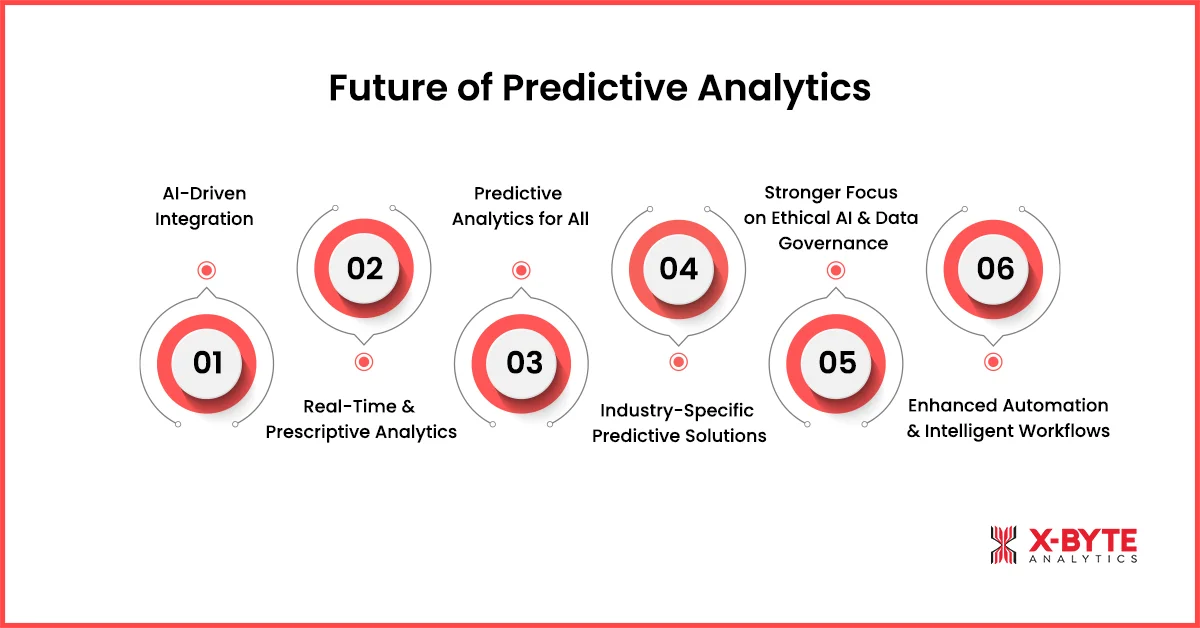
1. Increased Integration with Artificial Intelligence
Predictive analytics is increasingly merging with AI and machine learning to create smarter, self-learning systems. These systems continuously refine their predictions using real-time data, improving accuracy and enabling automated decision-making across industries.
2. Real-Time and Prescriptive Analytics
The next evolution goes beyond predicting outcomes. Businesses are shifting toward real-time analytics and prescriptive capabilities, where systems not only forecast what will happen but also recommend the best course of action.
3. Democratization of Predictive Analytics Tools
User-friendly dashboards, low-code platforms, and cloud-based predictive analytics tools are making advanced forecasting accessible to non-technical users. Business teams can now generate insights without deep technical expertise, accelerating data-driven decision-making.
4. Industry-Specific Predictive Solutions
Customized predictive analytics use cases are emerging across sectors such as healthcare, finance, retail, and manufacturing. Industry-focused models improve precision and deliver more actionable insights tailored to specific operational challenges.
5. Stronger Focus on Ethical AI and Data Governance
As predictive modeling relies heavily on data, organizations are placing greater emphasis on transparency, fairness, and regulatory compliance. Responsible AI practices and robust data governance frameworks will become essential components of future predictive analytics strategies.
6. Enhanced Automation and Intelligent Workflows
Predictive analytics will increasingly power automated workflows, from predictive maintenance systems to intelligent customer service platforms. This will reduce manual intervention and improve operational agility.
As technology continues to evolve, predictive analytics will become a core pillar of digital transformation strategies. Businesses that embrace these advancements will gain deeper insights, faster decision-making capabilities, and a sustainable competitive advantage in an increasingly data-driven world.
Partner With X-Byte Analytics to Unlock Predictive Insights That Drive Smarter Decisions.
Conclusion
Predictive analytics has become a critical component of modern business strategy. By transforming historical and real-time data into forward-looking insights, organizations can anticipate market shifts, optimize operations, enhance customer experiences, and reduce risks. Understanding what is predictive analytics and how it works enables businesses to move beyond reactive decision-making and embrace a proactive, data-driven approach.
From exploring the types of predictive analytics models to examining real-world predictive analytics use cases and the benefits of predictive modeling, it’s clear that this technology delivers measurable impact across industries. With the right predictive analytics tools and expertise, companies can unlock deeper insights, improve forecasting accuracy, and gain a lasting competitive advantage.
If you’re ready to harness the power of predictive analytics and turn your data into strategic growth opportunities, X-Byte Analytics can help. Our tailored predictive analytics solutions are designed to align with your business goals, ensuring accurate forecasting, optimized performance, and long-term success.
Connect with X-Byte Analytics today and start building a smarter, data-driven future for your business.