
Key Highlights:
- A data analytics service spans four delivery models like Managed, Consulting, Project-Based, and Staff Augmentation, each suited to a different stage of data maturity.
- Enterprise engagements run $3,000-$60,000+/month; the hybrid model delivers 2.3x faster time-to-insight than fully in-house teams.
- Compliance is an architecture decision: GDPR, EU AI Act, HIPAA, and UAE PDPL impose pipeline-level obligations that must be built in from day one.
A data analytics service is a managed, end-to-end capability that ingests raw organizational data, applies AI-driven predictive models and automated real-time data pipelines, and delivers actionable business intelligence to decision-makers, without requiring the organization to build or maintain the underlying infrastructure internally. It spans data engineering, compliance automation, and strategic execution, and is increasingly delivered as analytics as a service: a subscription-based model that scales with organizational complexity.
In 2026, a modern data analytics service encompasses four primary delivery models:
- Managed Service – fully outsourced pipeline operations, AI modeling, and governance
- Data Analytics Consulting – strategic advisory, architecture design, and roadmap development
- Project-Based / Custom Data Engineering – scoped engagements for specific infrastructure builds
- Staff Augmentation – embedded specialists who extend your internal analytics team
The global data analytics market is projected to reach $279.3 billion by 2030, growing at a CAGR of 27.6% (Grand View Research, 2024). Yet for most enterprise leaders, the challenge is not a shortage of data, it is the inability to convert fragmented, siloed information into real-time actionable intelligence. Closing that gap requires more than a visualization tool. It demands a comprehensive big data analytics service that spans infrastructure, compliance, and strategic execution across every market you operate in.
This guide covers everything decision-makers need to know: how the four delivery models differ, how enterprise analytics pricing works across all model types, which compliance frameworks apply to your region, and how to evaluate providers before signing a contract.
The Four Delivery Models of a Data Analytics Service
Understanding the full spectrum of delivery models is essential before issuing an RFP or signing a contract. Each model serves a different stage of organizational data maturity.
| Delivery Model | Best For | Primary Advantage | Primary Risk |
| Managed Data Analytics Service | Scaling enterprises needing speed + compliance | Operational continuity, built-in governance, faster time-to-insight | Requires strong vendor relationship management |
| Data Analytics Consulting | Orgs needing strategic clarity before investment | Objective audit, architecture blueprint, no lock-in | Execution falls back to internal team after engagement ends |
| Project-Based / Custom Engineering | Specific infrastructure builds (e.g., lakehouse migration) | Defined scope, fixed deliverables, clear exit point | Ongoing support requires a separate agreement |
| Staff Augmentation | In-house teams with capability gaps | Embedded expertise without full outsourcing | Institutional knowledge stays with the contractor, not the org |
| In-House Team | Data-native orgs with deep capital reserves | Full control and institutional knowledge | High talent cost ($180K+ per senior data engineer), long hiring cycles |
| Hybrid (Outsourcing Model) | Most mid-to-enterprise organizations in 2026 | 2.3x faster time-to-insight (McKinsey, 2024) | Requires clear scope boundaries to avoid duplication |
How Do I Know If My Organization Needs a Data Analytics Service?
The honest answer depends on your data maturity level, not your company size or budget. Use the readiness checklist below to determine which engagement model fits your current state.
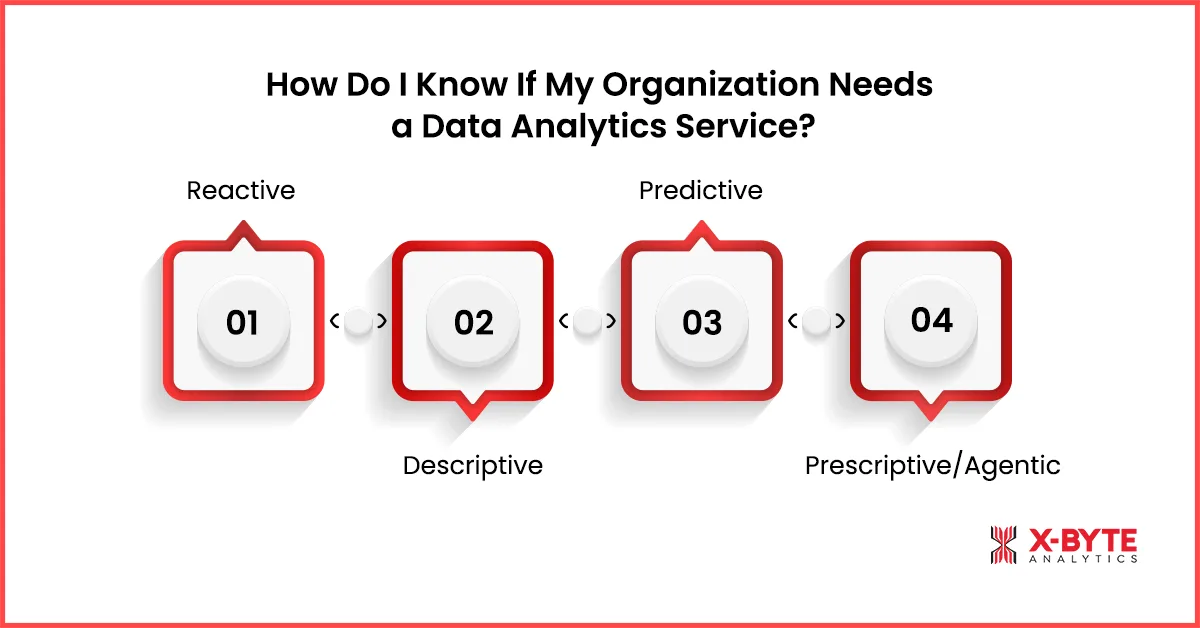
| Maturity Level | Symptoms | Recommended Model |
| Level 1 – Reactive | Spreadsheets, manual reports, monthly analytics | Start with data analytics consulting to build a maturity roadmap before any managed service engagement |
| Level 2 – Descriptive | Static dashboards, backward-looking, maintained by 1–2 analysts | Growth-tier managed service ($8,000–$18,000/month) adds real-time pipeline automation and ML model deployment |
| Level 3 – Predictive | Forecasting models exist but compliance governance and multi-region data residency are gaps | Enterprise-tier managed service with integrated compliance architecture |
| Level 4 – Prescriptive / Agentic | AI-driven analytics with agentic models that trigger automated business actions | Co-managed model: internal data owner + external execution partner |
Organizations with 100+ employees and more than two core data sources benefit significantly from a managed or consulting engagement. Mid-market firms that adopt managed big data analytics services grow revenue 1.7x faster than peers relying on spreadsheet-based reporting (Deloitte Insights, 2024).
What Are the Benefits of Data Analytics for Business?
The measurable benefits of deploying an enterprise data analytics service fall into four categories that directly map to C-suite priorities:
1. Revenue Acceleration
Organizations using enterprise data analytics services achieve 23x greater customer acquisition efficiency and 19x better profitability than competitors still relying on legacy reporting systems (McKinsey Analytics, 2024).
2. Risk Reduction
AI-driven data analytics with integrated compliance governance, built into the pipeline architecture rather than audited retrospectively, eliminates remediation costs that typically run 23% above the annual managed service retainer when governance is layered on post-deployment. This cost differential is consistently observed across enterprise analytics engagements in EMEA and GCC markets.
The role of AI in data analytics has evolved from experimental to foundational in 2026. AI-driven models embedded directly into pipeline architecture are what separate organizations achieving real-time prescriptive intelligence from those still waiting on weekly reports.
3. Operational Efficiency
Managed real-time analytics platforms consistently surface cost leaks, pricing inefficiencies, and process bottlenecks within the first 30 days of deployment through automated anomaly detection, without requiring additional analyst headcount.
4. Competitive Intelligence
Predictive models running on a real-time data analytics platform surface competitor pricing shifts and demand volatility signals before they impact quarterly results, a forward-looking capability unavailable in any static BI reporting environment.
Ready to Transform Your Raw Data Into Real-Time Business Intelligence With AI-Driven Analytics?
Data Analytics Service vs. Business Intelligence: What Is Actually Different?
Most providers deliberately blur the line between BI and a full data analytics service. Here is the honest distinction:
| Dimension | Business Intelligence (BI) | Data Analytics Service |
| Primary Question | “What happened?” | “Why did it happen, and what should we do next?” |
| Data Scope | Structured, historical data only | Structured + unstructured, real-time streams |
| Output | Static dashboards and reports | Predictive models, automated decisions, live alerts |
| Ownership | Internal team maintains tools | External experts manage the full pipeline |
| Compliance Handling | Manual, periodic audits | Continuous, automated governance (GDPR, HIPAA, UAE PDPL) |
| Time to Insight | Days to weeks | Seconds to hours via real-time analytics platform |
The practical implication: BI tells you that sales dropped 18% in Q3. A data analytics service tells you the drop was driven by a 34% increase in competitor promotional spend in the UK market, and predicts a further 9% decline unless the pricing strategy adjusts within 45 days. That is the difference between reporting and enterprise data analytics intelligence.
The 5 Core Components of a Modern Data Analytics Service
A credible managed service is not a single product. It is a layered capability stack. Understanding each component helps you evaluate what any provider is, or is not, actually delivering.
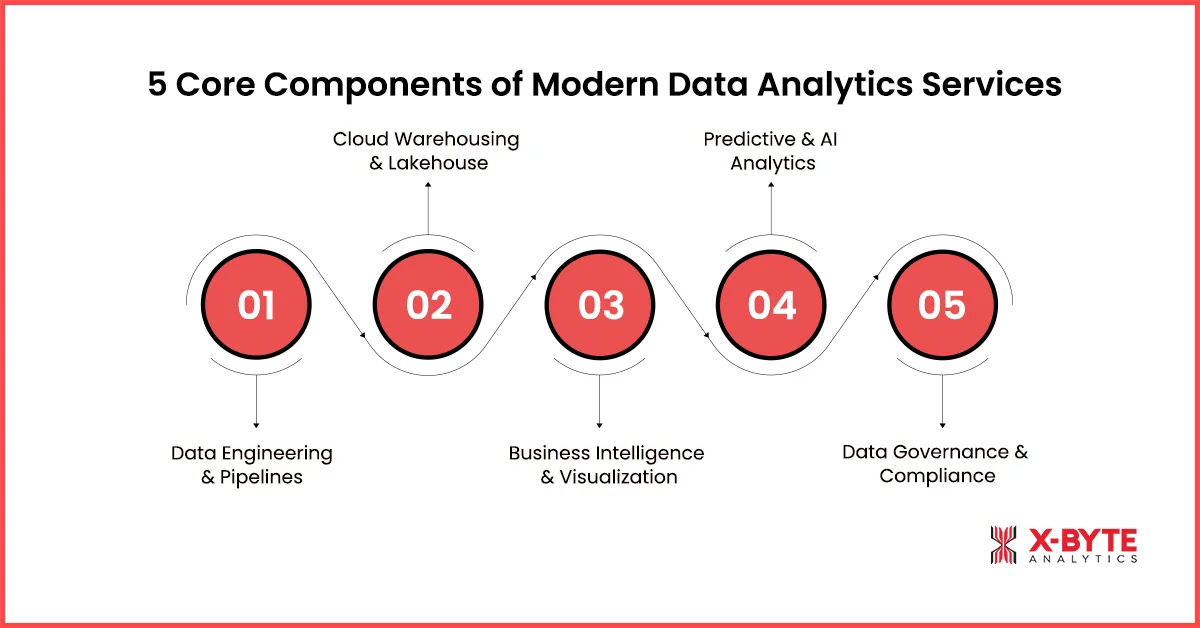
1. Data Engineering and Pipeline Architecture
This is the foundational layer of any serious big data analytics service. Data engineers build automated pipelines that ingest data from every source, CRM, ERP, transactional databases, IoT streams, and unstructured social data, and deliver it clean and structured to your analytics layer. Poor data pipeline design accounts for up to 80% of analytics project failures (Gartner Data Quality Market Survey, 2024). Without this layer, every downstream insight is built on unreliable ground.
2. Cloud Data Warehousing and Lakehouse Architecture
Modern enterprise data analytics solutions use platforms like Snowflake, Google BigQuery, or Apache Iceberg-based lakehouses to store and query massive datasets at speed. The 2026 shift is toward unified lakehouse architecture, which stores both structured and unstructured data in one layer, eliminating the cost and latency of moving data between systems.
Organizations that unified their lakehouse architecture reduced total cost of analytics ownership by 41% compared to those maintaining separate data warehouse and data lake environments (Databricks State of Data + AI Report, 2025), a finding that directly challenges the warehouse-first deployment model most legacy vendors still recommend.
3. Business Intelligence and Visualization
The dashboard layer translates processed data into executive-ready visuals. Platform choice matters for ecosystem fit and AI capability: Microsoft Power BI integrates natively with Fabric and Microsoft 365; Tableau leads for exploratory analysis; Google Looker governs via LookML for teams needing a single source of truth across regions.
4. Predictive Modeling and AI-Driven Analytics
This is where AI-driven data analytics, enterprise ROI, and real-time analytics platform capabilities converge. Machine learning models surface patterns invisible to manual analysis, predicting customer churn, forecasting demand volatility, or flagging transaction fraud before funds clear. In 2026, the leading services deploy agentic AI analytics that monitor data health and trigger automated responses without human intervention.
5. Data Governance and Compliance Automation
The integration of GDPR, EU AI Act, HIPAA, and UAE PDPL obligations directly into pipeline architecture is no longer optional or retrospective. This includes automated PII masking, row-level access controls, model transparency logs, and audit-ready data lineage documentation. Every pipeline design decision has regulatory implications. Providers who treat compliance as a legal add-on rather than an architecture constraint represent significant enterprise risk.
Self-Service Analytics: The Fourth Option Most Guides Ignore
Not every organization is ready for a fully managed service, and not every use case requires one. Self-service analytics platforms, including Microsoft Power BI Desktop, Tableau Public, and Google Looker Studio, allow internal analysts to build and publish reports without engineering support.
Self-service analytics is the right fit when:
- Your data sources are limited to 1–2 structured systems (e.g., a single CRM and one ERP)
- You have in-house analysts who can own tool configuration and maintenance
- Reporting is primarily backward-looking and internal, with no compliance obligations
- Budget constraints make a managed retainer impractical in the short term
The critical caveat: self-service tools do not provide real-time pipeline automation, AI-driven predictive models, or compliance governance. Organizations that scale past two data sources and enter regulated markets typically outgrow self-service analytics within 12–18 months and require a migration to a managed or consulting engagement.
How Much Does a Data Analytics Service Cost?
This is the question every enterprise buyer researches and almost no provider answers publicly. Here is an honest market-rate breakdown across all delivery models:
| Tier / Model | Scope | Investment Range | What It Includes |
| Consulting Engagement (One-Time) | Diagnostic audit, architecture design, roadmap | $15,000 – $50,000 project fee | Data maturity assessment, architecture blueprint, compliance gap analysis, vendor selection framework |
| Starter Managed Service | Single data source, basic dashboards | $3,000 – $7,000/month | Pipeline setup, 1 BI dashboard, monthly reporting, basic governance |
| Growth Managed Service | Multi-source integration, predictive models | $8,000 – $18,000/month | Full pipeline + 3–5 dashboards, ML model deployment, compliance monitoring |
| Enterprise Managed Service | Global, multi-region, AI-driven | $20,000 – $60,000+/month | Custom architecture, real-time AI analytics, full compliance (GDPR/HIPAA/UAE PDPL), dedicated team |
| Staff Augmentation | Per embedded specialist | $12,000 – $25,000/month per FTE | Senior data engineer, ML engineer, or analytics lead embedded in your team |
| Project-Based Engineering | Defined infrastructure build | $40,000 – $200,000+ per project | Lakehouse migration, pipeline rebuild, ML model development, or BI platform implementation |
Budget Alert: One cost most procurement teams miss is change management. Internal analytics rollouts fail not because of bad technology, but because business units are not trained to interpret model outputs. Factor in 15–20% of the project cost for adoption and training programs.
Managed Service vs. Consulting vs. In-House vs. Data Analytics Outsourcing: Which Model Is Right?
The term data analytics outsourcing is increasingly used by procurement teams to describe the hybrid engagement model, and understanding where it sits relative to pure consulting or pure managed service is essential before you issue an RFP.
McKinsey’s 2024 Global Analytics Survey found that organizations using hybrid analytics models, combining managed services with internal data ownership, achieved 2.3x faster time-to-insight than fully in-house teams.
The right model is not determined by company size alone. It is determined by three factors:
- Data maturity level – where you fall on the four-level readiness checklist above
- Regulatory exposure – how many compliance frameworks govern your operating markets
Speed to insight requirement – whether your competitive environment demands real-time intelligence or can tolerate weekly reporting cycles
Industry-Specific Use Cases With Measurable Outcomes
Generic use cases are useless. What enterprise buyers need is proof that analytics investment delivers specific, quantifiable outcomes in their industry.
1. FinTech and Banking
Financial institutions in the US and UK deploy real-time data analytics platforms to build fraud detection systems that analyze transaction patterns at the edge, blocking suspicious activity before funds clear. JP Morgan’s implementation of real-time AI analytics for fraud detection reduced false positive alerts by 60%, freeing compliance teams to focus on genuine threats (Financial Times, 2024). Beyond fraud, predictive analytics ROI in banking is also realized through propensity scoring models for loan origination, which reduce credit risk exposure while increasing approved volume.
2. Healthcare and Life Sciences
Global healthcare providers use enterprise data analytics solutions to optimize patient outcomes while maintaining strict HIPAA compliance and data governance. A 2024 study published in Nature Digital Medicine found that AI-driven predictive analytics reduced hospital readmission rates by 22% in a cohort of 47,000 patients, achieved through PII-masked datasets, with zero identifiable data exposure.
3. Retail and Logistics
A mid-size European retailer reduced inventory waste by 34% after implementing a demand forecasting model that incorporated weather, regional event, and competitor pricing data in real time (McKinsey Retail Analytics Report, 2024). Hyper-personalization engines driven by AI data analytics also allow retailers to surface the right offer to the right customer at peak purchase intent.
What These Cases Have in Common
Each deployment follows the same architectural pattern: real-time data pipelines replace periodic reports, AI-driven predictive models replace reactive decisions, and automated compliance governance replaces manual audit cycles. The infrastructure is invisible to the end user; the outcomes are visible on every executive dashboard. This is what enterprise data analytics looks like in operation.
Global Compliance Requirements Every Managed Analytics Service Must Meet in 2026
Compliance is not a legal department problem. It is a data analytics architecture problem. Every pipeline design decision, where data is stored, who can access it, how models make decisions, has regulatory implications.
| Region | Frameworks | Core Obligation | Key Enforcement Detail |
| US & Canada | HIPAA, CCPA | PII masking, data lineage, deletion-on-request | PHI must remain within authorized security perimeter; CCPA deletion applies to model training data |
| UK & EU | GDPR, EU AI Act (2026) | Model explainability logs, bias audit trails | €4.5B+ in cumulative GDPR fines; AI Act adds model transparency obligations on top of GDPR |
| Middle East | UAE PDPL, Saudi Arabia PDPL | In-country data residency, transfer agreements | Fines up to AED 20M; offshore processing without Data Transfer Agreement is non-compliant |
| Australia | Privacy Act, CPS 230 | Documented failover/recovery for regulated pipelines | CPS 230 (2025) requires high-availability architecture, not just performance optimization |
1. United States and Canada: HIPAA and CCPA
North American enterprise data analytics engagements must implement PII masking at the pipeline level and air-gapped development environments to ensure PHI never leaves the authorized security perimeter. Under CCPA, customers have the right to request deletion of their data from any analytics model trained on it, a requirement that demands data lineage documentation from day one.
2. United Kingdom and European Union: GDPR and EU AI Act
AI analytics compliance governance in Europe now requires documented proof that machine learning models do not produce algorithmically biased outcomes, a dual obligation created by the EU AI Act layered on top of existing GDPR requirements. EU regulators have issued over €4.5 billion in cumulative fines since GDPR enforcement began, with third-party data processor violations accounting for 38% of cases (GDPR Enforcement Tracker, 2025). Any analytics provider handling EU data must provide model audit trails and explainability reports on request.
3. Middle East: UAE PDPL and Saudi Arabia PDPL
Both the UAE Personal Data Protection Law and Saudi Arabia’s PDPL require that data about residents be processed within national borders. Localized cloud infrastructure is non-negotiable for any managed data analytics service operating in the GCC. International firms that process UAE resident data on offshore servers without a data transfer agreement face fines up to AED 20 million under current enforcement guidelines.
4. Australia: Privacy Act and CPS 230
APRA’s CPS 230 operational risk standard (full effect 2025) requires that data pipelines supporting regulated financial institutions maintain documented failover and recovery capabilities. Data analytics consulting in Australia now explicitly includes high-availability architecture design, not just speed and performance optimization.
How to Choose a Data Analytics Service Provider: 7 Questions That Expose the Gaps
Most provider evaluation frameworks are generic. These seven questions are specifically designed to expose the gaps that vague RFP responses hide. When hiring a data analytics consultant, the single most important qualification to verify is regulatory jurisdiction experience, a consultant who has delivered compliant architecture in your specific region will save more in avoided remediation costs than the entire consulting retainer.
- Do you have verifiable experience in my industry and my regulatory jurisdiction? Ask for a named client reference in your vertical, not a case study, an actual reference contact.
- What is your data residency architecture for my operating regions? If they cannot immediately name the data centers used for UK, UAE, or Australian data, that is a red flag.
- How do you handle model transparency and EU AI Act compliance? Providers not actively building explainability layers are not compliant with 2026 European enforcement standards.
- What does your onboarding process look like in the first 30 days? The answer reveals their actual implementation methodology, not just what is in the proposal.
- What certifications does your security infrastructure hold? Minimum baseline: ISO 27001 and SOC 2 Type II. For healthcare data: HIPAA Business Associate Agreement.
- How do you define and measure success? Any answer that does not include business-outcome KPIs, not just technical metrics, is insufficient.
- What is the exit process and data repatriation policy? You need to know how you retrieve your data and model outputs if you change providers. Non-negotiable.
See How a Data Analytics Service Can Deliver Faster Insights, Predictive Models, and Built-in Compliance.
Conclusion
In 2026, the gap between data-rich and insight-poor organizations is no longer abstract. Organizations that have deployed unified, AI-driven data analytics services report 23x greater customer acquisition efficiency and 19x better profitability than competitors still relying on legacy reporting systems (McKinsey Analytics, 2024). The architectural decisions you make today, whether to invest in a managed data analytics service, engage strategic data analytics consulting, pursue a project-based custom engineering engagement, or build internal capability through staff augmentation, will define your competitive position for the next three to five years.
The organizations that will lead their markets tomorrow are not the ones with the most data. They are the ones that, built the infrastructure to act on it faster than anyone else.