
Quick Summary:
- Restaurant analytics helps optimize inventory, staffing, menu performance, and pricing using real-time and historical data, reducing waste and controlling costs.
- Customer behavior insights enable personalized marketing, stronger loyalty programs, and improved overall dining experiences.
- Predictive and AI-driven analytics support accurate demand forecasting and proactive decisions, improving profitability and long-term competitiveness.
Introduction
In the fast-paced world of restaurants, operational efficiency is more than just a buzzword, it’s the difference between success and failure. Every decision, from menu pricing to staffing levels, has a direct impact on profitability, customer satisfaction, and long-term sustainability. In fact, a study by the National Restaurant Association found that 57% of restaurant operators cite labor costs as their biggest challenge, while inventory control accounts for another 20% of inefficiencies. But with so many variables at play, how can restaurant owners and managers make the right choices in real-time?
This is where Restaurant Analytics comes in. By turning raw data into actionable insights, restaurant analytics empowers operators to optimize operations, improve guest experiences, and boost profitability. According to a report by Deloitte, restaurants that adopt data analytics see an average 10-15% improvement in operational efficiency, with labor and food costs being the primary areas of impact. But how exactly can it solve operational challenges? Let’s explore.
What is Restaurant Analytics?
Restaurant Analytics refers to the systematic use of data to understand and improve performance across various operational areas, including sales, inventory management, staffing, marketing, and customer satisfaction. It involves collecting data from multiple sources, such as POS systems, reservations, inventory software, and customer feedback, and consolidating it into a unified system that provides actionable insights.
For restaurant owners and operators, restaurant operations analytics means moving beyond guesswork and intuition. Instead of making decisions based on what “seems” right, restaurant analytics helps operators make informed, data-driven decisions that positively affect the bottom line.
Restaurant analytics integrates historical data with real-time information, allowing businesses to identify trends, measure performance, and predict future outcomes. Whether you operate a single location or manage multiple sites, restaurant performance metrics offer a consistent way to track what matters most to your business.
The Role of Data in Solving Operational Challenges
Running a restaurant isn’t easy. We face a multitude of challenges, from fluctuating customer demand and staffing shortages to maintaining the right inventory levels. But here’s the good news: Restaurant analytics helps solve these operational issues by providing real-time data that can guide us in making smarter decisions. Let’s explore how we can use restaurant analytics to tackle some of the most common challenges we face.
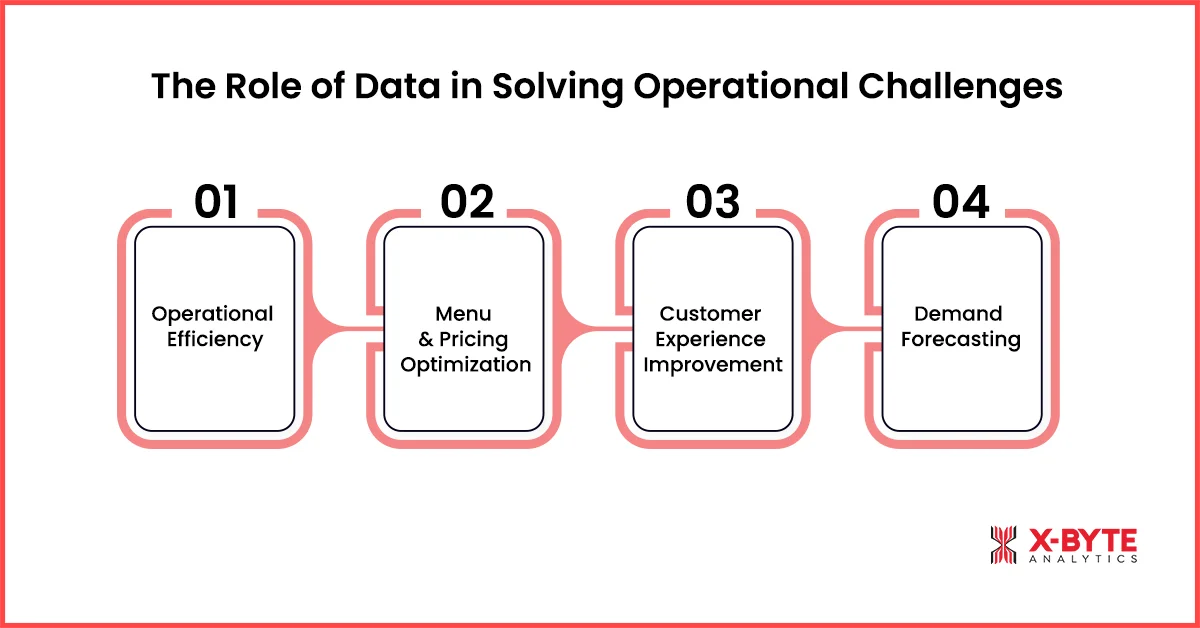
1. Improving Operational Efficiency with Analytics
Operational efficiency is the cornerstone of any successful restaurant. Analytics for restaurant efficiency helps us streamline processes and reduce waste, leading to substantial cost savings. Let’s break it down:
Inventory Management: In 2022, restaurants in the U.S. lost an estimated $25 billion in food waste, with inventory mismanagement being a significant contributor. Restaurant data analytics allows us to forecast demand more accurately, ensuring we only order what we need and minimize spoilage. By tracking real-time data, we can prevent overstocking, which means fewer ingredients go unused, ultimately reducing food waste and improving profitability.
Staffing Optimization: Labor is one of the largest expenses in restaurant operations. In fact, it can account for up to 30% of total expenses. By leveraging restaurant analytics, we can forecast busy periods based on historical sales data and adjust staffing levels accordingly. This ensures that we’re neither overstaffed (wasting money on idle labor) nor understaffed (leading to poor customer service).
With the right restaurant performance metrics, we can identify areas of inefficiency and make real-time adjustments, optimizing both labor and inventory to create smoother workflows.
2. Menu Optimization and Pricing
One of the most impactful ways restaurant analytics drives operational success is through menu optimization. Traditional menu planning often relies on anecdotal evidence or gut feelings, but analytics allows us to make data-backed decisions about menu items.
By analyzing:
Sales data: We can see which dishes are selling well and which are not, allowing us to adjust the menu accordingly.
Profitability: Analytics helps us understand which items generate the most profit. For example, we might find that a dish with high ingredient costs isn’t generating enough revenue to justify its place on the menu.
Customer preferences: By tracking what customers consistently order, we can tailor our offerings to their preferences.
For instance, consider a restaurant we worked with last year. By using restaurant analytics to identify the most profitable dishes, we were able to adjust pricing and remove low-margin items from the menu, resulting in a 12% increase in profitability in just three months. Restaurant analytics examples for inventory and labor optimization like this can make a significant impact on the bottom line.
3. Enhancing the Customer Experience
The restaurant business is about more than just food; it’s about creating an unforgettable experience for your guests. Data-driven restaurant decisions are key to delivering personalized customer experiences that keep guests coming back.
By analyzing customer data such as order history, visit frequency, and spending habits, we can:
Personalize marketing: Send targeted promotions based on what customers have ordered in the past, increasing the likelihood of repeat visits.
Improve loyalty programs: Tailor rewards and incentives to match individual customer behaviors, making them feel valued.
Enhance the dining experience: Use customer preferences to recommend dishes or even personalize the menu, creating a more engaging dining experience.
For example, a customer who regularly orders vegetarian dishes might receive personalized offers on plant-based specials. By using customer behavior insights for restaurants, we ensure that our marketing efforts are highly targeted and relevant, leading to higher engagement and loyalty.
4. Predictive Analytics for Forecasting and Demand Planning
Forecasting customer demand is one of the most powerful uses of restaurant analytics. Predictive analytics use cases in restaurant operations allow us to forecast everything from customer traffic to ingredient needs. This gives us a proactive approach to managing operations.
Forecast demand: Predict busy times (e.g., weekends, holidays) or special events, allowing us to adjust staffing and inventory ahead of time.
Plan promotions strategically: Run promotions during forecasted slow periods to boost traffic, rather than guessing what might work.
For instance, a fast-casual restaurant we worked with used restaurant analytics software for real-time operational insights to predict demand during the holiday season. By preparing in advance, they were able to handle a 20% increase in customer traffic without compromising service quality or running out of key ingredients.
Discover How X-Byte Analytics’ Restaurant Analytics Solutions Can Transform Your Business And Drive Growth
How to Implement Restaurant Analytics Successfully
Implementing restaurant analytics goes beyond simply investing in software, it requires a strategic approach that aligns with your operational goals. At X-Byte Analytics, we’ve helped many restaurants transform their data into actionable insights, driving real business results. Here’s a streamlined process to ensure restaurant analytics delivers maximum value:
1. Define Clear KPIs
Start by identifying Key Performance Indicators (KPIs) that align with your business objectives. These KPIs should be measurable and focused on profitability, efficiency, and customer satisfaction. For example:
- Revenue per seat: Measures how much revenue each seat generates.
- Table turnover rate: Tracks the efficiency of seating and serving guests.
- Food cost percentage: Helps control ingredient costs.
- Repeat customer rate: Indicates loyalty and satisfaction.
Tracking these KPIs will ensure you stay focused on the metrics that matter most.
2. Centralize Your Data
Bringing all your data into one unified platform is key. By centralizing data from POS systems, inventory tools, reservations, and customer feedback, you can streamline decision-making. A single platform ensures consistency across your operations, allowing your team to act quickly on insights.
3. Choose the Right Analytics Tools
Not all tools are created equal. When selecting a solution, ensure it includes:
- Real-time dashboards: For instant insights into critical metrics.
- Predictive analytics: To forecast customer demand and adjust staffing.
- Seamless integration: To ensure smooth data flow across your systems.
We recommend tools that are user-friendly and scalable, enabling your team to act on data in real-time.
4. Train Your Team
The power of analytics lies in how well your team can interpret and act on the data. Training is essential and without it, data is underutilized. A data-literate workforce makes better decisions, from optimizing inventory levels to improving guest service.
5. Start with High-Impact Areas
Instead of overloading your team with too many analytics projects, focus on high-impact areas first, such as:
- Inventory management: Track usage and reduce waste.
- Staffing: Optimize shifts based on real-time data.
- Menu optimization: Adjust pricing and highlight high-margin items.
By starting small, you can quickly see the value of restaurant analytics and build momentum.
Challenges of Restaurant Analytics & How to Overcome Them
While the benefits of restaurant analytics are clear, implementing it successfully often comes with its own set of challenges. From managing overwhelming amounts of data to integrating various systems and ensuring your team is well-equipped to handle analytics, the road to success is not always straightforward. To truly unlock the potential of restaurant analytics, it’s crucial to understand these challenges and take proactive steps to overcome them.
Here are some of the most common obstacles and how to address them:
1. Data Overload
Restaurants can accumulate vast amounts of data across different systems, but too much information can become overwhelming. Without a clear focus, it’s easy to get lost in the noise. To combat this, we recommend focusing on high-impact areas such as inventory management and staffing optimization first. This ensures you’re addressing the most pressing issues that will provide immediate returns.
2. Integration Issues
Many restaurants use different systems for POS, reservations, inventory, and customer feedback. Integrating these systems with your analytics platform can be a challenge, but it’s essential for a smooth workflow. Choose an analytics solution that integrates seamlessly with existing systems, ensuring data flows without friction, allowing you to make quicker, more accurate decisions. With data integration, you can consolidate all your business data into one platform, streamlining operations and enabling more effective decision-making across various departments.
3. Data Literacy Among Staff
Even the best analytics tools are only as effective as the team using them. If your staff isn’t familiar with how to interpret or act on data, it can lead to missed opportunities. Investing in data literacy training is key to making sure your team knows how to utilize the insights provided by analytics to drive operational improvements and deliver better customer service.
4. Resistance to Change
Introducing restaurant analytics can face resistance, especially if it disrupts existing processes. Many staff members might be hesitant to adopt new technologies. To overcome this, involve your team in the transition process from the start. Clearly communicate the benefits of analytics and how it will help make their jobs easier, such as by optimizing workloads or providing better customer insights.
5. Data Accuracy and Quality
Analytics is only as good as the data it processes. Inaccurate or inconsistent data can lead to faulty conclusions and bad decisions. Ensuring data accuracy is critical, so implement strong data entry protocols and regularly audit data sources. This step will guarantee that the insights drawn from your analytics tool are reliable and can be trusted.
6. Keeping Up with Technology
Analytics technologies are rapidly evolving, and staying on top of the latest tools and trends can be a challenge for many restaurants. Regularly review your analytics platform’s capabilities and be open to upgrading as needed. Partnering with a trusted vendor like X-Byte Analytics will keep you informed about the latest innovations, ensuring you’re always ahead of the curve.
The Future of Restaurant Analytics: Trends to Watch
As we look to the future of restaurant analytics, it’s clear that the evolution of technology will continue to transform the way restaurants operate. With AI, machine learning, and the Internet of Things (IoT) paving the way, we can expect even more advanced capabilities to optimize every aspect of restaurant operations. The key to staying competitive will be harnessing these emerging technologies to not only streamline workflows but also enhance the guest experience and operational efficiency.
From demand forecasting that’s more accurate than ever before to hyper-personalized dining experiences, the future holds exciting possibilities. But with these advancements, restaurants must continue to adapt and invest in the right tools to ensure they’re making the most of the data at their fingertips. Below are six key trends that will shape the future of restaurant analytics.

1. AI and Machine Learning for Enhanced Forecasting
AI and machine learning will further refine demand forecasting, allowing restaurants to predict trends with greater accuracy. These technologies can analyze large datasets, including seasonal patterns, local events, and historical sales, to forecast demand. This helps restaurants optimize staffing, inventory management, and even menu adjustments.
2. IoT-Enabled Smart Kitchens
With the Internet of Things (IoT) becoming more prevalent, smart kitchen equipment will send real-time data directly to analytics platforms. This will help monitor kitchen performance, track food quality, and ensure equipment efficiency. Smart fridges, ovens, and dishwashers will be able to track usage, maintenance needs, and energy consumption, ensuring restaurants are operating efficiently while reducing downtime and costs.
3. Hyper-Personalization with AI
AI will enable restaurants to offer deeply personalized dining experiences. By analyzing customer data, such as order history, dietary preferences, and spending patterns, restaurants can tailor everything from menu recommendations to loyalty rewards. This hyper-personalization builds stronger customer relationships, increasing retention and lifetime value.
4. Real-Time Operational Monitoring
The future of restaurant analytics will involve real-time operational insights at the manager’s fingertips. Dashboards will provide continuous updates on inventory levels, staff performance, and customer feedback, allowing managers to make adjustments on the fly. This will lead to faster decision-making and a more agile restaurant environment.
5. Enhanced Data Integration
As technology evolves, data integration will become even more seamless. Restaurants will be able to integrate data from POS systems, online orders, reservation systems, and third-party services like delivery platforms. This comprehensive view will offer more robust insights into everything from sales performance to customer behavior, allowing for smarter, data-driven decisions. With a powerful data integration tool, restaurants can effortlessly consolidate data from multiple sources into one platform, streamlining operations and ensuring real-time access to actionable insights.
6. Voice-Activated Analytics
With the rise of voice assistants like Alexa and Google Assistant, restaurants will begin to integrate voice-activated analytics into their operations. Managers could ask for real-time data on sales or inventory simply by speaking to their systems. This hands-free approach will make it easier for restaurant managers to stay informed without needing to check multiple platforms, streamlining their workflow.
As restaurant analytics continues to evolve, restaurants that stay ahead of the curve by adopting emerging technologies like AI, machine learning, IoT, and hyper-personalization will gain a significant competitive advantage. These trends will drive greater operational efficiency, improve guest experiences, and ultimately lead to higher profitability. At X-Byte Analytics, we’re committed to helping restaurants implement these cutting-edge technologies and stay at the forefront of the analytics revolution.
Conclusion: Data Is Your Competitive Advantage
Operational efficiency and customer satisfaction are at the heart of a restaurant’s long-term success. Restaurant analytics enables you to achieve both by transforming complex data into clear, actionable insights. Whether it’s optimizing inventory, improving staffing efficiency, or enhancing the customer experience, restaurant analytics empowers operators to make smarter, data-driven decisions that directly impact profitability and growth.
At X-Byte Analytics, we help restaurants harness the power of their data to gain a competitive edge. With our expertise in restaurant analytics and a deep understanding of the industry’s challenges, we offer tailored solutions that drive operational excellence and deliver exceptional guest experiences. Let us help you unlock the potential of your data and turn it into a strategic advantage for your business.