
Key Highlights:
- You’ll learn why data analytics has become a critical growth driver for UK businesses, helping organisations move beyond guesswork and make faster, data-driven decisions in a highly competitive market.
- Your takeaway will be a clear understanding of how data analytics is used across UK industries, with practical, real-world examples that show how businesses turn insights into operational and strategic advantages.
- You’ll know how UK SMEs and enterprises use analytics differently to stay competitive, including what challenges to avoid and how a strong data strategy creates long-term business value.
Introduction
UK businesses are operating in one of the most competitive and regulated environments in the world. Rising costs, shifting customer expectations, digital disruption, and ongoing global uncertainty mean that traditional decision-making methods are no longer enough. As a result, data analytics consulting in UK business has moved from being a “nice to have” capability to a strategic necessity.
This shift is reflected in market adoption and investment trends. The UK data analytics market reached approximately USD 3.5 billion in 2024 and is projected to grow at a compound annual growth rate of around 19.7% through 2033, surpassing USD 25 billion in value. This rapid growth highlights how analytics is becoming mission-critical for organisations seeking better visibility, control, and agility in decision-making.
Across sectors-from retail and manufacturing to healthcare and financial services-UK organisations are using data analytics to reduce risk, optimise operations, and make faster, more informed decisions. This article explores how data analytics is transforming UK business, the real-world ways companies apply analytics across industries, and what leaders must do to stay competitive in an increasingly data-driven UK economy.
Why Data Analytics Is Becoming Essential for UK Businesses?
UK businesses are operating in an increasingly complex environment shaped by rising operational costs, strict regulatory frameworks, and rapidly evolving customer expectations. In such conditions, relying on intuition, spreadsheets, or fragmented reports often results in delayed decisions and missed opportunities. This is where data analytics in UK business plays a critical role by giving organisations timely, accurate, and actionable insights.
Data analytics is becoming essential for UK businesses because it helps them:
- Gain real-time visibility into operations, finance, and customer performance
- Identify inefficiencies and cost leakages before they affect profitability
- Make faster, more confident decisions backed by data rather than assumptions
- Respond quickly to changing market trends and customer behaviour
- Improve forecasting accuracy for demand, revenue, and resource planning
- Ensure compliance through consistent, auditable reporting
- Align teams around a single source of truth for strategic execution
From our experience working with UK enterprises and growing SMEs, organisations that embed business intelligence in the UK into everyday decision-making are far better equipped to scale sustainably. Analytics gives leadership teams clarity and control-transforming uncertainty into informed, strategic action rather than reactive decision-making.
How Data Analytics Transforms Decision-Making?
One of the biggest shifts driven by analytics is how quickly and confidently decisions are made across UK businesses. Instead of relying on delayed reports, leadership teams now act on real-time insights that support smarter, faster responses to change, strengthening data-driven decision-making in UK companies.
- Businesses move from analysing past performance to anticipating future outcomes using predictive insights. This allows leaders to plan proactively rather than reacting after issues occur.
- Real-time dashboards enable faster decision-making by providing up-to-date visibility into operations, sales, and finance. Teams no longer wait days or weeks for consolidated reports.
- A single source of truth helps align departments around consistent and reliable data. This reduces confusion, misalignment, and conflicting interpretations of performance.
- Strategies and initiatives can be evaluated using measurable data instead of assumptions or intuition. Leaders gain confidence knowing decisions are backed by evidence.
- Early identification of trends and risks becomes possible through continuous data monitoring. This helps organisations take corrective action before problems escalate.
- Performance accountability improves when metrics are clearly tracked and visible. Teams understand how their actions impact business outcomes and overall goals.
Many UK organisations now rely on KPI dashboards and reporting to monitor sales performance, operational costs, customer engagement, and financial health in one place. This shift doesn’t just improve accuracy; it significantly accelerates decision speed, giving businesses a critical edge in highly competitive markets.
Sector-Wise Use of Data Analytics Across UK Industries
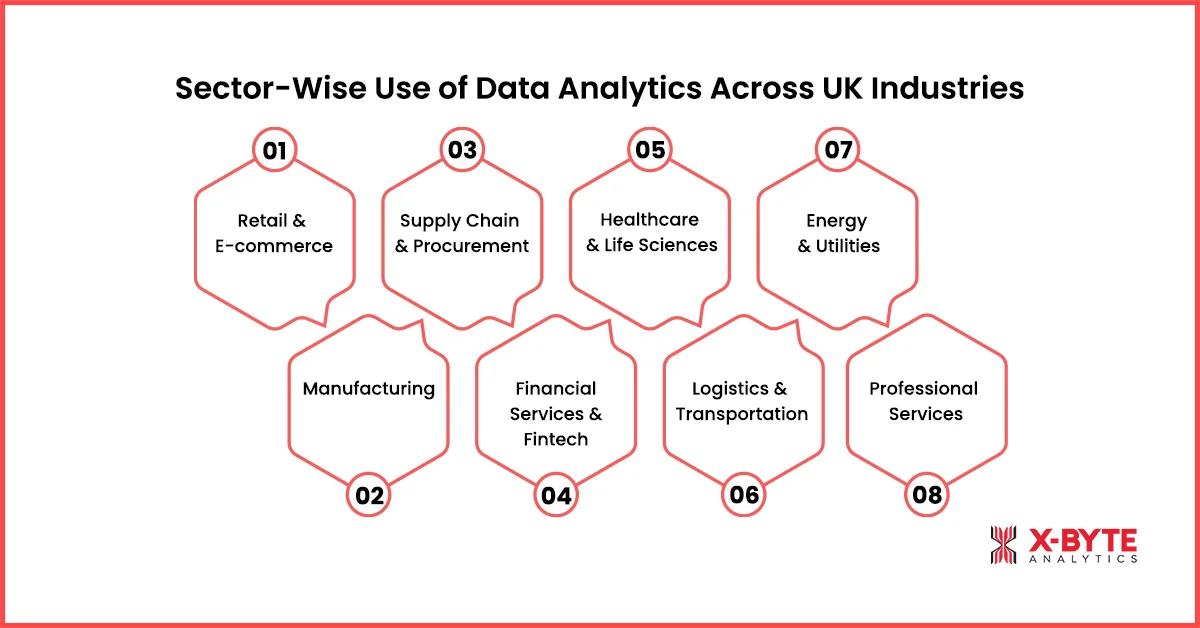
One of the biggest gaps in competitor content is the lack of meaningful, sector-specific explanation. In practice, data analytics across industries in the UK is not applied in a uniform way-each sector uses data differently based on its operational complexity, regulatory pressure, and customer expectations. Understanding these differences is essential to see how analytics truly drives competitiveness at scale.
1. Retail & E-commerce
Retailers use analytics to deeply understand customer purchasing behaviour, preferences, and price sensitivity. By analysing transaction data, browsing patterns, and loyalty insights, businesses can personalise promotions and optimise pricing strategies. Demand forecasting helps reduce stockouts and overstocking, directly protecting margins. UK brands like Tesco and ASOS rely on analytics to balance inventory across channels. This data-led approach improves customer retention while controlling operational costs.
2. Manufacturing
Manufacturers apply analytics to monitor production performance, equipment usage, and output quality in real time. Data from machines and production lines helps identify inefficiencies before they lead to downtime. Predictive analytics enables proactive maintenance, reducing costly disruptions. Analytics also supports capacity planning and cost optimisation across facilities. This results in more stable operations and improved profitability.
3. Supply Chain & Procurement
Supply chain teams use data analytics in supply chain to gain visibility across suppliers, inventory, and logistics partners. Demand forecasting and supplier performance data help reduce delays and manage risk. Businesses can optimize reorder points, negotiate better contracts, and minimize excess inventory. Analytics also improves resilience during disruptions, making the supply chain more agile and cost-efficient.
4. Financial Services & Fintech
Banks and fintech firms rely heavily on analytics for risk assessment, fraud detection, and regulatory compliance. Transaction data and behavioural models help detect suspicious activity in real time. Analytics enables faster, more accurate credit decisions without increasing exposure. Reporting automation supports compliance with strict UK regulations. This balance of speed and control creates a strong competitive advantage.
5. Healthcare & Life Sciences
Healthcare organisations use analytics to improve patient outcomes and operational efficiency. By analysing patient flow, appointment data, and treatment outcomes, providers can reduce waiting times. Resource allocation becomes more effective when staffing and equipment usage are data-driven. Analytics also supports population health insights. This leads to better care delivery while managing costs.
6. Logistics & Transportation
Logistics companies use data analytics to optimise routes, monitor delivery performance, and control fuel costs. Real-time tracking data enables faster responses to delays or disruptions. Performance analytics helps improve on-time delivery rates and customer satisfaction. Predictive insights support capacity planning. This results in more reliable and cost-effective logistics operations.
7. Energy & Utilities
Energy providers use analytics to forecast demand, monitor infrastructure performance, and optimise distribution. Predictive models help prevent outages and improve maintenance planning. Usage data enables better pricing and consumption insights. Analytics also supports sustainability goals. This improves reliability while controlling operational risks.
8. Professional Services
Consulting, legal, and advisory firms use analytics to improve project profitability and resource utilisation. Time tracking and performance data help optimise staffing decisions. Analytics enables better forecasting of workloads and revenue. Client insights support more targeted service offerings. This improves both efficiency and client satisfaction.
Across sectors, analytics is no longer limited to reporting-it is embedded into daily operations and strategic planning. Businesses that apply analytics in ways aligned with their industry realities gain sharper insights, faster responses, and stronger resilience. This sector-specific application is what truly separates competitive UK businesses from those struggling to keep pace.
Discover How X-Byte Analytics Helps UK Businesses Build Scalable Analytics, Intuitive Dashboards, And Data-Driven Teams.
How UK SMEs and Enterprises Use Analytics Differently
While analytics is valuable for businesses of all sizes, the way it is adopted and used varies significantly between SMEs and large enterprises. Factors such as budget, data complexity, decision speed, and organisational maturity shape how analytics delivers value. Understanding this difference between SME and enterprise analytics adoption helps UK businesses invest in solutions that match their scale and objectives.
| Aspect | UK SMEs | UK Enterprises |
| Primary Objective | Improve visibility into costs, sales, and cash flow | Drive strategic planning, forecasting, and long-term growth |
| Data Complexity | Limited data sources and smaller datasets | Large, complex datasets across multiple systems |
| Analytics Focus | Descriptive and diagnostic insights | Predictive and prescriptive analytics |
| Decision-Making Style | Fast, owner-led or small leadership teams | Structured, multi-level decision processes |
| Tools & Platforms | Simple dashboards and reporting tools | Enterprise-grade BI platforms and analytics ecosystems |
| Investment Approach | Cost-conscious, quick ROI-driven | Strategic, long-term analytics investments |
| Usage Scope | Department-level insights | Organisation-wide analytics adoption |
| Skills & Resources | Limited in-house analytics expertise | Dedicated data and analytics teams |
Despite these differences, both SMEs and enterprises benefit when analytics aligns with business priorities. A well-defined UK data analytics strategy ensures that organisations adopt the right level of sophistication-avoiding unnecessary complexity while still enabling data-driven growth.
Key Business Benefits UK Companies Gain from Data Analytics
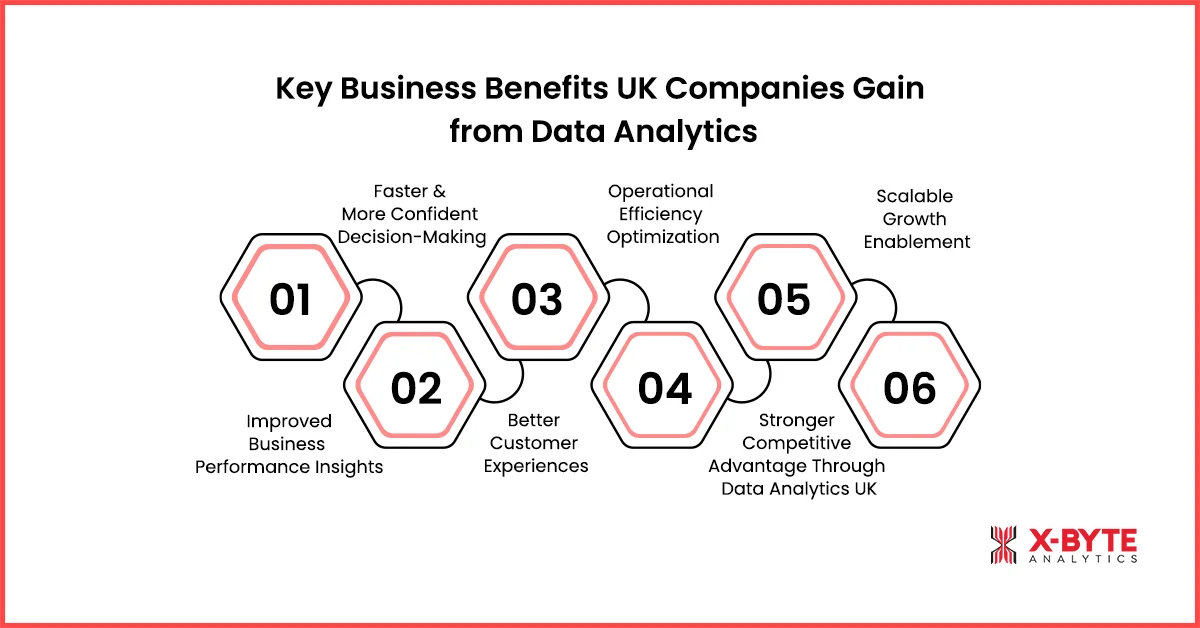
When implemented correctly, analytics delivers measurable and long-term value for UK organisations. It enables leaders to move beyond reactive decision-making and build resilience in competitive markets. Businesses that embed analytics across functions gain visibility, speed, and strategic control.
1. Improved Business Performance Insights
Analytics consolidates data from multiple sources into a single view, helping leaders clearly understand what is driving performance. This enables informed decisions based on facts rather than assumptions.
2. Faster and More Confident Decision-Making
Real-time dashboards reduce reporting delays and give teams immediate access to critical metrics. Decision-makers can act quickly with greater confidence in the accuracy of data.
3. Better Customer Experiences
Customer behaviour data helps organisations personalise services, anticipate needs, and improve satisfaction. This leads to higher retention and stronger brand loyalty.
4. Operational Efficiency Optimization
Analytics highlights inefficiencies across processes, enabling businesses to reduce waste and control costs. Teams can continuously refine operations based on performance data.
5. Stronger Competitive Advantage Through Data Analytics UK
Companies using analytics strategically gain insights that competitors may lack. This advantage allows businesses to respond faster to market changes and outperform peers.
6. Scalable Growth Enablement
Data-driven insights support smarter expansion decisions by identifying profitable opportunities. Analytics ensures growth is sustainable rather than reactive.
Common Challenges UK Businesses Face When Adopting Data Analytics
Despite its benefits, adopting analytics comes with practical challenges that can slow progress if not addressed early. Many UK businesses struggle not with technology itself, but with how analytics is introduced and used. Understanding these challenges helps organisations build stronger foundations.
1. Poor Data Quality and Siloed Systems: Inconsistent or fragmented data reduces trust in insights and slows decision-making. Siloed systems make it difficult to achieve a single source of truth.
2. Tool Overload Without a Clear Strategy: Businesses often invest in multiple analytics tools without a defined purpose. This creates complexity without delivering meaningful insights.
3. Lack of Analytics Skills and Expertise: Without the right skills, teams struggle to interpret data effectively. This limits the value analytics can deliver across the organisation.
4. Low User Adoption Across Teams: If dashboards are too complex or irrelevant, employees avoid using them. Analytics must be intuitive and aligned with daily workflows.
5. Unclear Business Objectives: Analytics initiatives fail when business questions are not clearly defined. Data should always support specific goals rather than generic reporting.
6. Change Management Resistance: Shifting to data-driven decision-making requires cultural change. Resistance from teams can delay adoption and reduce impact.
How X-Byte Analytics Helps UK Businesses Turn Data into Advantage
At X-Byte Analytics, we’ve partnered with organisations across multiple industries to deliver real-world data analytics transformation in UK companies, supporting both growing SMEs and large enterprises. Our experience working closely with leadership teams has shown that analytics creates value only when it is aligned with how businesses actually operate and make decisions.
Our approach focuses on aligning analytics initiatives with clear business goals, ensuring insights directly support strategic and operational outcomes. We design intuitive dashboards that decision-makers can easily interpret and use in day-to-day planning, not just monthly reporting. By enabling predictive analytics, we help organisations move beyond historical analysis and prepare for future risks and opportunities with confidence.
Rather than delivering generic reports, we build analytics ecosystems that integrate data, people, and processes. This enables leadership teams to make faster, evidence-based decisions with greater clarity, control, and long-term impact.
The Future of AI-Driven Data Analytics in UK Across Industries
AI-driven data analytics is rapidly reshaping how UK businesses plan, compete, and operate across industries. As data volumes grow and decision cycles shorten, organisations are moving beyond descriptive reporting toward intelligent, proactive decision-making. This shift is no longer experimental and is becoming a strategic priority for UK enterprises seeking long-term competitiveness.
1. Predictive and Prescriptive Decision-Making: AI enables businesses to anticipate demand, forecast risks, and recommend optimal actions. This helps leaders make proactive decisions rather than reacting to past performance.
2. Automated Insights and Anomaly Detection: AI continuously monitors data to surface unusual patterns and performance gaps. Teams can address issues early without relying on manual data checks.
3. Real-Time Decision Intelligence: Real-time analytics allows leaders to act immediately on changing conditions. This is critical for operations, finance, customer experience, and supply chain agility.
4. Scalable Analytics Across Business Functions: AI-powered analytics scales insights across departments without increasing manual effort. This ensures consistent, data-driven decisions at every level of the organisation.
5. Improved Accuracy and Reduced Bias: AI models process large data sets consistently, reducing human error and bias. This leads to more reliable insights and better business outcomes.
6. Stronger Human–AI Collaboration: AI enhances human judgment by providing timely, contextual insights. Decision-makers retain control while benefiting from intelligence at scale.
Businesses that successfully combine AI-driven analytics with domain expertise are better positioned to improve efficiency, manage complexity, and maintain a competitive edge in increasingly dynamic UK markets.
Get Expert Guidance On Building The Right Analytics Strategy For Your Business-Without Unnecessary Complexity Or Tools.
Final Thoughts
In today’s data-driven economy, data analytics in UK business is no longer optional-it is a foundational capability for sustainable growth and competitiveness. Organisations that treat analytics as a strategic asset, rather than a reporting function, gain deeper visibility, faster decision-making, and stronger alignment across teams.
By focusing on clear strategy, user-friendly insights, and real-world business outcomes, UK companies can turn data into a long-term advantage. Those that invest early and build analytics maturity over time will be better equipped to adapt, compete, and succeed in an environment where insight, speed, and accuracy define business performance.