
Quick Summary
- Learn how healthcare organizations use data analytics to improve medical services, clinical outcomes, and operational efficiency across the healthcare industry.
- Understand healthcare data analytics requirements, key data sources, benefits, and challenges involved in integrating analytics into healthcare systems.
- Explore real-world healthcare analytics use cases that support data-driven decision-making, patient care optimization, and performance improvement.
Introduction
Healthcare organizations are expected to deliver better patient outcomes while managing rising costs, regulatory pressure, and operational complexity. Traditional reporting methods and siloed data systems no longer support these demands. Data analytics in healthcare, supported by expert data analytics consulting services, has become a core capability for organizations focused on measurable clinical and operational improvement.
By implementing healthcare data analytics, providers gain real-time visibility into patient outcomes, clinical performance, and resource utilization. Analytics enables leadership teams to reduce inefficiencies, identify risks early, and make faster, evidence-based decisions that directly impact care quality and patient satisfaction.
This blog covers how healthcare organizations use data analytics in healthcare to improve patient outcomes, optimize operations, and support data-driven clinical decision-making. It explains healthcare data analytics use cases, data sources, benefits, challenges, and how advanced analytics and AI are applied in real-world healthcare environments.
For hospitals and healthcare providers evaluating analytics adoption or modernization, this guide focuses on practical, implementation-ready insights that support scalable, secure, and patient-centric healthcare delivery.
What Is Healthcare Data Analytics?
Healthcare data analytics is the practice of analyzing clinical, operational, and patient data to improve decision-making, care quality, and overall healthcare performance. When supported by data analytics services, healthcare organizations can process high-volume, complex datasets and convert them into meaningful insights that directly improve patient outcomes and operational efficiency.
Key focus areas of healthcare data analytics include:
- Analyzing clinical data to improve diagnosis accuracy, treatment effectiveness, and patient safety
- Monitoring operational performance to optimize staffing, resource utilization, and workflows
- Evaluating financial and claims data to control costs and improve revenue management
- Applying predictive analytics for early disease detection, risk stratification, and preventive care
- Enabling data-driven decision-making for clinicians, administrators, and executives
By using data analytics in healthcare, organizations move beyond static reporting toward proactive and predictive care models. This approach enables faster decisions, improved care coordination, and scalable analytics capabilities that support long-term healthcare sustainability and patient-centric outcomes.
What Is Big Data in Healthcare?
Big data in healthcare refers to the large-scale volumes of structured and unstructured data generated from electronic health records, medical imaging systems, wearable devices, claims platforms, and patient interactions. This data is created at high speed and in diverse formats, making traditional data processing methods inadequate for extracting timely and accurate insights. Big data analytics consulting services enable healthcare organizations to process, integrate, and analyze these complex datasets at scale.
Key characteristics of big data in healthcare include:
- High data volume from clinical records, diagnostics, and patient monitoring systems
- Data variety across structured, semi-structured, and unstructured formats
- Real-time data velocity from wearables, IoT devices, and monitoring tools
- Data complexity that requires advanced analytics, AI, and scalable infrastructure
By applying healthcare data analytics to big data environments, healthcare organizations can identify hidden patterns, predict patient risks, and improve population health management. Big data analytics services enable more precise clinical decisions, operational optimization, and proactive care delivery, making it a critical foundation for modern, data-driven healthcare systems.
What Are the Sources of Healthcare Data for Analytics?
Successful healthcare data analytics depends on integrating data from multiple clinical, operational, and digital systems into a unified analytics environment. These data sources provide the foundation for accurate reporting, predictive modeling, and data-driven decision-making across healthcare organizations.
Key sources of healthcare data analytics include:
- Electronic Health Records (EHRs): Patient demographics, diagnoses, lab results, prescriptions, and treatment history
- Administrative & Billing Systems: Claims data, reimbursements, costs, revenue, and financial performance metrics
- Clinical Support Systems: CPOE, CDSS, telemedicine platforms, and clinical workflow tools
- Medical Devices & Wearables: Vital signs, imaging data, remote patient monitoring, and IoT-generated health metrics
- Patient Experience Systems: Surveys, feedback platforms, portals, and engagement data
When these data sources are standardized and centralized, healthcare organizations gain a single source of truth. This enables reliable data analytics, improves care coordination, and ensures insights are accurate, timely, and decision-ready across clinical and administrative teams.
Partner With X-Byte Analytics To Unlock The Full Potential Of Your Data Analytics in the Healthcare Service Today
Applications of Data Analytics in Healthcare
Data analytics in healthcare is no longer experimental—it is actively used to improve patient outcomes, streamline operations, and support high-stakes clinical and administrative decisions. For healthcare leaders evaluating analytics adoption, understanding where analytics delivers the most measurable impact is critical to investment decisions.
Key applications of data analytics in healthcare include:
- Executive dashboards & reporting: Real-time visibility into patient volumes, bed occupancy, staff utilization, and operational KPIs
- Patient demand & capacity forecasting: Predicting admissions, discharge timelines, and staffing needs to prevent bottlenecks
- Clinical decision support: Identifying risk patterns, treatment effectiveness, and outcome trends to support evidence-based care
- Telemedicine & remote monitoring: Analyzing virtual care data to enable early intervention and personalized treatment
- Fraud detection & compliance monitoring: Detecting anomalies in claims, billing, and access patterns to reduce financial and regulatory risk
When applied strategically, healthcare data analytics shifts organizations from reactive care delivery to proactive, outcome-driven models. These applications of healthcare data analytics directly improve care quality, reduce operational costs, and give healthcare leaders the confidence to scale analytics as a core decision-support capability.
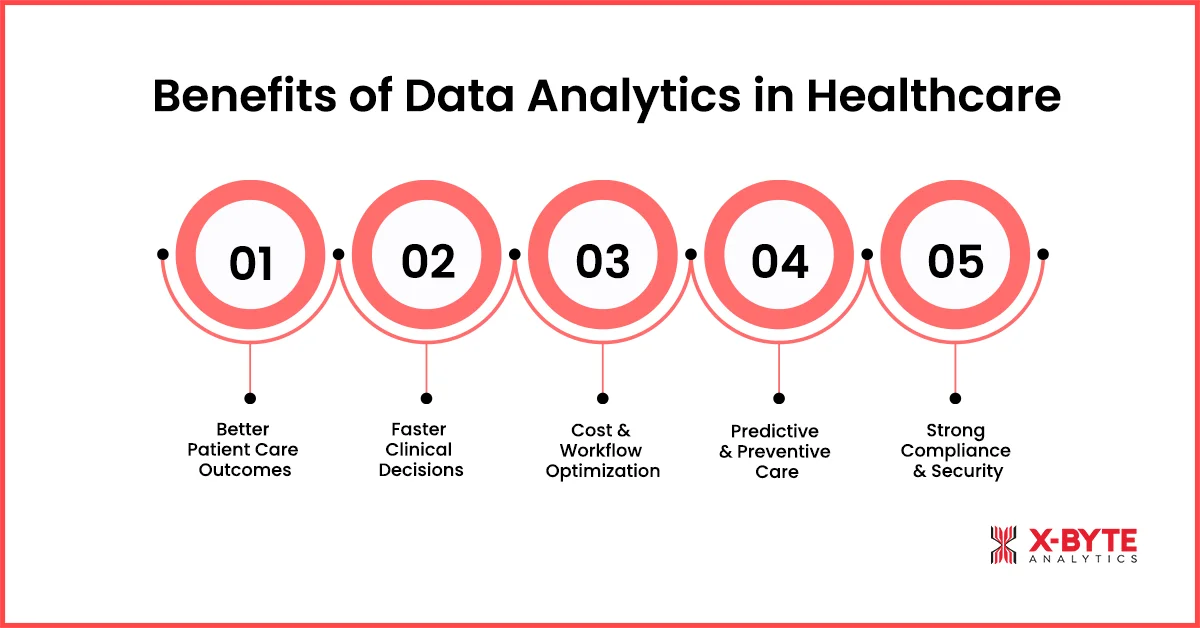
Benefits of Data Analytics in Healthcare
For healthcare organizations in the decision stage, data analytics delivers clear clinical, operational, and financial value. When applied strategically, healthcare data analytics enables better patient outcomes, stronger cost control, and more confident decision-making across the organization.
1. Improved Patient Outcomes and Quality of Care
Data analytics in healthcare helps providers analyze patient histories, clinical patterns, and treatment results to deliver more accurate and personalized care. Early risk detection and data-driven interventions reduce medical errors and improve overall patient outcomes.
2. Faster and More Accurate Decision-Making
Real-time dashboards and analytics replace manual reports and delayed insights. Clinicians and administrators gain instant visibility into critical data, enabling faster, evidence-based decisions that improve care delivery and operational responsiveness.
3. Operational Efficiency and Cost Optimization
Healthcare data analytics improves resource utilization by optimizing staff schedules, bed occupancy, equipment usage, and inventory levels. This reduces operational waste, lowers costs, and ensures resources are available when and where they are needed.
4. Preventive and Predictive Care Enablement
Predictive analytics allows healthcare organizations to shift from reactive treatment to preventive care. By identifying early warning signs and high-risk patients, analytics supports population health management and reduces readmissions.
5. Stronger Compliance, Security, and Fraud Detection
Advanced analytics continuously monitors data for anomalies and suspicious activity. This strengthens regulatory compliance, enhances data security, and helps healthcare organizations prevent fraud while protecting sensitive patient information.
Together, these benefits make data analytics a critical investment for healthcare organizations aiming to improve outcomes, control costs, and build a scalable, patient-centric healthcare system.
Challenges of Data Analytics in Healthcare
While data analytics in healthcare delivers strong business and clinical value, organizations often face significant challenges during adoption and scaling. Understanding these challenges helps decision-makers plan the right data strategy, technology investments, and governance models.

1. Data Quality and Data Integrity Issues
Healthcare data is often fragmented, incomplete, or inconsistent across systems such as EHRs, labs, and clinical platforms. Poor data quality directly impacts analytics accuracy, clinical insights, and reporting reliability.
2. Data Privacy, Security, and Regulatory Compliance
Healthcare data contains highly sensitive patient information. Ensuring compliance with regulations such as HIPAA and GDPR while enabling analytics is complex. Cybersecurity risks, access control, and consent management remain major concerns.
3. Lack of Data Standardization and Interoperability
Different healthcare systems store data in varying formats and structures. The absence of standardized data models and interoperability frameworks makes it difficult to integrate data and generate unified analytics across departments or care networks.
4. Infrastructure and Scalability Limitations
Traditional on-premise systems struggle to handle the volume, velocity, and variety of healthcare data. Limited storage, processing power, and real-time analytics capabilities restrict scalability and performance.
5. Integration of Legacy Systems
Many healthcare organizations still rely on legacy applications that are not designed for modern analytics. Integrating these systems with advanced data platforms often requires significant effort, time, and investment.
6. Skills Gap and Analytics Adoption
A lack of skilled analytics professionals and low data literacy among clinical and administrative teams can limit the effectiveness of healthcare data analytics initiatives. Without proper training and change management, insights may go unused.
Addressing these challenges requires a combination of strong data governance, secure and scalable infrastructure, interoperability standards, and a clear analytics adoption strategy aligned with healthcare goals.
Role of AI in Healthcare Analytics
Artificial intelligence plays a critical role in enhancing healthcare analytics by enabling faster, more accurate analysis of complex and high-volume healthcare data. By combining AI with data analytics, organizations can identify hidden patterns, automate insights, and support smarter clinical and operational decision-making.
AI-powered healthcare analytics improves predictive capabilities such as early disease detection, risk stratification, and patient outcome forecasting. Machine learning models analyze historical and real-time data to help clinicians personalize treatment plans, reduce errors, and improve care quality across healthcare systems.
In addition, AI enhances operational efficiency by automating data processing, detecting anomalies, and supporting real-time decision-making. As healthcare data continues to grow, AI-driven analytics is becoming essential for building scalable, proactive, and patient-centric healthcare solutions.
Conclusion
Data analytics is no longer a supporting function in healthcare; it is a strategic driver for better patient outcomes, operational efficiency, and sustainable growth. From predictive analytics and AI-driven insights to real-time dashboards and population health management, healthcare organizations that invest in advanced analytics are better equipped to deliver proactive, high-quality, and patient-centric care. Turning complex healthcare data into trusted, actionable insights is now essential for informed clinical and business decision-making.
X-Byte Analytics helps healthcare organizations design, implement, and scale secure healthcare data analytics solutions that deliver measurable impact. From data engineering and healthcare dashboards to AI-powered analytics and cloud-ready architectures, our experts enable faster decisions and improved patient outcomes. Talk to X-Byte Analytics today to transform your healthcare data analytics into actionable intelligence and build a future-ready, data-driven healthcare ecosystem.