
Quick Summary
- Retail BI tools like Power BI, Tableau, and Looker enable real-time visibility into sales, inventory, and customer performance.
- Cloud data platforms and custom dashboards help retailers scale analytics and make faster, data-driven decisions.
- Business value comes from aligned KPIs, strong data governance, and well-designed dashboards, not tools alone.
Introduction
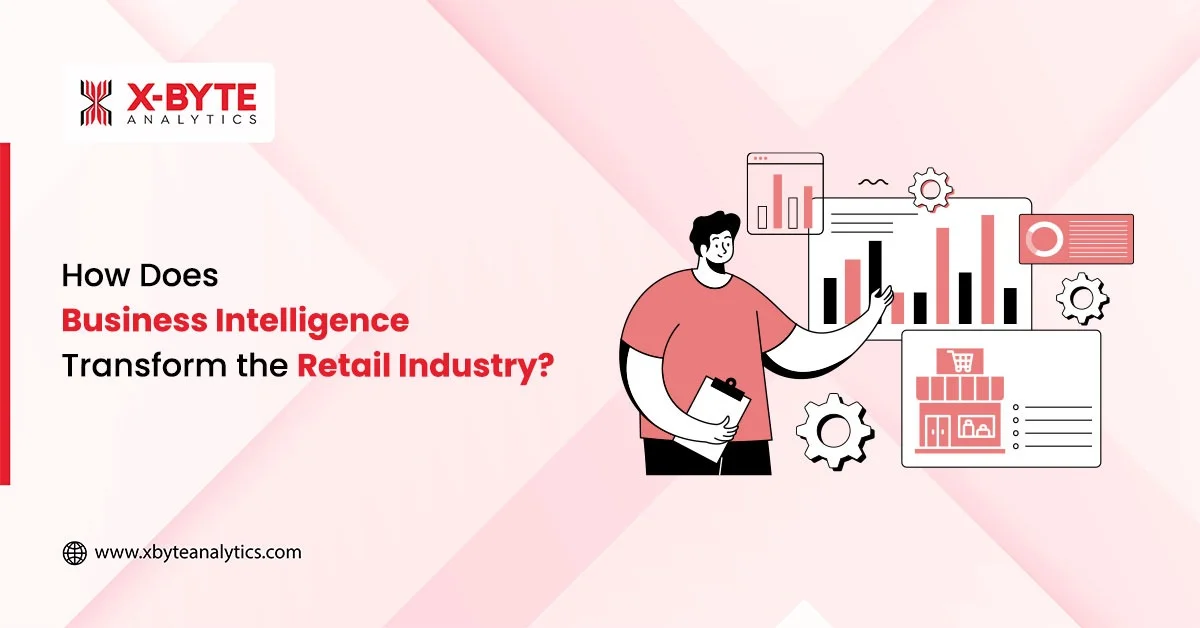
Retailers today operate in a highly dynamic environment shaped by omnichannel customer journeys, fluctuating demand, rising operational costs, and intense competition. Traditional reporting methods and siloed data systems can no longer keep pace with the speed and complexity of modern retail operations. This is where Business Intelligence in Retail plays a critical role, enabling organizations to transform operations through actionable insights powered by retail data analytics.
Retail organizations generate massive volumes of data from:
- Point-of-sale (POS) systems
- E-commerce and mobile platforms
- Inventory and supply chain tools
- Customer loyalty programs
- Marketing and promotional campaigns
However, data alone does not create a competitive advantage. Business Intelligence in Retail transforms raw retail data into reliable, actionable insights that empower organizations to make faster, more accurate, and more profitable decisions across operations, marketing, and customer engagement.
Retailers that adopt BI-driven decision-making consistently outperform competitors by improving forecast accuracy, reducing operational waste, and delivering highly personalized customer experiences at scale.
At X-Byte Analytics, we help global retailers design and implement scalable, enterprise-grade BI solutions that move beyond static reporting to deliver measurable business outcomes.
What Is Business Intelligence in Retail?
Business Intelligence in retail is the process of collecting, integrating, analyzing, and visualizing retail data to support data-driven operational and strategic decision-making.
Retail BI provides a unified view of performance across:
- Sales and revenue
- Inventory and supply chain
- Customer behavior and loyalty
- Marketing effectiveness
- Store and channel performance
Unlike traditional reports, modern retail BI delivers real-time dashboards, predictive analytics, and role-based insights that enable retailers to act proactively instead of reactively.
How Business Intelligence Transforms the Retail Industry
Business Intelligence transforms the retail industry by converting sales, inventory, and customer data into actionable insights. Retail BI enables data-driven decisions, improves demand forecasting, optimizes operations, enhances personalization, and increases overall profitability across omnichannel retail environments.
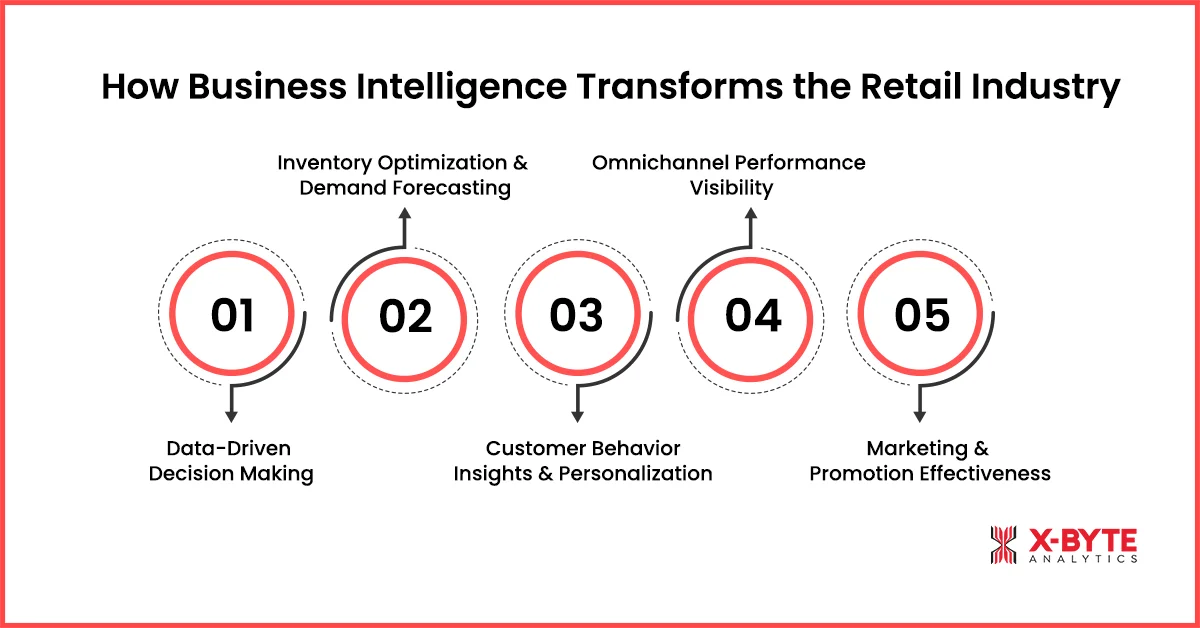
1. Data-Driven Decision Making
Retail BI replaces intuition-based decisions with real-time, data-backed insights. Executives and operational teams gain a single source of truth across sales, inventory, and customer performance, enabling faster and more confident decisions.
Key outcomes:
- Improved forecasting accuracy
- Faster decision cycles
- Reduced operational and financial risk
EEAT Case Example:
A multi-region retail chain partnered with X-Byte Analytics to centralize POS and e-commerce data into executive dashboards, reducing reporting latency from days to minutes and improving weekly decision turnaround by over 40%.
2. Inventory Optimization & Demand Forecasting
Using Retail Data Analytics, retailers can analyze historical sales, seasonality, promotions, and regional demand patterns to forecast inventory accurately. A well-implemented data analytics solution, supported by Retail Business Intelligence dashboards, helps optimize stock levels, minimize overstock, and prevent revenue loss caused by stockouts.
Retail BI enables:
- Accurate demand forecasting
- Reduced overstocking and stockouts
- Optimized replenishment cycles
EEAT Case Example:
A specialty retail brand used BI-driven demand forecasting models to improve inventory turnover by 22% while reducing excess stock holding costs within one fiscal year.
3. Customer Behavior Insights & Personalization
By leveraging Retail Business Intelligence, retailers can unify customer data across online and offline touchpoints to gain actionable insights into browsing behavior, purchase frequency, and lifetime value. Modern Retail Analytics Solutions also support targeted campaigns and personalized loyalty programs.
BI-driven personalization supports:
- Targeted promotions
- Optimized loyalty programs
- Increased customer lifetime value (CLV)
EEAT Case Example:
Using BI-powered customer segmentation, a retailer identified high-value repeat buyers and launched personalized campaigns that increased conversion rates by 18% across digital channels.
4. Omnichannel Performance Visibility
Retail BI creates a unified analytics layer by consolidating data from physical stores, e-commerce platforms, mobile apps, and online marketplaces. This end-to-end visibility allows retailers to track performance consistently across channels while delivering seamless and connected customer experiences.
Key outcomes:
- Channel-level profitability analysis
- Unified omnichannel reporting
- Consistent pricing and inventory allocation
EEAT Case Example:
A global omnichannel retailer used Retail BI dashboards to unify store and digital channel data, enabling centralized reporting and improving cross-channel inventory allocation accuracy by 30%.
5. Marketing & Promotion Effectiveness
Business Intelligence empowers retailers to measure marketing performance across digital and offline channels with accurate attribution and ROI tracking. Retail BI helps teams quickly identify underperforming campaigns and optimize promotional strategies in real time.
Key outcomes:
- Improved promotion effectiveness measurement
- Accurate multi-channel marketing attribution
- Higher marketing ROI and budget efficiency
EEAT Case Example:
By implementing BI-driven marketing analytics, a retail brand optimized campaign spend across paid and organic channels, increasing promotional ROI by 25% within a single quarter.
Unlock Actionable Insights and Drive Measurable Growth for Your Retail Business.
Key Use Cases of Business Intelligence in Retail
Retail BI supports demand forecasting, pricing optimization, inventory management, customer segmentation, and store performance analysis—enabling retailers to respond faster to changing market trends and evolving customer behavior. By converting operational and customer data into actionable insights, BI empowers retail leaders to make smarter, revenue-focused decisions across omnichannel environments.
1. Sales & Revenue Analytics
Retail BI enables detailed analysis of revenue performance by product, region, store, and sales channel. These insights help retailers optimize pricing strategies, refine product assortments, and evaluate promotional effectiveness to maximize profitability and revenue consistency.
2. Store Performance Management
Business intelligence allows retailers to compare store-level KPIs such as conversion rates, footfall, sales per square foot, and inventory turnover. This helps identify underperforming locations, replicate best-performing store strategies, and improve overall operational efficiency.
3. Supply Chain & Vendor Analytics
Retail BI evaluates supplier performance, lead times, logistics costs, and fulfillment efficiency. By identifying bottlenecks and underperforming vendors, retailers can reduce delays, control costs, and improve supply chain reliability while protecting margins.
4. Customer Segmentation & Loyalty Analytics
Advanced analytics segments customers based on purchase behavior, lifetime value, and engagement patterns. Retailers can identify high-value customers, predict churn risks, and design data-driven loyalty programs that increase retention and repeat purchases.
5. Inventory Optimization & Demand Planning
Retail BI provides real-time visibility into stock levels, sell-through rates, and demand patterns across channels. This helps retailers prevent stockouts and overstock situations, improve replenishment accuracy, and align inventory with localized demand—reducing carrying costs while protecting sales.
6. Promotions & Marketing Effectiveness Analytics
Business intelligence helps retailers measure the true impact of promotions, discounts, and campaigns across digital and physical channels. By analyzing uplift, margin impact, and customer response, teams can optimize promotional spend, eliminate unprofitable offers, and run data-backed campaigns that drive sustainable growth.
Business Intelligence vs Traditional Reporting in Retail
As retail operations grow more complex across digital and physical channels, the limitations of traditional reporting become increasingly evident. Static reports and siloed data fail to provide timely insights or support proactive decision-making. Business Intelligence (BI) addresses these gaps by integrating data across systems, enabling real-time analysis, predictive insights, and role-based dashboards that help retailers respond faster to market changes and customer expectations.
| Aspect | Traditional Reporting | Business Intelligence (BI) |
| Data Sources | Limited, siloed data from individual systems | Integrated data from POS, e-commerce, CRM, supply chain, and marketing |
| Data Refresh Frequency | Periodic (daily, weekly, monthly) | Real-time or near real-time updates |
| Decision-Making Approach | Reactive and retrospective | Proactive and predictive |
| Insights Depth | Static reports with historical metrics | Interactive dashboards with trends, forecasts, and alerts |
| Forecasting Capability | Manual or spreadsheet-based forecasts | AI and predictive analytics-driven forecasting |
| Customization | One-size-fits-all reports | Role-based dashboards for executives, managers, and teams |
| Scalability | Difficult to scale with growing data volume | Highly scalable with cloud-based BI platforms |
| Business Impact | Limited operational impact | Direct impact on revenue, inventory optimization, and customer experience |
| Speed to Insight | Hours or days | Minutes or seconds |
| Competitive Advantage | Low | High |
Retail BI Tools and Technologies
Modern retail BI ecosystems are powered by a combination of advanced analytics tools and scalable data platforms. Leading BI solutions such as Power BI, Tableau, and Looker enable retailers to visualize performance, monitor KPIs in real time, and analyze trends across sales, inventory, customers, and operations. When integrated with cloud data warehouses and custom dashboards, these tools support enterprise-level decision-making with speed and accuracy.
Commonly used retail BI platforms include:
- Power BI
- Tableau
- Looker
- Cloud data warehouses
- Custom retail analytics dashboards
However, technology alone does not guarantee business impact. True value comes from accurate data modeling, strong governance frameworks, and KPIs aligned with retail business objectives.
At X-Byte Analytics, we design and implement custom BI dashboards tailored to retail KPIs, ensuring data accuracy, scalability, and high adoption across executive and operational teams.
How to Implement Business Intelligence in Retail Successfully
Successful retail BI implementation requires clear business goals, robust data integration solutions, actionable KPIs, and scalable dashboards. By aligning BI strategy with revenue, inventory, and customer objectives, retailers ensure insights translate into measurable operational efficiency and financial outcomes.

Step 1: Define Business Objectives
Clearly define measurable goals such as revenue growth, inventory optimization, improved customer retention, or marketing ROI. BI initiatives should directly support these objectives.
Step 2: Centralize Retail Data
Integrate POS systems, e-commerce platforms, CRM tools, and supply chain data into a unified analytics foundation to establish a single source of truth.
Step 3: Focus on Actionable KPIs
Prioritize KPIs linked to profitability, efficiency, and customer outcomes. Avoid vanity metrics that do not drive meaningful business decisions.
Step 4: Build Scalable Dashboards
Develop role-based dashboards for executives, store managers, and frontline teams to enable real-time visibility and faster decision-making.
Step 5: Enable Advanced Analytics
Leverage predictive analytics, AI, and automation to move beyond historical reporting and enable proactive, data-driven decision-making.
Future Trends in Business Intelligence for Retail
Future trends in retail business intelligence service include AI-driven analytics, real-time dashboards, predictive demand forecasting, and hyper-personalization. Cloud-based BI platforms enable faster insights, scalability, and agility, helping retailers respond instantly to changing customer behavior and market dynamics.
AI & Predictive Retail Analytics: AI-powered BI models forecast demand, predict customer churn, and support dynamic pricing strategies, helping retailers stay ahead of market fluctuations.
Real-Time Retail Intelligence: Real-time dashboards provide instant visibility into sales performance, inventory levels, and supply chain disruptions, enabling immediate corrective action.
Hyper-Personalization: By combining BI with customer analytics, retailers deliver real-time personalized experiences, offers, and recommendations across digital and physical channels.
Cloud-Based BI Platforms: Cloud-native BI ensures scalability, flexibility, and faster deployment, making enterprise-grade analytics accessible across global retail operations.
Embedded & Decision-Centric Analytics: Retail BI is embedded into POS, ERP, and eCommerce systems to deliver insights within workflows. This reduces decision delays and improves execution across retail operations.
Augmented Analytics & Self-Service BI: AI-driven analytics automates insight discovery and enables natural language queries. Retail teams access insights faster without heavy reliance on technical teams.
Why Choose X-Byte Analytics for Retail Business Intelligence?
X-Byte Analytics is a trusted analytics consulting and implementation partner helping retailers transform fragmented data into actionable insights that drive growth, operational efficiency, and confident decision-making. Our business-first approach ensures every BI initiative is aligned with measurable outcomes, going beyond static dashboards to deliver real operational and financial impact.
Why retailers partner with XByte Analytics:
- Custom BI Dashboards for Retail KPIs: We design role-based dashboards tailored to executives, category managers, and operations teams, focusing on KPIs that directly impact revenue, margins, and customer experience.
- Enterprise-Grade Analytics Architecture: Our solutions are built on scalable, secure, and high-performance data architectures that integrate POS, e-commerce, CRM, and supply chain systems into a unified analytics foundation.
- Scalable Cloud BI Solutions: We leverage modern cloud platforms to enable flexible scaling, faster deployment, and real-time insights across single-store, multi-location, and global retail operations.
- Business-First, Outcome-Driven Approach: Every analytics initiative starts with clear business objectives—such as demand forecasting, inventory optimization, or marketing ROI—ensuring measurable ROI and faster value realization.
- Advanced Analytics & Predictive Insights: Beyond reporting, we enable predictive and AI-driven analytics to help retailers anticipate demand, reduce churn, optimize pricing, and respond proactively to market changes.
At X-Byte Analytics, we focus on delivering measurable business impact and not just reports, helping retailers turn data into a sustainable competitive advantage.
Learn How X-Byte Analytics Can Implement Tailored Business Intelligence Solutions for Your Retail Operations.
Conclusion
Business intelligence is no longer optional for retailers competing in a data-driven economy. As customer expectations rise and market dynamics become more complex, retailers must shift from intuition-based decisions to real-time, data-driven strategies. BI provides end-to-end visibility across sales, inventory, customer behavior, and operations, enabling faster decisions, improved forecasting accuracy, and streamlined processes across omnichannel environments.
With the right BI strategy and an experienced analytics partner, retail data becomes a powerful growth enabler rather than a reporting burden. Advanced dashboards, predictive analytics, and unified data platforms help retailers optimize margins, personalize customer experiences, and respond proactively to market changes. Ultimately, business intelligence transforms retail data into a sustainable competitive advantage that supports both short-term performance and long-term business resilience.