
Key Highlights:
- Generative AI in business intelligence moves BI closer to real decision-making, not just reporting.
- GenAI in Business Intelligence reduces reliance on dashboards by delivering clear, context-aware insights.
- The difference between traditional BI and generative BI lies in speed, clarity, and decision readiness.
- The future of BI with Gen AI focuses on guidance, clarity, and confidence in decisions.
Introduction
Business Intelligence was never meant to be slow, complex, or accessible only to analysts, yet for years that’s exactly how most organizations have experienced it. Traditional BI has largely depended on static dashboards, delayed reports, and manual analysis that explain what already happened, not what to do next. By the time insights arrive, opportunities are often already lost.
Generative AI in Business Intelligence is changing this model entirely.
Instead of simply presenting charts and metrics, GenAI in Business Intelligence actively analyzes data, interprets patterns, and communicates insights in plain language. Business users no longer need to navigate complex dashboards or wait on analysts to uncover answers.
You can now ask questions like:
- Why did sales drop last month?
- Which customer segment is most likely to churn?
- What’s driving the spike in support tickets?
And receive clear, contextual answers complete with explanations and recommendations.
This is AI-driven business intelligence in action. Instead of digging through reports, you’re having conversations with your data through generative AI services. AI-powered BI insights surface patterns you’d miss otherwise. And the future of BI with gen AI means faster decisions, smarter strategies, and actually understanding what your numbers are telling you.
Let’s keep on reading to know more about the basics of Generative AI in business intelligence, the difference between traditional BI and generative BI, and the future of BI with gen AI.
What is generative business intelligence?
Generative business intelligence is the combination of traditional business intelligence with generative AI, letting people interact with data naturally and get deeper insights without advanced technical skills.
Instead of only relying on dashboards and predefined reports, Generative BI allows users to type questions in everyday language and receive meaningful, contextual answers, visualizations, and even recommendations based on the data.
Let’s understand with a simple example:
Imagine a sales leader at a global enterprise preparing for a quarterly review. Traditionally, they would ask a data analyst for a sales performance report, wait for the file, then spend time interpreting charts and numbers.
With Generative AI analytics built into BI tools, the leader simply types:
Show me this quarter’s top 10 performing products by region and highlight any unusually strong or weak trends.
Within seconds, the system returns a clear table, a visual chart, and a written summary that explains trends and even suggests where attention might be needed next. There’s no waiting, no scripting queries, and no technical BI skills required, just a natural question and immediate, AI-powered BI insights that support faster, smarter decision-making.
How is Generative AI used in Business Analytics?
Generative AI in Business Analytics changes how teams analyze data by shifting the focus from building reports to understanding outcomes. Instead of relying on manual queries, complex models, or analyst-heavy workflows, businesses use AI to interact with data, uncover insights, and support decisions in real time.
Here’s how it’s actually used in practice
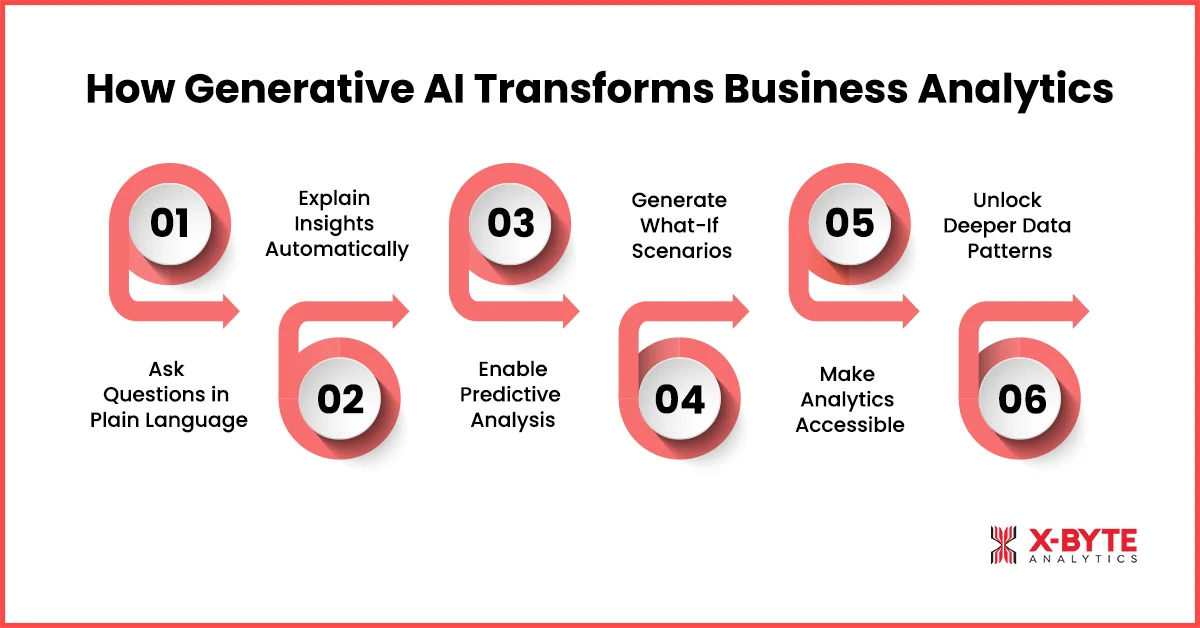
1. Asking Questions in Plain Business Language
With Generative AI in business intelligence and analytics, teams no longer need SQL, formulas, or technical dashboards. Leaders ask questions like:
- Why did sales drop in the Northeast last month?
- Which products are at risk next quarter?
Generative AI understands the intent, analyzes the underlying data, and delivers clear, business-ready explanations. This is a core shift in AI-driven business intelligence, and this is why 85% of business leaders expect to use generative AI for data analytics related tasks.
2. Automatically Explaining Insights, Not just showing them
Traditional analytics tools display charts and numbers and leave interpretation to the user. Generative AI analytics explains what the data actually means.
It highlights trends, anomalies, and correlations in simple language, helping teams quickly understand what’s changing and why. These AI-powered BI insights dramatically reduce interpretation time and improve alignment across stakeholders.
3. Supporting Predictive and Forward-Looking Analysis
Business analytics is no longer limited to historical reporting. With GenAI in Business Intelligence, models analyze past and current data to forecast outcomes, surface risks, and suggest possible next steps.
This clearly shows the difference between traditional BI and generative BI; one focuses on reporting what happened, while the other actively supports future-focused decision-making.
4. Generating Scenarios and What-if Analysis
Generative AI allows teams explore scenarios without rebuilding models or dashboards. Leaders can ask how pricing changes, demand fluctuations, or cost increases might impact revenue or margins.
This makes analytics more flexible and practical, faster to use, and far more practical, especially in fast-moving and complex business environments.
5. Making Analytics Accessible Across Teams
One of the biggest impacts of AI-driven business intelligence is accessibility. Finance, operations, sales, and leadership teams all use the same data without relying heavily on analysts.
This shared understanding plays a key role in the future of Power BI with generative AI, where insights flow directly to decision-makers instead of being trapped in technical layers.
6. Drives Richer Analytics Insights with Deeper Pattern Recognition
Generative AI models can analyze massive datasets to uncover patterns, anomalies, and relationships that would take human analysts significantly longer to detect.
This deeper pattern recognition improves predictive accuracy and supports proactive decision-making. It fundamentally changes how insights are extracted from complex data environments.
Supercharge Your Generative AI Service With X-Byte Analytics And Turn Data Into Powerful Business Insights.
Traditional BI vs Generative BI
At first glance, traditional Business Intelligence and Generative BI can look similar. Both work with the same underlying data, both aim to support better decisions, and both promise insights. The difference becomes clear only when teams start using them in real-world scenarios.
The comparison below breaks down how this shift shows up across day-to-day usage, decision-making speed, and overall business impact.
| Dimension | Traditional BI | Generative BI |
| Primary objective | Monitor performance and report historical outcomes | Generate insights, explanations, and recommended actions |
| Core approach | Predefined dashboards and structured reports | Conversational analysis powered by Generative AI analytics |
| Data interaction | Users explore data through filters and visualizations | Users ask questions in natural language and receive contextual answers |
| Insight creation | Analysts design metrics, queries, and dashboards | AI generates insights dynamically based on user intent |
| Dependency on analysts | High dependency for report creation and updates | Reduced dependency; business users access insights directly |
| Speed of insights | Slower due to data prep, reporting, and review cycles | Faster, near real-time AI-powered BI insights |
| Type of insights | Descriptive and diagnostic (what happened, why it happened) | Descriptive, predictive, and exploratory (what’s next, what to do) |
| Flexibility | Limited to predefined KPIs and data models | Highly flexible with follow-up questions and scenario exploration |
| Decision support | Indirect—requires interpretation by users | Direct—supports immediate, informed decisions |
| User experience | Technical and analyst-centric | Intuitive and business-centric |
| Handling complexity | Struggles as data volume and sources increase | Scales well by summarizing and contextualizing complex data |
| Learning curve | Steep for non-technical users | Low barrier to entry across teams |
| Role in strategy | Reporting and performance tracking | Strategic enablement through AI-driven business intelligence |
| Business value | Visibility into past performance | Continuous decision support and insight generation |
| Long-term relevance | Stable but limited in fast-moving environments | Central to the future of BI with gen AI |
How GenAI Improves Business Outcomes
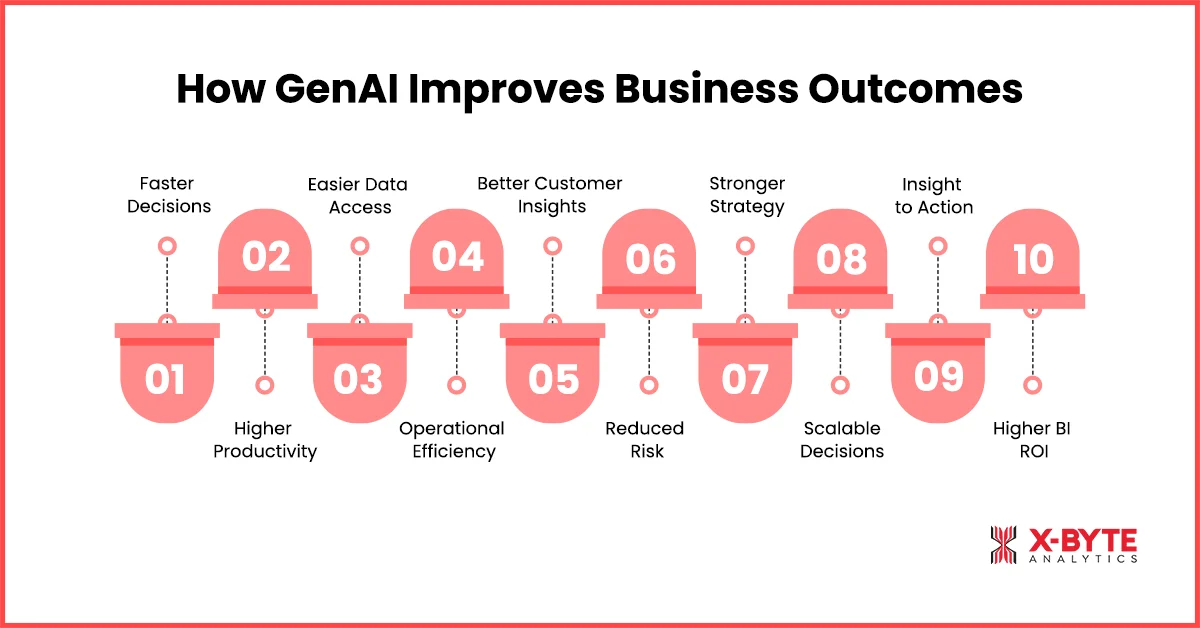
1. Speeds Up Decision-Making, Along with Quality
GenAI helps organisations move beyond static reporting to real-time, context-aware analysis, enabling faster and more accurate decisions.
According to industry research, around 65% of organisations report improved decision quality when AI-augmented analytics helps surface trends and anomalies that humans might overlook. This shows that AI doesn’t just speed things up; it improves the quality of decisions.
Why it matters: When decisions happen faster and are backed by data you can trust, teams avoid costly delays and respond to market shifts more confidently.
2. Higher Productivity and Streamlined Workflows
Generative AI reduces repetitive tasks across analytics, reporting, and modeling, freeing up time for strategic work. Reports suggest workers using GenAI save 2–4+ hours per week by automating tasks like content drafting, data interpretation, and routine analysis.
Why it matters: Those reclaimed hours let teams focus on high-impact work, like strategy, innovation, and planning, rather than manual data wrangling.
3. Simplifies Data Access Across the Organization
GenAI breaks down the technical barriers that used to limit insight generation to analysts or specialists. Instead of teams waiting on BI experts to prepare reports or queries, business users can ask questions directly and get meaningful answers.
Why leaders care: Executives no longer hear excuses like we need a data expert to interpret this. Teams become more self-sufficient, collaboration improves, and decisions don’t bottleneck around a single person or department.
4. Improves Operational Efficiency and Cost Optimization
GenAI doesn’t just generate insights; it highlights inefficiencies and operational gaps that might be hard to detect with traditional analytics alone. Whether it’s inventory waste, process delays, or resource allocation issues, AI-powered analysis brings them to the surface.
Why managers care: When you can spot inefficiencies early, you save money, simplify processes, and streamline operations, which directly boosts margins and frees up budget for strategic growth.
5. Strengthens Customer Understanding and Experience
GenAI analyzes customer behavior, feedback, and engagement trends deeper and faster than traditional models. It can help segment audiences, uncover preferences, and predict what customers are most likely to do next.
Why owners care: Better customer insights lead to smarter product decisions, more effective marketing, and higher retention. Companies that understand their customers grow faster and build stronger lifelong value.
6. Reduces Risk and Improves Decision Confidence
GenAI helps leaders see risks earlier by continuously scanning data for anomalies, shifts, and early warning signals. Instead of relying on gut instinct or delayed reports, decision-makers act with clearer evidence and context.
Why leaders care: Fewer surprises mean fewer costly mistakes. When decisions feel backed by data, not assumptions, leaders gain confidence, boards gain trust, and businesses stay resilient in uncertain markets.
7. Improves Strategic Planning and Long-Term Visibility
GenAI supports scenario analysis and forward-looking insights, helping businesses understand how today’s decisions may impact future performance. Leaders can explore what-if situations without rebuilding models or waiting weeks for analysis.
Why owners care: Better visibility into the future leads to smarter investments, controlled expansion, and sustainable growth. Strategy stops being reactive and starts becoming intentional.
8. Scales Decision-Making as the Business Grows
As companies scale, decision complexity increases. GenAI helps maintain clarity by handling larger data volumes and more variables without slowing teams down.
Why managers care: Growth doesn’t mean chaos. GenAI ensures teams make consistent, informed decisions even as operations, markets, and data sources expand.
9. Strengthens Execution by Linking Insight to Action
GenAI doesn’t stop at explaining performance; it helps teams understand what actions align with current data. This shortens the gap between analysis and execution.
Why managers care: Plans don’t stall in meetings. Teams move from discussion to execution faster, with fewer follow-ups and less rework.
10. Increases ROI from existing BI and data investments
Most enterprises already invest heavily in data infrastructure and BI tools. GenAI sits on top of these systems, unlocking more value without requiring a complete overhaul.
Why owners care: Better outcomes without rebuilding systems mean faster ROI, lower risk, and smarter use of existing investments.
Best GenAI Tools for Business Intelligence (2026)
As Generative AI reshapes how organizations interact with data, Business Intelligence platforms are evolving from static reporting tools into intelligent decision-support systems. The best GenAI BI tools in 2026 don’t just visualize data—they explain it, contextualize it, and help leaders act on it.
Here are the leading platforms driving this shift.
1. ThoughtSpot (Sage / Spotter)
ThoughtSpot is one of the real-world examples of Generative AI in business intelligence, being used the way it was intended by business users, in real time, without heavy dashboards.
Instead of building reports, users ask questions in plain language. The platform responds with visual answers, written explanations, and follow-up insights.
Why does it lead GenAI BI in 2026
- Conversational analytics is the primary interface
- AI automatically explains trends, outliers, and drivers
- Strong fit for enterprise decision-making, not just analysis
2. Microsoft Power BI with Copilot
Power BI with Copilot brings Generative AI into one of the world’s most widely adopted BI platforms. Power BI remains BI-first, but Copilot pushes it closer to AI-driven business intelligence.
Copilot allows users to generate reports, summaries, and insights using natural language prompts and helps reduce manual effort and speed up insight discovery.
Where it fits best
- Enterprises already using Microsoft data ecosystems
- Teams that want GenAI assistance without replacing BI
- Use cases where explanation and summarisation matter
3. Snowflake Cortex
Snowflake Cortex brings Generative AI analytics directly into the data layer. Instead of exporting data to separate AI tools, enterprises run GenAI models securely on governed enterprise data.
This makes Cortex powerful for organisations that want AI-powered BI insights without compromising control or governance.
Why Cortex matters for GenAI BI
- GenAI works directly on enterprise data
- Supports AI-driven querying, summarisation, and insight generation
- Ideal for large-scale, data-heavy environments
4. Databricks (Lakehouse AI/GenAI Stack)
Databricks enables enterprises to build custom GenAI-powered BI experiences rather than relying only on out-of-the-box dashboards.
Using its GenAI stack, teams can create AI-assisted analytics workflows that explain data, generate insights, and support decision-making at scale.
Why Databricks stands out
- Strong support for advanced Generative AI analytics
- Ideal for complex data and large organisations
- Enables tailored GenAI BI solutions for specific business needs
5. IBM Cognos Analytics with Watsonx
IBM Cognos combines enterprise-grade BI with AI-driven business intelligence, using Watsonx to generate explanations, insights, and guided analysis.
Rather than asking users to interpret charts, Cognos uses GenAI to explain performance drivers and surface insights in business language, while maintaining strict governance.
Why enterprises choose it
- Strong governance, security, and explainability
- AI-generated narratives for metrics and trends
- Designed for large, regulated organizations
6. Tableau (Pulse & GenAI features)
Tableau is evolving from visualization-led BI to insight-led BI. Its GenAI capabilities focus on automatically explaining what’s happening in the data and why it matters. Instead of asking users to explore endlessly, Tableau Pulse pushes AI-generated insights, summaries, and alerts.
Why it matters for GenAI BI
- AI explains insights, not just visuals
- Proactive insight delivery
- Strong bridge between traditional BI and Generative AI analytics
Challenges & Considerations When Adopting GenAI for Business Intelligence
While Generative AI in business intelligence offers clear advantages, adoption isn’t plug-and-play and comes with its own set of challenges. Understanding these challenges early helps avoid inflated expectations and ensures GenAI actually improves decision-making.
Here are the key challenges and considerations business leaders should evaluate:
1. Data Quality and Consistency Still Matter
GenAI can explain, summarize, and generate insights, but it can’t fix broken data foundations. Inconsistent definitions, missing data, or poorly governed sources can lead to misleading AI-powered BI insights.
What to consider: Before scaling generative AI business intelligence, ensure core metrics, data sources, and governance rules are clearly defined and trustworthy.
2. Trust and Explainability in Decision-Making
Leaders won’t act on insights they don’t understand. If GenAI produces answers without context or transparency, teams may question accuracy, especially in high-stakes decisions.
What to consider: Choose platforms that explain why an insight surfaced, not just what it says. Explainability is critical for AI-driven business intelligence to gain adoption.
3. Over-Reliance on AI-Generated Outputs
GenAI supports decisions, but it shouldn’t replace human judgment. Blindly following AI recommendations can introduce risk, especially when they do not reflect context or external factors in the data.
What to consider: Position GenAI in Business Intelligence as a decision assistant, not a decision-maker. Human oversight remains essential.
4. Change Management and Adoption Resistance
Even intuitive GenAI tools change how teams interact with data. Some users may resist shifting away from familiar dashboards and reports.
What to consider: Start with high-impact use cases and leadership adoption. When teams see real value, adoption follows naturally without forcing change.
5. Security, Privacy, and Governance Concerns
Enterprises must ensure GenAI models don’t expose sensitive data or violate compliance standards, especially in regulated industries.
What to consider: Look for GenAI BI tools that support enterprise-grade governance, access controls, and secure data handling across workflows.
6. Managing Expectations Around Intelligence
GenAI doesn’t automatically understand business nuance. It learns from patterns in data, not strategy, culture, or market intuition.
What to consider: Set realistic expectations. The real value of Generative AI analytics lies in speed, clarity, and exploration, not perfect answers.
The Future of Business Intelligence with GenAI
Business Intelligence is at the start of a much bigger shift than most teams realize. What we see today is only the early stage. As Generative AI in business intelligence continues to evolve, BI will change in ways that go far beyond faster insights or easier dashboards.
The future isn’t about doing the same analytics work more efficiently. It’s about changing how decisions themselves get formed.
Here’s what is likely to unfold next:
1. BI will move ahead of decisions, not react to them: Instead of responding to questions after something changes, BI systems will anticipate decision moments. GenAI in Business Intelligence will highlight potential outcomes and trade-offs before leaders commit to a direction.
2. Decisions will become guided, not just informed: Future BI won’t stop at explaining data. AI-driven business intelligence will help leaders understand consequences, compare options, and see second-order effects, while still leaving the final call to humans.
3. Dashboards will fade into the background: In the future, teams won’t open BI tools to check numbers. Generative AI analytics will surface insights inside planning sessions, reviews, and workflows, right where decisions happen.
4. Strategy will shift from fixed plans to living decisions: Long-term plans will evolve continuously. Generative AI business intelligence will support ongoing scenario exploration, helping teams adapt strategy as markets, costs, and demand shift.
5. BI will start shaping organizational thinking: Over time, BI won’t just answer questions; it will influence how teams frame problems. AI-powered BI insights will encourage clearer trade-offs and sharper prioritization.
6. Trust in BI will grow through consistency: As GenAI systems mature, they will deliver more stable, explainable insights. This consistency will make BI a trusted input for high-stakes decisions, not just operational reviews.
Final Thoughts
By now, one thing should feel clear: Business Intelligence is moving toward clarity, speed, and better decisions, not more complexity. GenAI is simply helping BI do what it was always meant to do: support real business choices at the right time.
The future doesn’t demand a complete overhaul of your existing systems. It starts with using data more thoughtfully, asking the right questions, and letting intelligence guide decisions instead of slowing them down.
At X-Byte Analytics, this is exactly how we approach BI and GenAI. We focus on making intelligence practical, whether through generative AI consulting services, generative AI integration, or strengthening business intelligence services that businesses already rely on.
The goal is to keep things simple, stay focused on outcomes, and make better decisions consistently.