
Key Highlights:
- Generative AI automation in data and analytics shifts enterprises from manual, report-driven workflows to AI-generated, real-time insights that accelerate decision-making and reduce analyst dependency.
- Successful implementation is not about adopting new tools first; it starts with a strong data foundation, clearly prioritized business use cases, and governance frameworks built for enterprise scale.
- Leading organizations are using generative AI to compress insight cycles, improve forecasting accuracy, strengthen cost control, and build decision-speed infrastructure that compounds into long-term competitive advantage.
According to the New York Times, data scientists spend 50% to 80% of their time collecting and preparing data before any real analysis even begins.
Not finding insights. Not influencing decisions. Not doing the work that actually moves the business forward.
Here’s what makes this harder to ignore: while your team is buried in that cycle, some of the leading companies aren’t standing still.
- JPMorgan has already deployed AI system that automates thousands of hours of financial data analysis annually.
- Amazon uses generative AI to synthesize operational data across its entire supply chain in real time.
- Google, Microsoft, and Salesforce have restructured their entire analytics functions around AI-first workflows.
While AI-first enterprises are shrinking insight cycles to minutes, many teams are still moving at reporting speed.
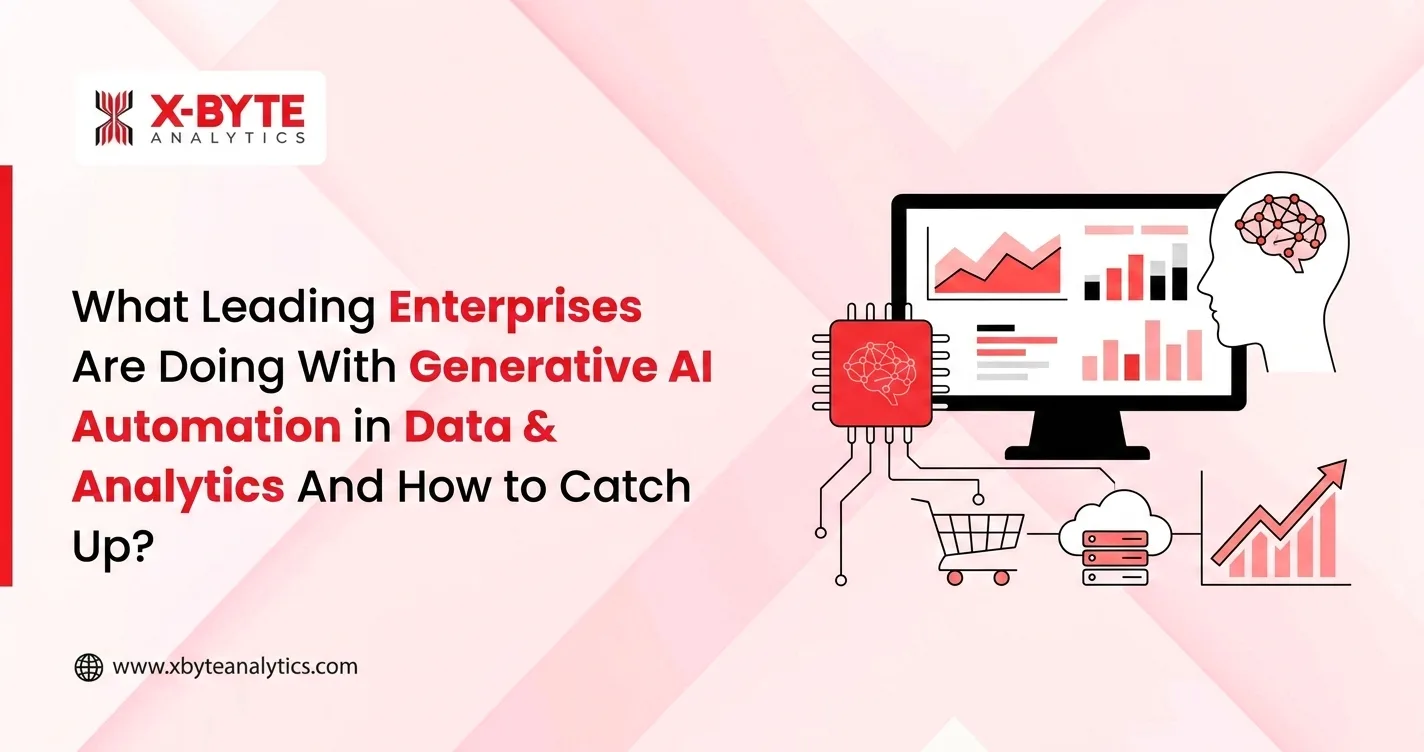
That’s where Generative AI Automation in Data and Analytics becomes a strategic shift.
- Less manual reporting.
- Less dependency on analyst queues.
- More intelligent, immediate decision support.
The future of data analytics automation isn’t about building more dashboards.
It’s about building systems that think, interpret, and deliver insights automatically, at enterprise scale.
This blog breaks down the high-value opportunities of generative AI automation in enterprise analytics, how to implement generative AI automation in data and analytics, and beyond. Let’s get into it.
What Is Generative AI Automation in Data & Analytics?
Generative AI Automation in Data and Analytics is the evolution of enterprise analytics from query-based reporting to AI-driven insight generation.
Traditionally, analytics teams pull data, clean it, build models, create dashboards, and then interpret results. Generative AI changes that workflow. It can automatically prepare data, generate analytical narratives, surface anomalies, simulate scenarios, and recommend actions, all within governed enterprise environments.
Similarly, Thomas H. Davenport has emphasized that AI’s real business value comes when it augments human decision-making rather than replacing it. Generative AI automation does exactly that: it reduces operational analytics work while elevating strategic interpretation.
In essence, intelligent data automation allows your analytics function to move:
- From delayed reporting → real-time decision support
- From manual → automated
- From descriptive → predictive, and prescriptive
Why Generative AI Automation Matters for Enterprises?
Generative AI automation is not just another analytics upgrade. It represents a fundamental shift in how enterprises generate, interpret, and act on data. Instead of waiting for reports, leaders receive continuous, AI-generated insights that support faster and more confident decision-making.
Here’s why it matters at an enterprise level:
- Faster decisions, fewer delays: When automated data insights are generated continuously rather than on a reporting cycle, business leaders stop waiting for the monthly review to find out something went wrong three weeks ago. They know now. They act now.
- The business stops depending on analysts for every data question: Natural language interfaces mean a CFO, a regional director, or a supply chain lead can get real answers from real data without involving a data analyst. It means faster and real-time decisions.
- You catch problems before they become expensive: Generative AI for business analytics doesn’t just report what happened; it continuously monitors, flags anomalies early, and explains their likely meaning. That shift from reactive to proactive intelligence has a direct impact on risk, cost, and operational performance.
- Higher analytics productivity without increasing headcount: Enterprise AI automation handles repetitive processes like data cleaning, summarization, and first-level interpretation. This allows analytics teams to focus on predictive modeling, scenario planning, and performance optimization, the work that drives business outcomes, without the added cost.
- Sustainable competitive advantage: The future of generative AI in data analytics automation belongs to enterprises that operate at decision speed. Faster insights mean faster pivots, faster optimizations, and faster strategic execution, which directly translates into market advantage.
- Revenue growth through intelligent opportunity detection: Generative AI for business analytics identifies hidden revenue drivers, customer behavior shifts, pricing inefficiencies, upsell opportunities, churn signals, and demand fluctuations, before they appear in static reports.
- Stronger margin and cost control: Intelligent data automation continuously monitors cost structures, procurement trends, operational inefficiencies, and performance deviations. Early anomaly detection prevents small issues from becoming profit erosion.
- Improved cross-functional execution: AI automation for enterprise analytics creates a unified layer of insight across finance, operations, supply chain, marketing, and strategy teams. Everyone works from consistent, AI-generated intelligence rather than disconnected reports.
Enterprises adopting generative AI automation are not just improving efficiency, they are accelerating decision speed. Continuous, AI-driven insights replace delayed reporting and manual analysis. Over time, this creates a compounding advantage: faster decisions, smarter execution, and stronger competitive positioning.
Ready to Move From Manual Analytics to AI-Driven Intelligence That Delivers Real-Time, Actionable Business Insights?
Key Opportunities of Generative AI Automation in Enterprise Analytics
Generative AI automation becomes truly valuable when applied to practical, high-impact enterprise use cases. It moves beyond experimentation and embeds intelligence directly into daily workflows. From conversational BI to predictive automation, these opportunities redefine how enterprises generate, interpret, and act on data at scale.
Below are the key opportunities of Generative AI automation in enterprise analytics:
1. Conversational Business Intelligence
This is where Generative AI Automation in Data and Analytics becomes practical.
Instead of waiting for analysts to pull reports, leaders simply ask questions in plain language and get contextual answers backed by governed enterprise data.
- Why did revenue drop 4% in the West region?
- Which customer segment improved margins last quarter?
- What’s driving churn this month?
With AI automation in data analytics, the system doesn’t just show charts. It explains drivers, compares periods, and highlights risk areas automatically. That’s generative AI for data analytics in action, reducing query cycles from days to seconds.
In our experience working with enterprise BI teams, conversational analytics typically reduces routine analyst requests by 40 to 60% within the first six months, freeing up significant capacity without a single additional hire.
2. Automated Insight Generation
Traditional dashboards show metrics. Generative AI analytics automation explains them.
Instead of manually reviewing 25 KPIs, enterprise AI automation can:
- Detect a 6% spike in logistics cost
- Connect it to fuel price increases and route inefficiencies
- Recommend vendor renegotiation or route optimization
This is automated data insights with AI, not just numbers, but context + next steps. It reduces analysis time and increases action speed.
3. Intelligent Data Preparation & Engineering
Data scientists often spend 50–80% of their time cleaning data. That’s operational drag.
With intelligent data automation, AI can:
- Auto-clean missing values
- Standardize formats across business units
- Merge CRM, ERP, and supply chain datasets
- Flag inconsistent data before reporting
Instead of spending 3 days preparing quarterly reports, teams can shift that time toward forecasting and optimization. This is where AI automation for enterprise analytics improves productivity without increasing headcount.
4. AI-Powered Executive Dashboards
Static dashboards show what happened. AI-powered dashboards explain why and what’s next.
Using generative AI use cases in analytics, executives can see:
- Revenue down 3% → driven by pricing changes in two product categories
- Customer acquisition cost up 8% → tied to channel mix shift
- Inventory turnover improving 12% → due to demand pattern adjustments
This is the future of data analytics automation, summarized intelligence, not manual interpretation.
5. Predictive & Prescriptive Analytics Automation
Enterprise already forecast. Generative AI makes forecasting continuous and adaptive.
With generative AI automation in data and analytics, systems can:
- Predict demand fluctuations weeks in advance
- Simulate pricing strategies before rollout
- Flag 5–7% potential revenue leakage early
- Recommend corrective actions automatically
It’s no longer What happened? It’s what will happen, and also get real-time recommendations on what you should know to better prepare for the future. That shift improves revenue planning and reduces strategic blind spots.
6. AI Agents for Data Workflows
Think of AI agents as digital analytics assistants. Instead of analysts manually running weekly tasks, enterprise AI automation can deploy AI agents to:
- Refresh models automatically
Monitor KPIs in real time - Trigger alerts when thresholds shift
- Generate executive summaries every Monday morning
For example, if gross margin drops 2%, the agent can instantly:
- Identify affected SKUs
- Highlight cost drivers
- Notify relevant stakeholders
That’s intelligent, automated workflow orchestration, not just analytics support.
How to Implement Generative AI Automation in an Enterprise?
We’ve worked with enterprise data functions across industries long enough to know one thing with certainty: the organizations that struggle with generative AI implementation aren’t struggling because the technology doesn’t work. They’re struggling because they didn’t build the right foundation before they started.
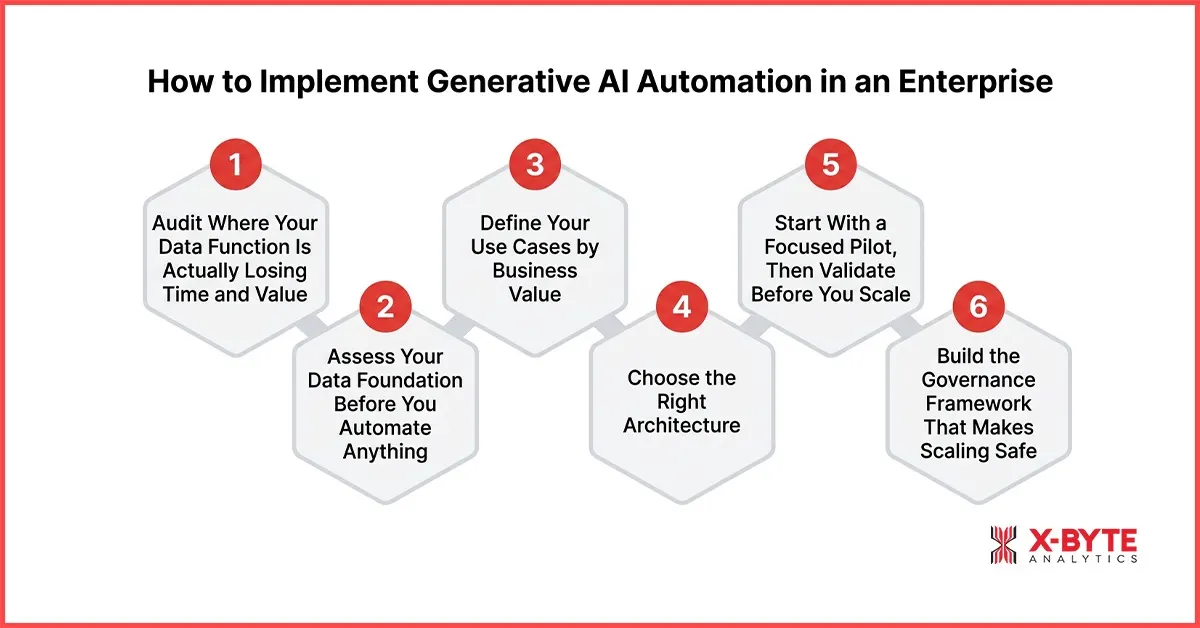
Here’s how to do it right.
Step 1: Audit Where Your Data Function Is Actually Losing Time and Value
Before you touch a single tool or talk to a single vendor, get ruthlessly honest about where your current analytics function is breaking down.
Map your existing workflows end-to-end.
- Where are the bottlenecks?
- Where is skilled time being spent on work that shouldn’t?
- Where are business stakeholders waiting longest?
- Where are decisions being made without adequate data?
It’s the foundation of your entire implementation strategy.
Quick Tip: Don’t rely solely on process documentation for this audit. Sit with your analysts for a week and watch where their time actually goes. What gets documented and what actually happens are often very different, and implementation strategies built on the wrong picture of reality fail fast.
Step 2: Assess Your Data Foundation Before You Automate Anything
This is the step many enterprises try to skip. It’s also the step that determines success.
If your data pipelines are inconsistent, your metadata is incomplete, your governance frameworks are underdeveloped, or your data is siloed across systems, automated data insights built on that foundation will be fast, confident, and wrong.
Before moving forward, assess:
- Data quality: Is your data accurate, consistent, and complete enough to trust at scale?
- Data accessibility: Can AI systems reach the data they need, or is it locked in legacy systems and disconnected silos?
- Governance and lineage: Do you have clear ownership, documentation, and audit trails for your critical data assets?
- Security and compliance: Are your data handling practices ready for the additional exposure surface that AI integration introduces?
X-Byte Expert Tip: We run a focused data readiness assessment before scoping any AI automation initiative. It typically takes two to three weeks and saves months of rework downstream. The organizations that skip this step almost always come back to it at a much higher cost. – Jay Bagthariya, SR. Business Development Manager
Step 3: Define Your Use Cases by Business Value
One of the most common mistakes we see in enterprise AI automation initiatives is letting technical teams drive use case selection. The result is implementations that are impressive in a demo and irrelevant to the business.
Use case selection should be driven by business impact.
Rank use cases across two dimensions:
- the value they would deliver to the business if automated,
- and the complexity of implementing them, given your current data and technology landscape.
Start with the ones having high priority and low complexity, then move forward accordingly.
Quick Tip: We recommend starting with one or two use cases that have a visible, quantifiable impact on a business process that senior stakeholders actually care about.
Step 4: Choose the Right Architecture
This decision has more long-term strategic consequences than most enterprise leaders give it credit for.
- Building a generative AI automation capability from scratch, training your own models, and building your own infrastructure is rarely the right answer for enterprise analytics functions. The cost is prohibitive, the timeline is too long, and the core models you’d be building are already available.
- Buying an off-the-shelf solution has the opposite problem. Pre-built platforms can move fast, but they often lack the flexibility to work with your specific data architecture, domain context, and proprietary workflows.
For most enterprises, the right answer is a hybrid model:
- Leverage foundation models and enterprise AI platforms such as Google Vertex AI, Microsoft Azure OpenAI, AWS Bedrock, or specialized analytics AI platforms as your base layer
- Build your differentiation on top through fine-tuning on proprietary data, custom workflow integration, and domain-specific prompt engineering
- Integrate with your existing data stack rather than building parallel infrastructure
Building from scratch is rarely right, the cost is prohibitive and the timeline too long. Buying off the shelf often lacks the flexibility your specific environment requires.
For most enterprises, the right answer is a hybrid model:
- Leverage foundation model platforms , Google Vertex AI, Microsoft Azure OpenAI, AWS Bedrock as your base layer
- Build differentiation on top through fine-tuning on proprietary data and domain-specific workflows
- Integrate with your existing data stack, Snowflake, Databricks, Microsoft Fabric, BigQuery rather than building parallel infrastructure
Step 5: Start With a Focused Pilot, Then Validate Before You Scale
Resist the temptation to roll out broadly before you’ve validated. A focused pilot on one high-value use case with a defined business unit gives you something far more valuable than a wide deployment: proof that it works in your environment, with your data, for your users.
A well-structured pilot should:
- Run for eight to twelve weeks, long enough to generate meaningful data.
- Have clearly defined success metrics agreed upon before it starts
- Involve end users from day one
- Include a structured feedback loop that captures both quantitative performance data and qualitative user experience insights
Step 6: Build the Governance Framework That Makes Scaling Safe
Generative AI automation at enterprise scale introduces risks that don’t exist at pilot scale. Outputs reach more people. Decisions are influenced more broadly. The consequences of errors, biases, or hallucinations become more significant.
A robust AI governance framework for enterprise analytics should cover:
- Output validation: What review processes exist before AI-generated insights reach decision-makers?
- Explainability standards: Can the system explain why it produced a given output in terms that business users and auditors can evaluate?
- Bias monitoring: How are you detecting and mitigating bias in AI-generated analysis, particularly where it could affect business decisions?
- Data privacy and security: How is sensitive data handled within AI workflows, and what are your controls around model inputs and outputs?
- Audit trails: Can you trace every AI-generated insight back to its source data and the logic that produced it?
- Human escalation protocols: At what point in an automated workflow does a human need to review, approve, or override an AI output?
X-Byte Expert Tip: Governance frameworks built after the fact are always more expensive and disruptive than those built in.
Transform Your Enterprise’s Data Analytics with Generative AI to Drive Faster, Smarter Decisions.
How X-Byte Analytics Enables Generative AI Automation?
At X-Byte Analytics, we don’t start with AI tools. We start with your data reality.
We help you assess where your analytics function stands, data quality, architecture, reporting bottlenecks, governance gaps, and then identify practical areas where generative AI analytics automation can create measurable business impact.
Our role is to simplify adoption.
- We align AI automation in data analytics with your existing systems instead of disrupting them.
- We prioritize high-value use cases first while ensuring governance and compliance
- We design workflows that reduce manual effort while improving decision speed.
Through our data analytics consulting services and generative AI consulting service, we help enterprises move step by step, from structured data foundations to scalable enterprise AI automation.
Because successful adoption isn’t about experimenting with AI.
It’s about embedding it into your analytics ecosystem in a way that improves revenue visibility, strengthens cost control, and accelerates strategic decision-making in a practical, sustainable way.
Conclusion
Generative AI Automation in Data and Analytics isn’t just another technology shift. It’s a shift in how enterprises operate, decide, and grow.
The real advantage doesn’t come from having more dashboards or more data. It comes from reducing friction between information and action. When insights are generated automatically, explained clearly, and delivered at the right time, decision-making becomes faster, more confident, and more aligned with business goals.
That’s the direction enterprise analytics is moving toward: intelligent, automated, and continuously evolving.
If you’re exploring how to make that shift practical within your organization, the team at X-Byte Analytics works closely with enterprises to simplify the journey. From strengthening data foundations to implementing generative AI consulting service strategies, the focus is always on measurable business outcomes, not experimentation for the sake of innovation.
Because in the end, the goal isn’t just adopting AI.It’s building an analytics ecosystem that consistently supports smarter, faster, and more scalable decisions. Get on a call with our data experts, today.