

Quick Summary
- You’ll learn why enterprise data management has become a critical business priority and how the right data strategies improve decision-making, efficiency, and competitive advantage.
- You’ll understand why rapidly growing data volumes require modern, scalable data management solutions that can handle complexity, governance, and performance at scale.
- You’ll explore what enterprise data management really means and discover the seven emerging trends shaping how organizations manage, govern, and use data effectively.
What Is Enterprise Data Management?
Enterprise data management refers to the end-to-end process of collecting, storing, organizing, governing, and securing data across an organization so it remains accurate, accessible, and trustworthy throughout its lifecycle.
Unlike basic data handling, enterprise-level data management focuses on scale, governance, and cross-functional usability. It enables organizations to manage both structured data (databases, ERP systems) and unstructured data (documents, logs, IoT data) under a unified framework.
A well-designed enterprise data management framework helps businesses:
- Use data confidently for analytics and forecasting
- Eliminate duplication and data silos
- Maintain regulatory compliance through governance controls
- Enable collaboration across departments
- Support advanced enterprise analytics platforms
At its core, enterprise data management transforms raw data into a reliable, decision-ready business asset.
Discover The Top Trends Shaping Data Management Success Today.
Importance of Enterprise Data Management for Business Success
Data fuels modern business operations, but without structure, quality, and governance, it quickly becomes a liability. Enterprises that invest in data management solutions for enterprises gain visibility, consistency, and control across their data ecosystem.
Strong enterprise data management enables organizations to:
- Make data-driven decisions instead of relying on intuition
- Improve operational performance through automation and analytics
- Enhance customer experience with unified data insights
- Reduce compliance risk using governed data processes
- Increase productivity by enabling self-service analytics
In real-world enterprise environments, poor data quality often leads to inaccurate reporting, duplicated work, and slow decision-making. A unified enterprise data governance approach ensures data is standardized, trusted, and accessible across business units.
Top 7 Emerging Trends in Data Management
These enterprise data management trends show how organizations are shifting toward intelligent, secure, and scalable data ecosystems. By combining AI automation, cloud platforms, data governance, blockchain, and self-service analytics, enterprises gain better data quality and real-time insights. Together, these trends enable faster decision-making, compliance, and sustainable business growth.
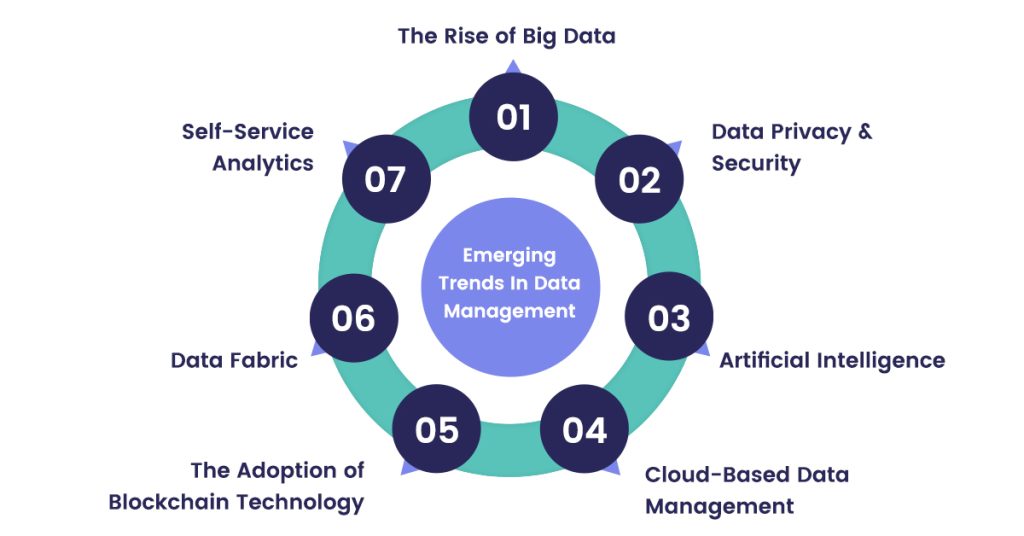
1. The Rise of Big Data Analytics at Enterprise Scale
Enterprises now manage massive volumes of data from digital channels, operational systems, sensors, and customer touchpoints. The challenge is no longer data collection-but insight generation.
Modern enterprise analytics platforms enable organizations to analyze real-time and historical data at scale. By integrating big data analytics into enterprise data management, businesses can identify trends, optimize processes, and uncover growth opportunities.
This trend reflects a shift toward insight-driven data architectures, where analytics is embedded directly into business workflows.
2. Heightened Focus on Data Privacy, Security & Governance
With stricter regulations and increasing cyber threats, enterprise data governance has become a critical pillar of data management.
Enterprises now implement:
- Data governance frameworks
- Encryption and access controls
- Policy-based data lifecycle management
- Audit trails and compliance reporting
For example, a global financial services firm managing customer data across regions must ensure compliance with multiple privacy regulations while maintaining consistent analytics. Enterprise data governance ensures regulatory alignment without slowing innovation.
3. Integration of AI & Machine Learning into Data Management
AI is reshaping how enterprises manage data. Instead of manual processes, organizations embed AI into data pipelines to automate data quality management, classification, and anomaly detection.
AI-driven enterprise data management enables:
- Automated data cleansing and deduplication
- Predictive analytics and forecasting
- Intelligent data cataloging
- Self-learning analytics systems
Real-world example:
A large retail enterprise uses AI-powered data management to automatically identify inconsistent product data across regions, improving pricing accuracy and inventory planning.
4. Cloud-Based and Hybrid Data Management Platforms
Cloud adoption continues to accelerate, driving demand for scalable data management solutions for enterprises. Most organizations now operate in hybrid environments, combining on-premises infrastructure with cloud platforms.
A modern enterprise data management strategy leverages cloud platforms for:
- Scalable storage and compute
- Real-time analytics
- Disaster recovery and backups
- Flexible data access across teams
Hybrid architectures allow enterprises to balance security, performance, and cost efficiency while supporting advanced analytics workloads.
5. Blockchain for Data Integrity and Trust
Blockchain is emerging as a powerful solution for ensuring data integrity in enterprise environments. Its immutable ledger structure provides a tamper-proof record of transactions and data changes.
Enterprises use blockchain-based data management for:
- Audit trails and compliance
- Supply chain transparency
- Financial transaction validation
- Secure cross-organization data sharing
This trend is particularly valuable in industries where data trust and traceability are critical.
6. Adoption of Data Fabric Architecture
Data fabric is gaining traction as enterprises struggle with fragmented data systems. A modern data management architecture based on data fabric unifies data access across platforms without physically moving data.
By leveraging metadata, automation, and governance policies, data fabric enables:
- Seamless enterprise-wide data access
- Consistent governance enforcement
- Scalable data integration
Data fabric supports enterprise agility by simplifying access to trusted data across complex environments.
7. Growth of Self-Service Analytics
Self-service analytics empowers business users to explore data independently without relying on IT teams. This trend accelerates insight generation and reduces reporting bottlenecks.
By combining self-service analytics with governed enterprise data management, organizations enable:
- Faster decision-making
- Improved collaboration
- Reduced analytics dependency on IT
This balance between accessibility and governance is key to data-driven decision-making at scale.
Real-World Enterprise Benefits from Data Management
Strong enterprise data management delivers measurable business impact by improving efficiency, decision quality, and customer experience at scale. Leading global organizations treat data as a governed, strategic asset, using enterprise data management frameworks to drive automation, compliance, and competitive advantage across operations. These benefits consistently prove that enterprise data management is a long-term business investment, not just a technical upgrade.
How Leading Enterprises Benefit
- Operational efficiency & automation: Amazon uses centralized enterprise data management to automate inventory planning, logistics optimization, and demand forecasting-reducing manual effort while improving delivery speed and cost efficiency.
- Faster, data-driven decision-making: Netflix relies on unified data platforms to analyze viewer behavior in real time, enabling faster content decisions, personalized recommendations, and higher customer retention.
- Compliance, cost control & customer experience: JPMorgan Chase leverages enterprise data governance and lifecycle management to meet regulatory requirements, reduce data redundancy, and deliver secure, personalized financial services at scale.
Common Data Management Mistakes in Large Organizations
Many enterprises struggle with data management not because of missing tools, but due to fragmented ownership, weak governance, and legacy decision-making models. From enterprise data management consulting experience, organizations that underperform often treat data management as an IT initiative instead of a business transformation, leading to recurring operational and strategic gaps. Addressing these mistakes early is critical to building scalable, trusted data ecosystems.
Most Common Enterprise Data Management Mistakes
- Operating with data silos: When departments manage data independently, insights remain fragmented and inconsistent. This limits enterprise-wide visibility and slows strategic decision-making.
- Ignoring data quality management: Inaccurate or inconsistent data leads to flawed analytics and poor business outcomes. Without ownership and validation rules, even advanced analytics lose credibility.
- Weak data governance frameworks: Lack of governance results in unclear access controls, compliance risks, and inconsistent reporting. Governance must be embedded, not enforced reactively.
- Over-reliance on legacy systems: Older platforms struggle to scale with modern data volumes and analytics demands. This restricts innovation and increases operational costs over time.
- Tool-first, strategy-last approach: Investing in platforms without a clear enterprise data management strategy leads to underutilized tools and misaligned outcomes.
- Limited executive sponsorship: Without leadership ownership, data initiatives stall at the departmental level. Successful enterprises align governance, funding, and accountability at the executive level.
From our enterprise data management consulting experience, organizations that achieve long-term success focus first on ownership, governance alignment, and scalable architecture, then select tools to support those goals. Enterprises that make this shift consistently outperform peers in agility, analytics maturity, and customer trust.
Partner With X-Byte Analytics To Harness The Full Potential Of Data Management Service And Drive Business Growth
Conclusion
As data volumes and complexity grow, enterprise data management has become essential for sustainable business success. Organizations that embrace modern data management architecture, AI automation, governance frameworks, and cloud platforms are better positioned to compete in a data-driven economy.
By aligning strategy, technology, and governance, enterprises can transform data into a trusted, high-value asset that fuels innovation and long-term growth. For organizations seeking expert guidance, enterprise data management services help design scalable architectures, governance models, and analytics frameworks tailored to enterprise needs.