
Key Highlights:
- GPT-4o Is Faster, Claude Is More Accurate. Independent research shows GPT-4o generates complex SQL queries 42.4% faster, but Claude outperforms it by 3.34% in table selection accuracy.
- Your Cloud Stack Should Drive the Decision. For enterprise AI analytics platforms built on Microsoft Azure, GPT-4o integrates natively. For teams running on AWS, Claude’s native Bedrock integration is the more practical and compliant choice.
- The choice depends on use case, not brand.GPT models typically lead in speed, structured outputs, tool integration, and real-time BI interactions. Claude excels in deeper reasoning, long-document analysis, and governance-sensitive enterprise workflows.
Every enterprise data team is asking the same question right now: between OpenAI’s GPT and Anthropic’s Claude, which one truly belongs in the analytics stack?
It’s not a simple question.
- Both models are highly capable.
- Both are backed by world-class research teams.
- Both are being positioned aggressively for enterprise adoption.
And yet, when you put them to work on real analytics tasks, writing production SQL, reading a 150-page financial filing, explaining an anomaly in your pipeline, or powering a self-service BI assistant, they behave very differently.
So, our team has researched our way out and found out that: Independent research shows that GPT-4o generates complex SQL queries 42% faster and handles very large databases, having over 1,000 tables more reliably.
Claude, on the other hand, is more accurate when working with the mid-sized databases that most companies actually use. It also produces better quality column descriptions and data documentation, and handles long, complex documents more effectively thanks to a significantly larger context window.
Neither model wins across the board. But each one has a clear home, a set of tasks where it genuinely outperforms the other. This guide maps that out, section by section, using real data.
If your team is trying to figure out which model belongs in your analytics stack, this is the guide that gives you a straight answer.
Overview of OpenAI in Data Analytics
OpenAI is currently one of the most widely adopted AI platforms in enterprise technology. It has become deeply embedded in modern analytics workflows and is used by 92% of Fortune 500 companies because of its mature API ecosystem, strong developer tooling, multimodal capabilities, and wide adoption across enterprise AI analytics platforms.
For data teams specifically, GPT-4o supports a wide range of day-to-day analytics tasks. It can:
- Generate production-grade SQL across major data warehouses
- Analyze datasets by executing Python-based workflows
- Create charts and summaries from natural language instructions
- Integrate with platforms such as Google Drive, Microsoft OneDrive, and the Microsoft Azure ecosystem
Enterprise adoption signals are strong. Usage of structured workflows within ChatGPT Enterprise has increased significantly year to date, indicating that organizations are moving beyond experimentation and embedding AI into repeatable, production-grade processes.
Where GPT earns its place most clearly is in environments that demand speed and scale. It processes outputs at 111 tokens per second, handles very large databases with over 1,000 tables more reliably than Claude, and generates complex SQL queries 42% faster.
The honest limitation: in niche industries, GPT sometimes struggles with sector-specific context and jargon, and its tendency to generate confident outputs means human oversight remains essential, especially for teams where a wrong assumption in the data carries real consequences.
Did you know that in early 2026, Snowflake signed a $200 million partnership to embed OpenAI models directly into its Cortex AI platform, so companies can query and act on their own data using plain English, without moving that data anywhere. Databricks followed with a $100 million deal, making GPT the flagship model for its 20,000+ enterprise customers.
Overview of Anthropic in Data Analytics
Anthropic has taken a quieter but more targeted path into enterprise, and the numbers reflect it. According to Menlo Ventures’ 2025 Mid-Year LLM Market Update, Claude now holds 32% of the enterprise AI market, overtaking OpenAI’s 25%, a dramatic reversal from OpenAI’s 50% share just one year earlier.
More then 6,000 enterprise applications now integrate with Claude, including Salesforce, Notion, and Slack, and 85% of Claude’s usage comes from professional and enterprise environments. Companies like Accenture have standardized on Claude at scale, with 30,000 employees trained on the platform as part of a landmark enterprise agreement.
- For data teams, Claude’s core advantage is context. Its 200,000-token window, roughly 500 pages of material, means it can read an entire data dictionary, a full dbt project, or a lengthy compliance document in one pass without losing coherence.
- In the 50 to 500 table range that most enterprise databases actually sit in, Claude outperforms GPT on schema accuracy by 3.34% and produces column descriptions that are over 6% more detailed and readable.
- Computer and mathematical tasks which include data analysis and coding make up 36% of all Claude activity, making it the most common professional use case on the platform.
The honest limitation: Claude is slower at 72 tokens per second versus GPT’s 111, and its third-party integration ecosystem while growing fast is not yet as deep as OpenAI’s across BI tools and analytics platforms.
Transform Your Enterprise Data Workflows With the Right AI Model and Implementation Strategy.
OpenAI vs. Anthropic: Core Differences in Data Analytics
When it comes to real analytics work, the differences between GPT-4o and Claude show up quickly. Here is how they compare across the tasks your data team actually performs:
1. Natural Language to SQL
| Capability | GPT | Claude |
| Overall SQL Accuracy | ~52.5% execution accuracy on BIRD benchmark | ~41% execution accuracy on BIRD benchmark |
| Large Schema Performance (1,000+ tables) | Stronger, better table and column selection at scale | Falls behind GPT at very large schema complexity |
| Mid-Size Schema Performance (50–500 tables) | Competitive | 3.34% higher table selection accuracy |
| Query Generation Speed | 42.4% faster on complex queries | Slower but more deliberate |
| When Unsure | Tends to make an assumption and proceed | Asks a clarifying question, safer for production |
Bottom line: GPT is the faster choice for large, complex databases. Claude is more accurate in the mid-size environments that most enterprise teams actually operate in.
2. BI & Dashboard Insights
| Capability | GPT | Claude |
| Executive Summaries | Strong, fast, concise KPI summaries | More detailed, explains the why behind the numbers |
| Multimodal Analysis | Processes charts, images, and text together natively | Text and documents only, no native audio |
| Dashboard Creation Accuracy | Generates quickly but can make confident assumptions | Also prone to hard-coding stats rather than querying live data |
| Real-Time BI Tools | Better fit, faster response times | Better fit for async, document-heavy reporting |
Bottom line: Neither model is fully reliable for autonomous dashboard creation yet. GPT is faster for live tools; Claude is better for deeper analytical reports.
3. Data Documentation & dbt Projects
Bottom line: Claude is the stronger choice for dbt documentation and large project work, but both models need structured guardrails to prevent hallucinations.
4. Large Schema & Metadata Analysis
| Capability | GPT | Claude |
| Context Window | 128,000 tokens (~96,000 words) | 200,000 tokens (~150,000 words) |
| Recall at Large Context | Degrades toward the end of the window | Maintains strong recall even near the top of the window |
| Schema Interpretation | Faster extraction and formatting | Deeper reasoning across relationships and dependencies |
| Best Fit | Structured metadata extraction at speed | Full schema reasoning across large, complex data environments |
Bottom line: If your team works with large documents, lengthy schemas, or complex governance files, Claude’s context advantage is real and practical.
5. Data Governance & Policy Review
Bottom line: For governance-sensitive environments, Claude’s cautious, step-by-step reasoning is a practical advantage over GPT’s tendency to summarize and move on.
6. Integration with Modern Data Stack
| Capability | GPT | Claude |
| Cloud Integration | Native on Microsoft Azure / Azure OpenAI | Native on AWS Bedrock and Google Cloud Vertex AI |
| Ecosystem Maturity | Larger third-party ecosystem, more pre-built connectors | Growing fast, Anthropic’s enterprise market share grew from 15% in mid-2024 to 35% by the end of 2025. |
| dbt Integration | Available | Claude Desktop is the recommended interface for dbt MCP |
| Best Fit | Teams on Microsoft / Azure stack | Teams on AWS or Google Cloud |
Bottom line: Your cloud stack is the most practical deciding factor here. GPT fits Azure environments; Claude fits AWS and GCP.
7. Structured Outputs & Production Reliability
| Capability | GPT | Claude |
| Structured JSON Output | Very consistent, widely used in production pipelines | Capable but optimized more for reasoning than rigid formatting |
| Output Length | 16,384 token output limit | 8,000 token output limit, can truncate on very long outputs |
| Response Speed | 111 tokens/second | 72 tokens/second |
| Model Stability | Frequent updates, GPT-4o was retired in Feb 2026 | More stable versioning and clearer deprecation policies |
Bottom line: GPT is faster and better for rigidly structured outputs. Claude is more stable long-term, important for teams that cannot afford to rebuild prompts every time a model is deprecated.
In simple terms, the GPT vs Claude enterprise comparison usually comes down to this:
- If your priority is automation, structured outputs, and embedding AI directly into tools, GPT is often preferred.
- If your priority is reviewing large datasets, interpreting complex logic, or working with long documentation, Claude often stands out.
Anthropic Claude vs OpenAI GPT Business Impact: Use Cases in Real Analytics Work
Benchmarks tell you how a model performs in a lab. Use cases tell you how it performs on a Tuesday afternoon when your team actually needs it. Here is where each model earns its place.
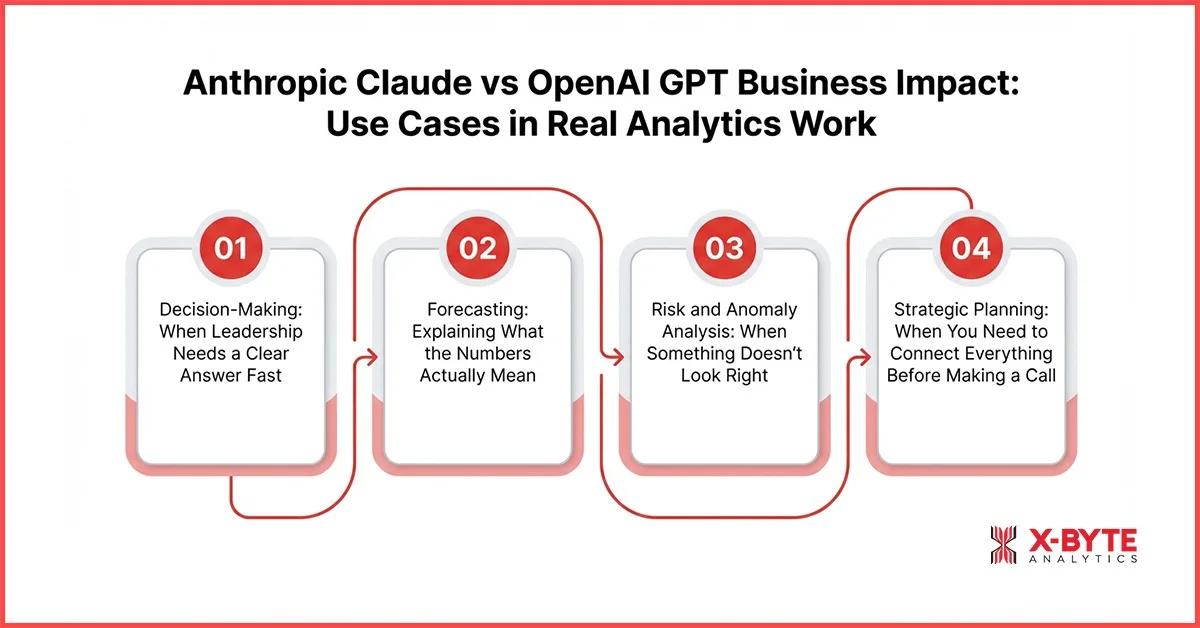
1. Decision-Making: When Leadership Needs a Clear Answer Fast
Every data team hits this moment. Something has shifted in the numbers, leadership wants to know what is going on, and you need to pull together a clear picture, fast.
This is where the two models behave very differently in practice.
GPT-4o is built for speed. It scans your data, picks out the key points, and formats a clean summary quickly. It is sharp at pulling headlines from data and presenting them in a way that is easy to read and act on.
Claude takes a different approach. In production systems, Claude is frequently chosen for reasoning-heavy steps where consistency, instruction-following, and reduced hallucination are critical. Claude thinks, not just the summarizing, and is less likely to give you a confident answer that turns out to be wrong.
The practical split: use GPT when you need something on the table fast. Use Claude when the decision carries real weight and a wrong call is costly.
2. Forecasting: Explaining What the Numbers Actually Mean
Projections are built by analysts but read by people who did not build them. Getting everyone aligned on what a forecast actually means and what could make it wrong is harder than it looks.
GPT-4o is good at translation. It takes a complex projection and turns it into plain language that non-technical stakeholders can read and trust. It structures the output cleanly, keeps it concise, and gets the key message across without overwhelming. For a forecast that just needs to be communicated clearly, GPT does the job well.
Claude is better when the forecast itself needs to be questioned. It is focused on safe reasoning, long-context understanding, and reliability, qualities that matter most when your team is using generative AI for enterprise analytics to inform decisions that carry real business weight. It does not just restate what the numbers say, it looks at the assumptions behind them, flags what could make the projection wrong, and explains the risks in plain terms.
The practical split: use GPT to present a forecast clearly. Use Claude when someone needs to pressure-test it.
3. Risk and Anomaly Analysis: When Something Doesn’t Look Right
A metric behaves unexpectedly. A number does not reconcile. Something looks off, and you need to figure out whether it is a real problem or a false alar,m and if it is real, where it started.
GPT moves quickly across large volumes of data, flags unusual patterns in a structured format, and gets you to a shortlist of potential issues fast. For teams that need to triage a lot of signals in a short time, GPT handles that volume well.
Claude is better at the investigation that follows. Its 200,000-token context window means it can read through a long audit trail, reason through what actually went wrong step by step, and surface the root cause rather than just the symptom, making it particularly strong in analytical reasoning and compliance-heavy environments.
The practical split: use GPT to spot the problem. Use Claude to find what caused it.
4. Strategic Planning: When You Need to Connect Everything Before Making a Call
Strategic planning is not about summarizing one dataset. It is about reading through a lot of material, performance reviews, market signals, operational data, past plans, and finding the thread that connects all of it into a clear direction.
GPT-4o is good at pulling together a clean brief. It synthesizes multiple inputs quickly, organizes them well, and produces something that leadership can read in no time.
Claude is better at analyzing very large material before concluding. Claude and GPT for data analytics serve different roles here, you can feed Claude your entire knowledge base, past plans, and supporting documents, and it will draw insights across all of it simultaneously. Claude does not skim, it reads everything and reasons across it, which shows in the output.
The practical split: use GPT when you need a quick brief ready. Use Claude when the decision is big enough to deserve the full picture.
Which Is Better for Enterprise Data Analytics?
There is no universal winner between GPT-4o and Claude the right choice depends on the workload. GPT-4o excels in large-scale, high-speed environments where multimodal workflows, Azure integration, and long, structured outputs are critical. Claude stands out in accuracy-sensitive settings that require deep document review, careful reasoning, and strong AWS Bedrock alignment. In practice, most enterprises strategically deploy both, routing tasks to the model best suited for each job.
Here is the honest split:
Choose GPT-4o if your team:
- Works with very large databases over 1,000 tables, where speed and schema navigation matter
- Needs real-time responses inside live BI tools or dashboards
- Runs on Microsoft Azure or needs tight integration with the Microsoft ecosystem
- Prioritizes multimodal analysis, charts, images, and text together in one workflow
- Needs longer structured outputs in a single pass, GPT’s 16,384 output token limit is double Claude’s
GPT’s strength is operational velocity. It is optimized for scale, responsiveness, and broad enterprise integration.
Choose Claude if your team:
- Works with mid-sized databases where accuracy matters more than speed
- Reads through long documents, governance files, audit trails, and financial reports before drawing conclusions
- Runs on AWS and wants native Bedrock integration with built-in compliance controls
- Needs reliable code generation, Claude scored 93.7% on coding benchmarks versus GPT-4o’s 90.2%
- Cannot afford confident wrong answers, Claude asks before assuming, GPT assumes and moves on
Claude’s advantage lies in deliberate reasoning, long-context comprehension, and risk-sensitive workflows.
The truth: 78% of enterprises now use more than one model, routing different tasks to different models based on what each does best. That is not indecision. That is the right call.
Ready to Deploy GPT or Claude Seamlessly Across Your Enterprise Data Ecosystem Today?
How X-Byte Analytics Helps You Choose & Implement the Right AI?
Choosing between GPT-4o and Claude is only half the decision. The harder part is making it work reliably inside your actual data environment, your warehouse, your pipelines, your governance requirements, your team’s workflows.
That is where many enterprise teams hit a wall. Not because they chose the wrong model, but because implementation is more complex than a comparison guide can cover.
X-Byte Analytics works with enterprise data teams at exactly this stage. We have helped organizations move from we think we want Claude or we are running GPT in a pilot to having AI actually embedded in their stack, running stably, monitored properly, and delivering measurable value.
Our work spans the full lifecycle:
- Identifying high-impact AI use cases within your specific data ecosystem
- Designing secure and scalable integration architectures
- Embedding AI into SQL workflows, reporting automation, document intelligence, forecasting, and predictive analytics
- Implementing monitoring, guardrails, and governance frameworks
- Ensuring measurable ROI through defined performance benchmarks
Whether your stack runs on Azure, AWS, or a hybrid architecture, we focus on making generative AI operational, not experimental.
To learn more, you can explore our Generative AI Consulting Services and Generative AI Integration Services, or connect directly with our team to discuss your specific environment and goals.
Conclusion
Both GPT and Claude are highly capable enterprise models. But as this guide demonstrates, capable does not mean interchangeable.
The right choice depends on your day-to-day workflows, database scale, document complexity, response-time requirements, compliance exposure, and existing cloud ecosystem.
In practice, many enterprise teams deploy both models, routing tasks based on strengths rather than forcing a single-model strategy. The organizations extracting the most value are not those that “picked the best model.” They are the ones who understood the differences and architected around them.
That clarity rarely happens by accident. Moving from “Which model should we use?” to “AI is running securely and effectively inside our stack” involves integration decisions, workflow redesign, governance planning, and ongoing optimization.
If your team is at that stage and wants a partner that has guided enterprises through this transition before, X-Byte Analytics is ready to help. Our Generative AI Consulting Service and Generative AI Integration Services are designed to turn model selection into measurable business impact.
We’re happy to have that conversation whenever your team is ready. Connect with our Generative AI experts to discuss your goals, evaluate the right model for your environment, and build a clear roadmap for secure, scalable implementation.