
Key Highlights:
- The global average cost of a data breach has reached $4.88M, with organizations leveraging AI in their security operations closing breaches 108 days faster than those without.
- AI-powered analytics platforms introduce significant risks such as unauthorized data access, vulnerabilities from third-party integrations, and potential leakage of sensitive training data from machine learning models.
- With stricter regulations like GDPR, HIPAA, and country-specific data protection laws, it’s critical to ensure your AI analytics platform complies to avoid costly legal liabilities and security breaches.
According to IBM’s 2024 Cost of a Data Breach Report, the global average cost of a data breach has reached $4.88 million and organisations using AI extensively in their security operations closed breaches 108 days faster than those that did not. The implication for enterprise analytics leaders is direct: AI-powered analytics environments are simultaneously your fastest path to insight and your most complex data security exposure.
From predictive revenue modelling to real-time customer behaviour analysis, the intelligence these platforms unlock is genuinely transformative. But somewhere between the dashboard and the data pipeline, a serious problem is forming quietly.
The more powerful your AI analytics environment becomes, the more sensitive data it touches, processes, stores, and shares. For CTOs, CISOs, Data Leads, and Founders scaling their analytics capabilities, this is no longer a theoretical concern. It is an operational and regulatory compliance reality showing up in boardroom conversations across the US, UK, UAE, Europe and Australia.
This blog does not approach data security from a generic cybersecurity angle. It goes directly into the analytics environment itself, where the risks are forming, and where enterprise leaders need clarity the most.
What AI-Powered Analytics Actually Means for Your Enterprise Data
AI-powered analytics is not just a smarter dashboard. It is a continuous, high-volume data processing environment that ingests signals from across your entire enterprise, runs machine learning models over that data, and surfaces insights at a speed no human team could replicate manually. The reason this matters for enterprise data security is direct: analytics environments are always on, always pulling data, and increasingly connected to every corner of your technology stack.
AI analytics platforms routinely process personally identifiable information (PII), financial records, health data, and commercially sensitive operational data simultaneously, often without any unified data classification layer governing what enters the pipeline.
Real-time analytics pipelines create continuous data movement across systems, meaning the attack surface is never static and point-in-time security assessments are structurally insufficient.
The ML models themselves are a governed security asset, not just a technical component. Cloud-hosted analytics environments distribute data across infrastructure your internal security team does not fully control. The deeper your analytics integration goes, the more legacy systems, third-party tools, and external APIs get pulled into the data flow.
For enterprises operating at scale in regulated industries, this is not just a technology concern. It is a governance, compliance, and business continuity issue. Organisations at this stage often turn to data analytics consulting to ensure their analytics environments are built on a secure and scalable foundation from day one.
What Are the Biggest Data Security Risks of AI-Powered Analytics?
Every risk below originates inside the analytics workflow itself. These are not abstract cybersecurity threats, they are direct consequences of how AI analytics platforms are built, deployed, and scaled inside real enterprise environments.
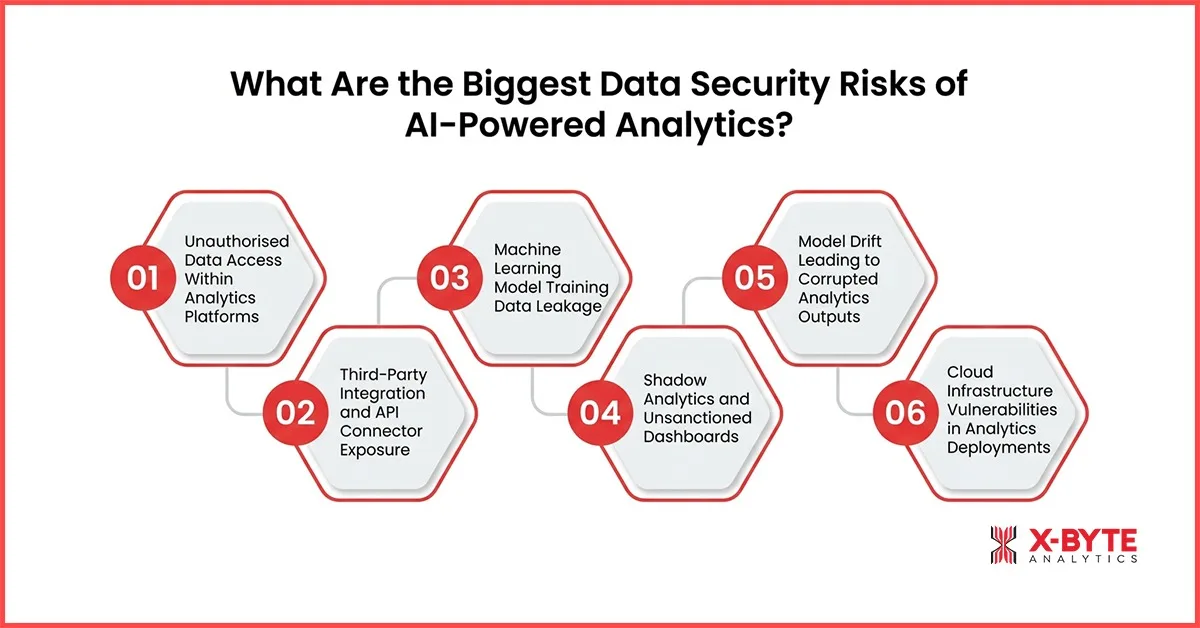
1. Unauthorised Data Access Within Analytics Platforms
As analytics platforms expand across departments, access controls often fail to keep pace with data growth. Employees across finance, marketing, operations, and HR end up with visibility into datasets that fall well outside their role requirements, creating significant internal exposure without any external breach ever occurring.
2. Third-Party Integration and API Connector Exposure
Modern AI analytics platforms connect to dozens of external tools through APIs and native connectors. Each API integration point is a potential enterprise security vulnerability. When a third-party connector is compromised or misconfigured, it can silently expose the data flowing through your analytics environment without triggering any internal alert.
3. Machine Learning Model Training Data Leakage
The machine learning models powering your analytics insights are trained on real enterprise data. If those models are not properly isolated within your AI analytics security architecture, the training data can be reconstructed or inferred through model output analysis, a technique known as a model inversion attack.
Gartner projects that by 2027, 45% of organisations will have experienced a security incident involving an unsecured AI or ML model, yet fewer than 20% of enterprises currently include ML model governance within their formal security frameworks.
4. Shadow Analytics and Unsanctioned Dashboards
Business users across global enterprises regularly export data from approved analytics platforms and build their own unsanctioned dashboards, a practice categorised as shadow IT analytics risk. This behaviour sits completely outside your governance and compliance controls, creating invisible data exposure that your security stack cannot detect or remediate.
5. Model Drift Leading to Corrupted Analytics Outputs
When AI models within your analytics platform degrade over time due to data drift, they do not just produce inaccurate insights. They can begin surfacing outputs based on corrupted or manipulated data inputs. Decisions made on drifted model outputs carry both a business risk and, in regulated industries, a direct compliance liability.
6. Cloud Infrastructure Vulnerabilities in Analytics Deployments
The majority of enterprise AI analytics platforms run on cloud infrastructure. Misconfigured storage buckets, overly permissive identity and access management (IAM) policies, and shared tenancy risks in multi-cloud analytics environments have been responsible for some of the most significant data exposures in recent enterprise history across North America, the UK, and the Asia Pacific region.
If you’re Concerned About AI Analytics Security, Let us Help. Schedule a Consultation with X-Byte Analytics Today to Ensure Your Data is Protected and Compliant.
How Do You Make an AI Analytics Platform Compliant with Global Data Privacy Laws?
Regulatory frameworks are no longer background noise for analytics teams. They are active constraints shaping how AI analytics platforms can be deployed, what data they can process, and how long they can retain it. The pressure is intensifying across every major jurisdiction simultaneously.
1. GDPR for EU and UK Operations
Any AI analytics platform processing EU or UK personal data must meet strict requirements under GDPR Article 5 around consent, data minimisation, purpose limitation, and the right to erasure. Analytics platforms that aggregate and retain behavioural or transactional data at scale are under direct scrutiny from data protection authorities across Europe. Failure to embed GDPR compliance into the analytics architecture, rather than applying it retrospectively, remains the most common regulatory failure mode.
2. HIPAA for United States Healthcare Analytics
Healthcare organisations in the US deploying AI analytics over patient data face binding HIPAA obligations around protected health information (PHI). Analytics environments connecting to electronic health records, claims data, or patient engagement platforms must be architected with HIPAA compliance built in from the ground up, not bolted on after deployment.
3. UAE PDPL for Middle East Enterprise Deployments
The UAE Personal Data Protection Law introduces consent requirements, data localisation obligations, and cross-border transfer restrictions that directly affect how AI analytics platforms deployed in the Middle East handle and store data. Enterprises expanding analytics operations across the Gulf region require an explicit compliance architecture for UAE PDPL before deployment begins.
4. India DPDP Act for South Asia Operations
India’s Digital Personal Data Protection Act places obligations on enterprises processing the personal data of Indian residents. For analytics teams operating across India’s rapidly growing enterprise technology sector, this means building data processing agreements, consent frameworks, and purpose limitation controls directly into analytics workflows.
5. Australia Privacy Act for APAC Analytics
Australian enterprises and global organisations handling Australian resident data through AI analytics platforms are subject to the Privacy Act and the Australian Privacy Principles. Ongoing Privacy Act reforms are strengthening obligations around automated decision-making and data retention, both core functions of AI analytics environments.
What Happens When Analytics Security Governance Is Absent
| Scenario | Without Governance | With Governance |
| Data access control | Any team member can access any dataset across the platform | Role based access limits data visibility to need to know only |
| Third party integrations | Connectors are added without security review or audit trail | All integrations go through security assessment and periodic review |
| Model performance monitoring | Drift goes undetected until business decisions fail | Continuous monitoring flags anomalies before outputs are acted on |
| Shadow analytics | Unsanctioned dashboards proliferate across the organisation | Data export policies and monitoring reduce shadow analytics risk |
| Compliance readiness | Regulatory audits reveal gaps that require emergency remediation | Governance framework keeps the platform audit ready at all times |
| Incident response | A breach or exposure is discovered after significant damage | Early detection systems limit exposure scope and response time |
How Enterprise Leaders Should Respond: A Practical AI Analytics Data Governance Framework
Security in AI analytics is not a one-time configuration exercise. It is an ongoing strategic discipline, an AI analytics data governance framework, that requires ownership at the leadership level and execution across every layer of the analytics stack.
1. Implement Role-Based Access Controls Across All Analytics Layers:
Every user, team, and system that touches your analytics platform should have access scoped precisely to what their role requires, not just across dashboards and reports, but across underlying data sources, model outputs, and pipeline configurations.
2. Audit Third-Party Connectors and API Permissions Regularly:
Conduct a full inventory of every integration your analytics platform maintains. Review the data each connector can access, the permissions it holds, and the security posture of the third party on the other end. Decommission unused integrations immediately.
3. Establish Data Classification Before Analytics Ingestion:
Before any dataset enters your AI analytics environment, classify it by sensitivity level. PII, commercially sensitive data, and regulated health or financial data require different handling protocols within the pipeline. Classification at ingestion prevents downstream governance failures.
4. Build ML Model Monitoring Into Your Analytics Governance Stack:
Treat your AI models as living assets requiring continuous health monitoring. Track model performance against baseline benchmarks, set automated alerts for drift thresholds, and establish a retraining protocol that does not wait for business impact to trigger a response.
5. Create an Explicit Shadow IT Analytics Detection Protocol:
Invest in data loss prevention (DLP) tooling that monitors for large-scale exports from your analytics platform. Establish clear policies around personal analytics account usage and communicate them across all business units.
6. Align Analytics Architecture With Regional Compliance Requirements:
If your analytics platform serves users or processes data across multiple regions, your architecture must reflect the compliance obligations of each jurisdiction. Data residency, transfer restrictions, and retention limits are not uniform globally, your analytics infrastructure must not treat them as if they are.
Want to Secure Your AI-Powered Analytics Environment? Reach Out to X-Byte Analytics For Expert Guidance and Tailored Solutions to Safeguard Your Data.
Where AI-Powered Analytics Security Is Heading in 2025 and Beyond
The regulatory and threat landscape around AI analytics is not stabilising, it is accelerating. Enterprises that treat analytics security as a project rather than a permanent operational function will face compounding risk as their analytics footprint expands.
1. Privacy-Enhancing Computation Is Becoming an Analytics Standard:
Technologies like federated learning, differential privacy, and secure multiparty computation are moving from research environments into mainstream enterprise analytics. These approaches allow AI models to learn from sensitive data without directly exposing it, and they are increasingly being mandated by regulators in healthcare, finance, and government sectors. Enterprises leveraging AI Predictive Analytics are at the forefront of adopting these privacy-enhancing techniques to balance deep insight generation with stringent data protection.
2. Regulatory Scrutiny of AI Analytics Vendors Is Intensifying Globally:
Governments across the EU, UK, US, UAE, and India are actively developing or enforcing AI-specific regulations that will directly govern how analytics platforms process, store, and act on personal and sensitive data. Vendor due diligence is no longer optional, it is a compliance obligation.
3. Analytics Security Is Becoming a Boardroom-Level Conversation:
CISOs and CTOs are no longer the only leaders accountable for AI analytics security decisions. CEOs, CFOs, and board members in regulated industries are being held personally accountable for data governance failures that originate in analytics environments. The conversation has moved up the organisational hierarchy, permanently.
This is precisely where X-Byte Analytics operates. Built with a security-first approach to enterprise analytics, X-Byte Analytics helps organisations across North America, the UK, the Middle East, and Asia Pacific deploy AI-powered analytics environments that do not trade insight for exposure. From governance architecture to compliance alignment, the focus is always on making your analytics capability an asset, not a liability.
How X-Byte Analytics Keeps Your Data Secure From Day One
When enterprises provide access to their data for analytics and dashboard development, trust is not assumed, it is earned through process, protocol, and a security-first operational culture that governs every stage of the engagement. At X-Byte Analytics, data security is not a compliance checkbox applied at the end of a project. It is the foundation on which every dashboard, every pipeline, and every client engagement is built.
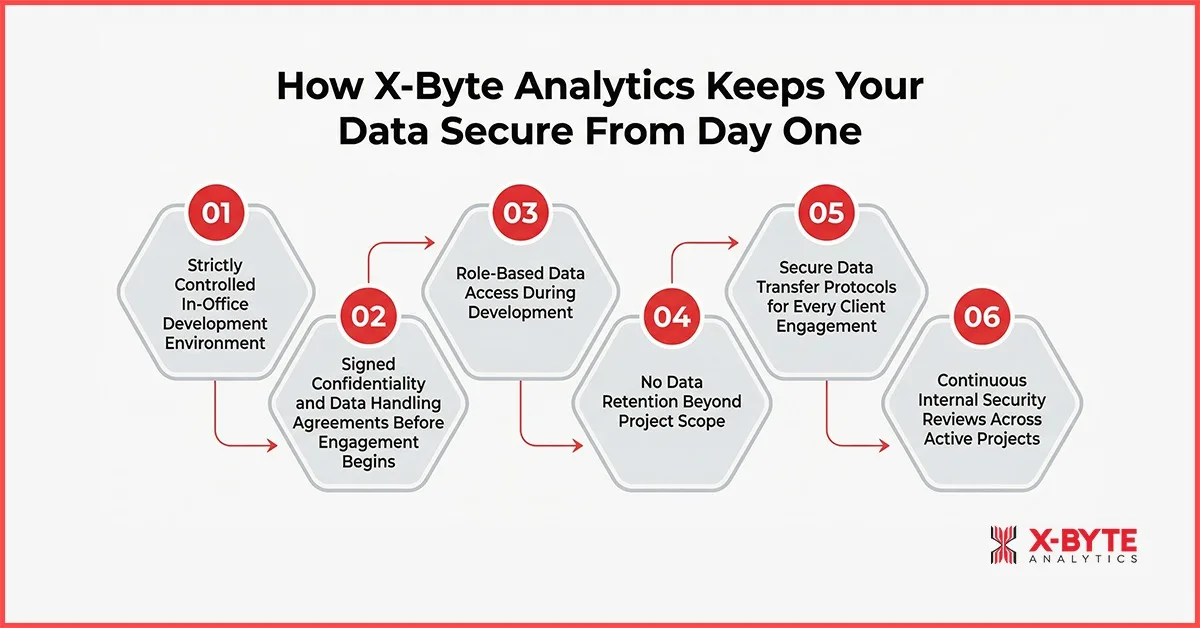
1. Strictly Controlled In-Office Development Environment:
All client dashboard development at X-Byte Analytics is carried out within a controlled, monitored in-office environment. Remote access to client data is not permitted during active development phases. Sensitive enterprise data never travels outside a governed physical workspace, eliminating the exposure risks that accompany distributed or unmonitored development setups.
2. Signed Confidentiality and Data Handling Agreements Before Engagement Begins:
Before a single dataset is shared or a single connection established, every engagement at X-Byte Analytics begins with formally executed non-disclosure agreements and data handling protocols. These agreements define exactly what data will be accessed, for what purpose, by whom, and for how long.
3. Role-Based Data Access During Development:
Not every team member working on your analytics project requires access to your full dataset. X-Byte Analytics applies role-based access principles internally during development, ensuring each team member can only access the specific data required for their defined contribution, mirroring the governance standards we recommend to every client.
4. No Data Retention Beyond Project Scope:
Once a dashboard or analytics solution is delivered and signed off, client data is not retained within X-Byte Analytics systems. Data purge protocols are followed at project closure, and clients receive written confirmation that their data has been removed from all development environments.
5. Secure Data Transfer Protocols for Every Client Engagement:
All data shared between clients and X-Byte Analytics travels through encrypted transfer channels. Whether arriving via secure file transfer, encrypted cloud storage handoff, or direct API connection, the transfer method is agreed upon and documented before the project begins. Robust data integration services underpin every transfer protocol, ensuring that data moving between environments remains governed, traceable, and fully secure at every stage.
6. Continuous Internal Security Reviews Across Active Projects:
Active client projects go through internal security review checkpoints at defined stages of development. These reviews assess access logs, check for data handling anomalies, and confirm that the development environment remains aligned with the agreed security protocol. Issues are resolved internally before they can become client-facing risks.
Conclusion
AI-powered analytics is one of the most significant competitive advantages available to enterprise organisations right now. But that advantage carries a responsibility that too many leadership teams are still underestimating. The data flowing through your analytics environment is not just fuel for insight, it is a high-value target, a regulatory obligation, and a trust asset that your customers, partners, and regulators expect you to protect.
The AI analytics security risks explored in this article are not future scenarios. IBM research confirms that organisations without AI-integrated security detect and contain breaches on average 98 days later than those that do, at a compounding cost that erodes the very ROI advantage analytics was meant to deliver. The enterprises leading in 2025 are the ones building security and governance into their AI analytics data governance framework now, before a breach, regulatory audit, or model failure makes it unavoidable. Partnering with the right AI Consulting firm ensures security architecture is embedded from day one rather than retrofitted under pressure.
If you are not certain how secure your current analytics environment is, that uncertainty is itself a risk signal worth acting on. Start with a free dashboard audit from X-Byte Analytics and get a clear, expert assessment of where your data exposure exists and what it will take to close the gaps. Book your consultation today to take the first step toward an analytics environment your organisation can trust completely.