
Quick Summary:
- Manufacturing data analytics transforms factory operations by using IoT, AI, and dashboards to improve efficiency, reduce costs, and enhance quality in real time.
- Key objectives include predictive maintenance, supply chain optimization, cost control, quality improvement, and faster data-driven decision-making.
- Real-world impact includes 20–35% efficiency gains, 40–50% downtime reduction, improved safety, and measurable ROI within months.
Introduction
Manufacturing is no longer just about machines and materials, it’s about data. The way factories collect, analyze, and act on information is transforming how products are made, costs are controlled, and quality is maintained.
According to recent industry reports, the manufacturing analytics market is expected to reach $9.11 billion by 2026. This growth reflects a fundamental shift: manufacturers who embrace data analytics are outperforming competitors by significant margins, with many reporting 20-35% improvements in operational efficiency.
In this comprehensive guide, we’ll explore what manufacturing data analytics really means, why it matters for your business, and how leading manufacturers are using it to solve real production challenges.
What is Manufacturing Data Analytics?
Manufacturing data analytics is the process of collecting and analyzing data from production systems, equipment, and processes to improve decision-making and operational performance. Instead of relying on gut feelings or limited information, manufacturers use data to understand exactly what’s happening on the factory floor and why.
Think of it as giving your factory a voice. Every machine, production line, and process generates data, temperature readings, cycle times, quality measurements, energy consumption, and more. Manufacturing analytics turns this raw data into actionable insights that help you make better, faster decisions.
How Manufacturing Analytics Works
Modern data analytics in manufacturing combines several key technologies:
Data Collection: IoT sensors, production machines, and enterprise systems continuously capture operational data. This includes everything from machine performance metrics to product quality measurements and supply chain information.
Data Processing: Cloud-based platforms and on-premise systems organize and clean this data, making it ready for analysis. This step is crucial because raw data often comes from different sources in different formats.
Data Analysis: Analytics tools examine the data to find patterns, trends, and anomalies. This is where manufacturing business intelligence comes into play, transforming numbers into meaningful insights.
Actionable Insights: The analysis produces recommendations, alerts, and visualizations through production performance dashboards that help managers and operators make informed decisions quickly.
At X-Byte Analytics, we specialize in manufacturing data analytics solutions that integrate seamlessly with your existing systems, turning data complexity into operational clarity.
Why Manufacturing Data Analytics Matters
The manufacturing landscape has changed dramatically. Customer demands shift faster, supply chains are more complex, and competition is global. Manufacturers who rely on traditional methods, periodic reports, manual inspections, and reactive problem-solving, simply can’t keep pace.
Data-driven manufacturing addresses this challenge by enabling:
- Real-time visibility into every aspect of production
- Predictive capabilities that spot problems before they occur
- Optimization opportunities that were previously invisible
- Faster response times to quality issues and production bottlenecks
- Better resource utilization across materials, energy, and labor
The manufacturers seeing the biggest gains aren’t necessarily the largest or most advanced. They’re the ones who have embraced analytics as a core strategy, using data to guide everything from daily production decisions to long-term investment planning.
8 Key Objectives of Manufacturing Data Analytics
Understanding what manufacturing analytics aims to achieve helps clarify how it creates value. Here are the primary objectives that drive successful analytics programs.
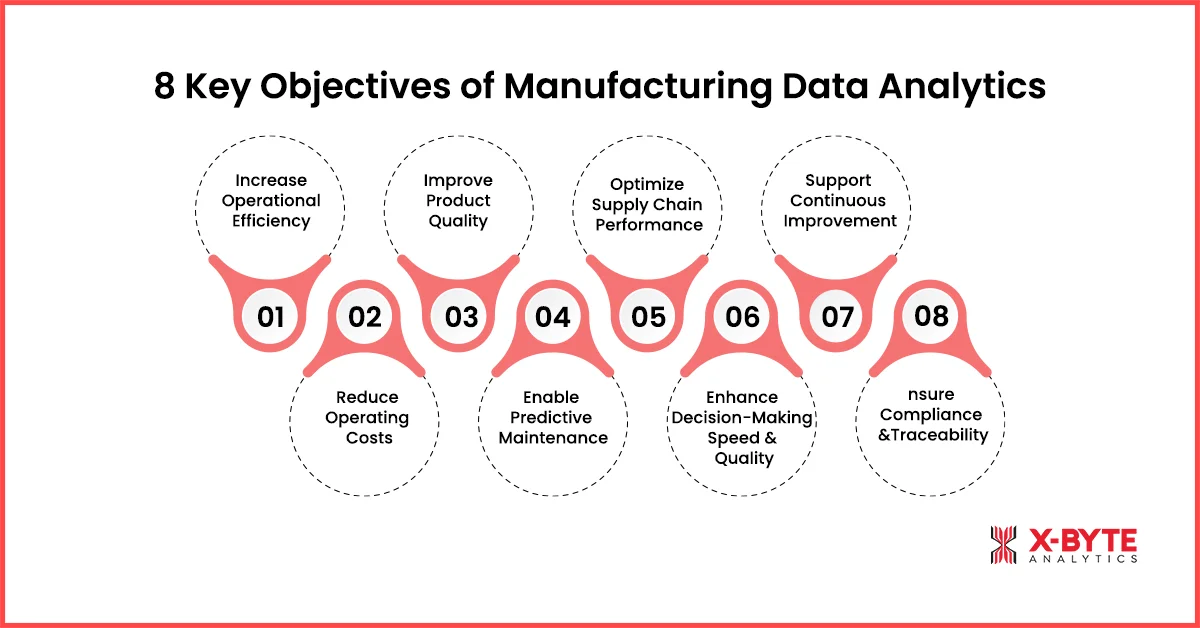
1. Increase Operational Efficiency
The first objective is making operations run smoother and faster. Manufacturing performance analytics identifies bottlenecks, reduces waste, and optimizes resource use.
What this looks like: Analytics reveals that a particular machine has 15% more downtime during second shift. Investigation shows it’s a training issue, not a mechanical problem. Addressing this increases overall equipment effectiveness (OEE) without any capital investment.
Typical improvements: 10-20% increase in throughput, 15-25% reduction in cycle times.
2. Reduce Operating Costs
Every manufacturer faces pressure to cut costs without sacrificing quality. Analytics pinpoints exactly where money is being wasted and identifies the highest-impact cost reduction opportunities.
Common cost savings areas:
- Energy consumption optimization (10-20% reduction)
- Material waste reduction (8-15% improvement)
- Labor productivity enhancement (12-18% gains)
- Inventory optimization (20-30% working capital reduction)
- Maintenance cost reduction (25-35% through predictive approaches)
3. Improve Product Quality
Quality issues are expensive. Defects lead to scrap, rework, customer returns, and damaged reputation. Quality control analytics helps manufacturers catch problems early and prevent them from recurring.
The analytics advantage: Traditional quality control checks samples. Analytics-driven quality control can monitor 100% of products in real-time, detecting subtle variations that predict defects before they occur.
4. Enable Predictive Maintenance
Equipment breakdowns disrupt production, create emergency costs, and stress the entire operation. Predictive maintenance analytics shifts maintenance from reactive (fix when broken) to proactive (fix before it breaks).
How it works: Sensors monitor equipment health indicators, vibration, temperature, acoustic signatures, and power consumption. Machine learning models detect patterns that indicate impending failure, typically 5-14 days before breakdown occurs.
Business impact: 40-50% reduction in unplanned downtime, 25-30% lower maintenance costs, 20-40% longer equipment lifespan.
Our predictive analytics service has helped manufacturers across industries implement successful predictive maintenance programs, with most seeing positive ROI within 6-9 months.
5. Optimize Supply Chain Performance
Manufacturing doesn’t exist in isolation. Supply chain analytics connects production planning with supplier performance, inventory levels, and customer demand to create a responsive, efficient flow of materials.
Key capabilities:
- Demand forecasting with 85-90% accuracy
- Supplier performance tracking and risk identification
- Inventory optimization balancing cost and service levels
- Material flow optimization reducing lead times
6. Enhance Decision-Making Speed and Quality
Fast, accurate decisions provide competitive advantage. Production dashboards give decision-makers instant access to critical information, eliminating the hours or days previously spent gathering and reconciling data.
Impact: When a quality issue emerges, analytics immediately shows which batches are affected, identifies the root cause, and calculates the impact. What used to take days now takes minutes.
7. Support Continuous Improvement
Data-driven manufacturing creates a culture where improvement is systematic, not random. Analytics provides the objective foundation for identifying opportunities, testing changes, and measuring results.
8. Ensure Compliance and Traceability
For regulated industries, manufacturing analytics provides the documentation and control required for compliance. Full traceability from raw materials to finished products becomes automatic rather than manual.
7 Major Benefits of Data Analytics in Manufacturing
While objectives describe what analytics aims to achieve, benefits describe the actual value delivered to the business.
1. Better Quality Control
Quality isn’t just about inspection, it’s about understanding and controlling the factors that create quality products.
How analytics improves quality:
- Real-time monitoring catches deviations instantly, not at end-of-line inspection
- Root cause analysis identifies why defects occur, not just that they occurred
- Predictive quality models forecast quality issues based on process parameters
- Supplier quality tracking connects incoming material quality to finished product outcomes
Real example: A pharmaceutical manufacturer implemented quality control analytics that monitors critical process parameters every second. When parameters drift toward the edge of acceptable ranges, the system alerts operators before any out-of-specification product is produced. Result: 94% reduction in quality deviations.
2. Optimized Production Processes
Production optimization goes beyond working faster, it’s about working smarter. Analytics reveals opportunities that aren’t visible through observation alone.
Optimization opportunities analytics uncovers:
- Line balancing: Matching workstation capacities to eliminate bottlenecks
- Changeover reduction: Analyzing changeover times to identify improvements
- Batch sizing: Optimizing batch sizes to balance efficiency and flexibility
- Sequence optimization: Determining the best production sequence to minimize setup time
- Speed optimization: Finding the ideal operating speed that balances throughput and quality
Typical results: 12-25% productivity improvement, 15-30% faster throughput, 8-15% reduction in work-in-process inventory.
3. Significant Cost Reduction
Cost reduction through analytics isn’t about across-the-board cuts. It’s about intelligent resource allocation based on actual consumption patterns.
Energy cost optimization: Industrial IoT analytics tracks energy consumption by machine, product, and time period. Many manufacturers discover that 20-30% of energy costs come from easily addressable sources, equipment running when idle, inefficient operating parameters, or poor scheduling.
Material waste reduction: By analyzing scrap patterns, manufacturers identify the specific conditions that create waste. Addressing these root causes typically reduces material waste by 10-18%.
Labor optimization: Analytics shows where labor is most and least productive, enabling better scheduling, training focus, and resource allocation. Improvements of 15-20% are common.
4. Predictive Maintenance Excellence
The full benefit of predictive maintenance extends beyond cost savings to fundamentally improve how manufacturing operates.
Traditional reactive maintenance problems:
- Unexpected breakdowns disrupt production schedules
- Emergency repairs cost 3-5x normal maintenance
- Rushed repairs often miss related issues
- No ability to plan downtime efficiently
Predictive maintenance advantages:
- Maintenance scheduled during planned downtime
- Parts ordered in advance (avoiding rush shipping)
- Maintenance performed when actually needed
- Related issues addressed in single maintenance event
5. Supply Chain Optimization
Supply chain challenges affect production directly. Running out of materials stops production. Excess inventory ties up working capital. Late deliveries from suppliers disrupt schedules.
Key improvements:
- Inventory optimization: Reduce inventory levels 20-35% while maintaining service levels
- Supplier performance management: Identify reliable vs. problematic suppliers
- Demand forecasting: Improve forecast accuracy from typical 60-70% to 85-92%
- Risk management: Early warning of supplier issues or material shortages
Example: An automotive parts manufacturer used supply chain analytics to identify that 80% of their production delays traced to just 3 of their 40 suppliers. Targeted intervention reduced delays by 73%.
6. Enhanced Decision-Making Capabilities
Better decisions, made faster, based on facts rather than assumptions.
What decision-makers gain:
- Complete visibility: See what’s happening across all operations in real-time
- Context and trends: Understand not just current status but how it compares to normal
- Predictive insight: Know what’s likely to happen next
- Impact analysis: Evaluate consequences of different decisions before acting
- Mobile access: Make informed decisions from anywhere
Working with our Data Analytics Consulting team, manufacturers implement decision support systems tailored to their specific needs, from plant manager dashboards to executive scorecards.
7. Improved Workplace Safety
Manufacturing environments can be hazardous. Analytics helps identify safety risks before accidents occur.
Safety analytics applications:
- Equipment safety monitoring: Track the health of safety systems
- Environmental monitoring: Continuous tracking of air quality, noise, and temperature
- Incident pattern analysis: Identify circumstances that lead to near-misses
- Predictive risk assessment: Flag high-risk situations based on multiple factors
Results: Manufacturers using safety analytics typically see 30-50% reductions in recordable incidents.
Supercharge Your Manufacturing Data Analytics Service With X-Byte Analytics And Turn Data Into Powerful Business Insights.
7 Critical Manufacturing Data Analytics Use Cases
Understanding use cases helps clarify how analytics solves real manufacturing challenges.
1. Predictive Maintenance and Equipment Health
The challenge: Equipment failures cause unplanned downtime, emergency repair costs, and production delays.
The analytics solution: IoT sensors continuously monitor equipment condition. Machine learning models analyze vibration patterns, temperature trends, and acoustic signatures to predict failures before they occur.
Business outcomes: 40-50% reduction in unplanned downtime, 25-30% lower maintenance costs, improved production schedule reliability.
2. Quality Control and Defect Detection
The challenge: Quality issues often aren’t detected until products reach final inspection or customers.
The analytics solution: Quality control analytics monitors process parameters and product characteristics in real-time, detecting quality issues at the point of creation.
Key technologies:
- Vision systems with machine learning for automated inspection
- Statistical process control (SPC) with automated alerts
- Root cause analysis algorithms
- Supplier quality tracking
Business outcomes: 40-60% reduction in defect rates, 50-70% lower scrap and rework costs.
3. Production Performance Optimization
The challenge: Production runs below capacity due to bottlenecks, inefficiencies, and suboptimal operating parameters.
The analytics solution: Manufacturing performance analytics identifies constraints and optimization opportunities across the production system.
What gets optimized:
- Equipment operating parameters (speeds, feeds, temperatures)
- Production sequences and batch sizes
- Line balancing and workload distribution
- Changeover procedures and times
Business outcomes: 15-25% throughput improvement, 12-20% productivity gains.
4. Supply Chain and Inventory Management
The challenge: Balancing inventory costs against the risk of stockouts, while managing unreliable suppliers and fluctuating demand.
The analytics solution: Supply chain analytics provides visibility across the entire supply network and optimizes inventory levels based on actual consumption patterns.
Capabilities delivered:
- Automated demand forecasting using machine learning
- Safety stock optimization by SKU and location
- Supplier scorecards tracking delivery, quality, and reliability
- Material requirements planning with real-time updates
Business outcomes: 25-35% inventory reduction, 90%+ improvement in forecast accuracy.
5. Energy Management and Sustainability
The challenge: Energy costs represent 10-30% of manufacturing expenses, and sustainability requirements are increasing.
The analytics solution: Industrial IoT analytics tracks energy consumption by machine, process, product, and time, identifying optimization opportunities.
Business outcomes: 15-25% energy cost reduction, improved sustainability metrics, reduced carbon footprint.
6. Workforce Performance and Safety
The challenge: Understanding workforce productivity patterns and ensuring safe working conditions.
The analytics solution: Workforce analytics identifies productivity patterns, training needs, and safety risks.
Applications:
- Shift performance comparison to identify best practices
- Training effectiveness measurement
- Safety incident pattern analysis
- Task allocation optimization
Business outcomes: 10-18% labor productivity improvement, 30-50% reduction in safety incidents.
7. Product Development and Process Improvement
The challenge: New product introductions often encounter unanticipated production challenges.
The analytics solution: Manufacturing analytics provides data-driven insights into what works and what doesn’t, accelerating product launches.
Business outcomes: 30-40% faster new product ramp-up, higher first-pass yield on new products.
How to Get Started with Manufacturing Data Analytics
Beginning your analytics journey doesn’t require massive investment or complete system overhauls.
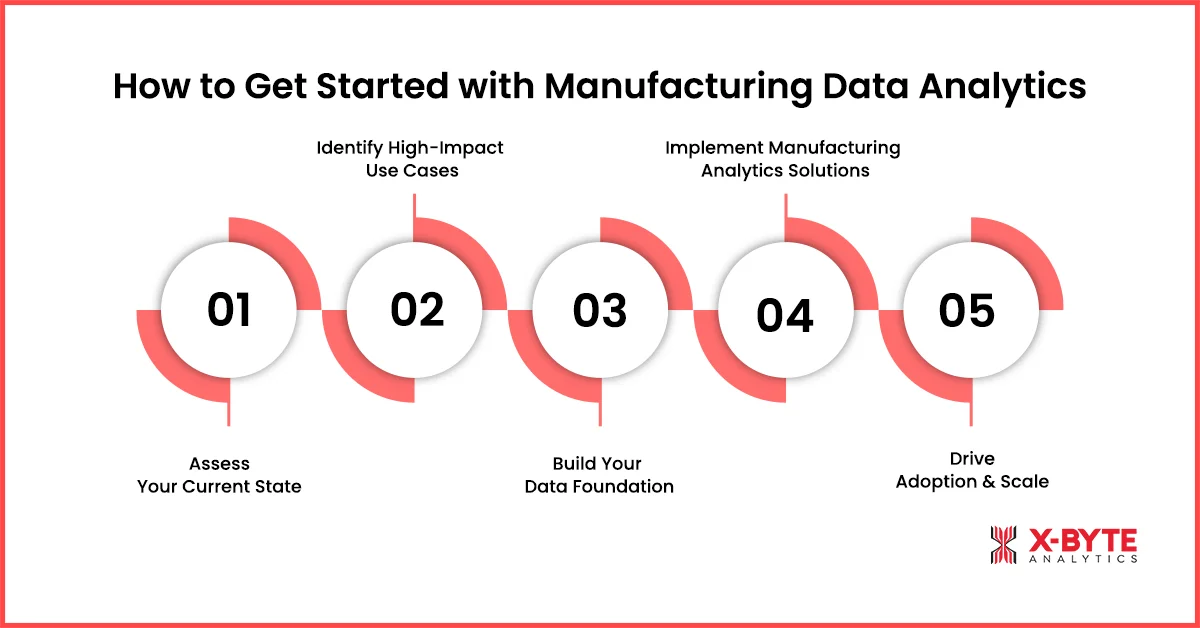
Step 1: Assess Your Current State
Start by understanding what data you already have and what problems you most need to solve.
Questions to answer:
- What data are we currently collecting?
- What’s the quality and accessibility of that data?
- What operational challenges cause the most pain?
- Where would improved visibility provide the most value?
Step 2: Identify High-Impact Use Cases
Choose 1-2 initial use cases that offer clear value and reasonable implementation complexity. Predictive maintenance and quality analytics are often good starting points.
Step 3: Build Your Data Foundation
Ensure you have the infrastructure to collect, store, and access the data you need.
Technical requirements:
- IoT sensors on critical equipment
- Reliable network connectivity on the factory floor
- Data storage infrastructure (cloud or on-premise)
- Integration with existing systems (ERP, MES, SCADA)
Step 4: Implement Manufacturing Analytics Solutions
Deploy analytics tools and develop the models that turn data into insights.
Implementation options:
- Partner with specialized providers
- Build internal capabilities gradually
- Hybrid approach combining external expertise with internal development
Step 5: Drive Adoption and Scale
Technology alone doesn’t create value. People using analytics to make better decisions creates value.
Success factors:
- Training operators, engineers, and managers
- Demonstrating quick wins to build momentum
- Creating feedback loops for continuous improvement
- Expanding successful use cases to other areas
Timeline: Initial pilot projects take 8-12 weeks. Full implementation typically requires 12-18 months, with incremental value delivered throughout.
Common Challenges and How to Overcome Them
Data Quality Issues
The problem: Inaccurate, incomplete, or inconsistent data undermines analytics effectiveness.
The solution: Implement data validation rules, automated quality checks, and clear data governance policies.
Integration Complexity
The problem: Manufacturing environments include legacy systems, proprietary protocols, and disconnected data sources.
The solution: Take a phased approach. Start with systems that are easiest to integrate, demonstrate value, then tackle complex integrations.
Resistance to Change
The problem: People comfortable with existing processes may resist new approaches.
The solution: Focus on demonstrating value quickly. Show how analytics makes jobs easier and helps people perform better.
Skills Gap
The problem: Manufacturing organizations may lack data science expertise.
The solution: Partner with experts initially while building internal capabilities. Upskilling existing employees who understand manufacturing is often more effective than hiring external data scientists.
Conclusion
Manufacturing data analytics has moved from competitive advantage to competitive necessity. The manufacturers thriving today are those who have embraced data-driven decision-making as a core competency.
You don’t need to be a technology giant to benefit. Manufacturing analytics solutions are more accessible than ever, with options suitable for operations of all sizes.
The key is to start. Begin with a clear use case, demonstrate value, build momentum, and scale from there. Whether you’re addressing quality issues, reducing downtime, optimizing costs, or improving safety, analytics provides the visibility and insight to drive measurable improvements.
At X-Byte Analytics, we’ve helped manufacturers across industries implement successful analytics programs that deliver real business results. Our approach combines deep manufacturing expertise with advanced analytics capabilities.
Ready to explore how manufacturing data analytics can transform your operations? Contact our team for a complimentary operational assessment.