

Key Highlights:
- Data mining helps modern businesses turn everyday data into clear, actionable insights using simple data mining techniques, real patterns, and business-ready predictions.
- The data mining process shows you how data mining works, its cleaning, pattern discovery, and interpretation come together to reveal what your customers truly want and what decisions will move your business forward.
- The blog breaks down the types of data mining and the real-world applications of data mining in marketing, sales, operations, staffing, personalization, demand forecasting, and customer experience.
Introduction
In 2025, Netflix reported that its personalized recommendation engine, powered by data mining and AI, generates around 80% of total viewing hours.
Less effort. More user satisfaction and viewing hours. Insane Netflix. On top of it, that system alone is estimated to save Netflix over US$1 billion per year by reducing churn and keeping subscribers hooked.
It’s not just Netflix; top brands like Amazon, Spotify, Starbucks, and Walmart also leverage data mining to enhance personalized customer experiences and drive growth.
If you are also a business leader, owner, or manager and want to understand what data mining is, exactly, how it works, why it matters (so much), and how to get started, then this blog is all you need.
If the world’s most successful brands can unlock unprecedented value from their data, there’s no reason your business can’t do it too.
What is Data Mining?
Data mining is the process of analyzing large sets of raw data—such as customer behavior, transactions, website activity, and product usage—to uncover hidden patterns, trends, and insights that support better decision-making. It transforms existing data into meaningful information that helps businesses gain a competitive advantage.
It helps you see what customers love, what they ignore, what they might buy next, and even what they’re likely to do in the future.
For example, imagine you run an online fashion store. When you manually review your sales data, everything appears to be normal. But when you apply data mining, you discover something interesting: customers who buy denim jackets often come back within 7 days to buy white sneakers. You may not have noticed it because it wasn’t immediately obvious, but the pattern is real.
Now you can bundle both products, run targeted ads, or show white sneakers as recommended add-ons. Result? Higher conversions, better customer experience, and more revenue, all because a hidden pattern became visible.
That’s the power of data mining: turning everyday data into insights you can act on.
Importance of Data Mining in Business
Businesses don’t need more data; they need clarity. And that’s exactly where data mining becomes a game-changer. Let’s keep on reading to know about the importance of data mining in business and why businesses are leveraging it.
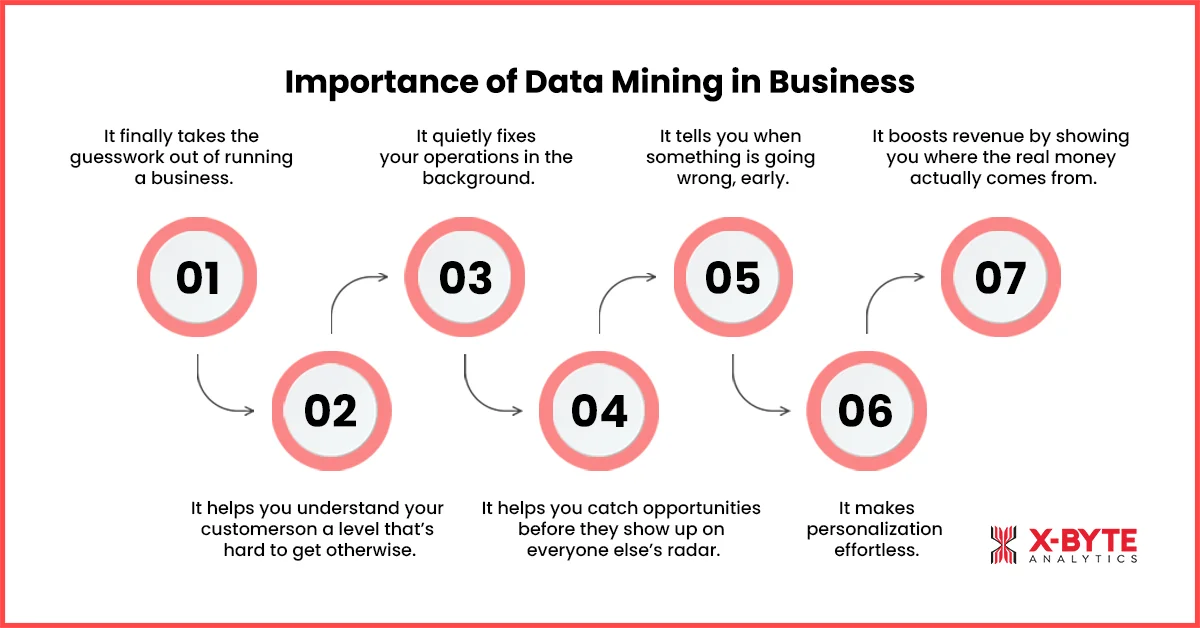
1. It finally takes the guesswork out of running a business.
Many leaders still rely on gut feeling, instincts, and decades of experience, but today’s market moves too fast for that. Data mining shows you what’s actually happening in your business: what customers click, what they skip, what they love, and what they’ll probably buy next. It turns all the noise into clarity so you can act with confidence, not hope.
2. It helps you understand your customers on a level that’s hard to get otherwise.
Ever launched a campaign you thought would kill it… and it flopped? Or seen a random product suddenly go viral? Data mining uncovers the why behind customer behavior. You start seeing patterns, buying habits, timing, preferences, and channel choices that make your marketing and sales feel sharper and more intentional.
3. It quietly fixes your operations in the background.
One of the underrated superpowers of data mining is how smoothly it streamlines everyday work. Demand forecasting, stock planning, staff allocation, and budget spending suddenly everything feels more predictable. No more over-ordering, last-minute shortages, mismatched inventory, or waiting for someone to manually check. Your workflow gets cleaner without you even noticing.
4. It helps you catch opportunities before they show up on everyone else’s radar.
Trends don’t announce their arrival; they creep in. And, if you are late, there’s an opportunity lost. But, with the importance of data analytics in business, you can catch those early signs: a product rising faster than usual, a channel performing better than expected, a customer segment responding differently. You get the head start your competitors wish they had.
5. It tells you when something is going wrong, early.
Every business has warning signs… but most leaders only see them when things have already fallen apart. Data mining acts like a pulse monitor. It spots churn patterns, customer dissatisfaction, product dips, campaign fatigue, all before they become expensive fires to put out.
6. It makes personalization effortless.
When Netflix nails your next binge, or Amazon suggests exactly what you didn’t know you needed, that’s data mining in action. And you don’t need to be a billion-dollar brand to use the same logic. Even simple data mining helps you send smarter offers, more relevant emails, and more personalized recommendations at scale.
7. It boosts revenue by showing you where the real money actually comes from.
Every business has a few products, campaigns, or customer groups that drive the majority of results. The importance of data mining in business helps you spot them instantly. Once you know what genuinely moves the needle, you can double down on the right areas and stop wasting resources on the wrong ones. Revenue starts growing because your decisions finally align with what works.
Discover How X-Byte Analytics’ Data Analytics Service Can Transform Your Business And Drive Growth
How Data Mining Works?
The data mining process follows a clear, structured flow. Once you understand these steps, it becomes easier to see how businesses turn raw information into useful insights. Here’s the simplified version of how data mining works, broken down into practical stages:
1. Collect the Data
Every business already generates data, sales, customer interactions, website analytics, transactions, support tickets, marketing metrics, and more. This step is about bringing all that data together in one place so it can be analyzed properly.
2. Clean and Organize the Data
Raw data is messy. It may have duplicates, missing values, or errors. In this step, the system cleans, formats, and organizes everything so the information becomes accurate and usable.
Why it matters: Cleaner data = more reliable insights.
If it feels too technical or time-consuming, you can always connect with a professional data analytics company to help you clean, structure, and prepare your data properly.
3. Select the Right Data
Not all data is important for every goal. This step identifies which parts of the data are actually relevant to what you want to analyze, like customer behavior, sales trends, or product performance.
This prevents: Analysis overload and irrelevant insights.
4. Transform the Data
The cleaned data is converted into a suitable structure for analysis. Techniques such as normalization, aggregation, data integration, and feature selection are applied to ensure the data is optimized for mining algorithms and efficient processing.
Purpose: Improves accuracy, speed, and performance of data mining techniques.
5. Apply Data Mining Techniques
This is where the actual magic happens. Different data mining techniques are applied depending on the goal: classification, clustering, prediction, association rules, or pattern detection.
Example: Grouping customers with similar buying patterns or predicting what they might purchase next.
6. Discovering & Interpreting Patterns and Insights
This is where the real magic of the data mining process starts to show. This step translates insights into clear explanations for business teams, marketing, sales, operations, product, and leadership.
Maybe you notice a specific group of customers buying more during late evenings, or a product category quietly growing every weekend. This step shows you what’s actually happening inside your business, backed by data instead of assumptions.
This is the moment businesses realize: Oh, this is what’s really happening.
7. Visualize the Results
The insights are presented visually in the form of dashboard panels, charts, graphs, reports, and interactive visual displays, making them easy for stakeholders across departments to understand and act upon.
Why it matters: clear visualization = faster decisions & stronger alignment.
8. Take Action
The final step is where businesses turn insights into decisions. It could be adjusting inventory, improving customer segmentation, refining your pricing strategy, running a targeted campaign, or enhancing the customer journey. Once this becomes part of your routine, you move from guessing to scaling with confidence.
Understanding the Key Types of Data Mining
Each type serves a specific purpose & when you understand these types of data mining, you can pick the right approach for your goals.

1. Classification
You sort data into predefined categories to understand which group a customer, product, or behavior belongs to. It helps businesses predict outcomes based on past labeled data.
Example: Predicting whether a new customer is high-value or low-value based on their first week of activity.
2. Clustering
You group similar data points when you don’t know the categories yet. It reveals natural segments and patterns in large datasets.
Example: Grouping customers into clusters like bargain buyers, loyal shoppers, and seasonal buyers without defining these labels beforehand.
3. Association Rule Mining
You discover relationships between items or actions that frequently occur together. It shows what customers often do or buy in combinations. It’s one of the most popular data mining techniques used in retail and e-commerce.
Example: Customers who buy protein powder often buy shaker bottles too.
4. Regression
Another popular type of data mining is regression, where you predict continuous values using historical data. It helps estimate numbers like sales, revenue, or demand.
Example: Predicting next month’s sales based on past performance, seasonality, and marketing spend.
5. Anomaly Detection
You identify data points that don’t match normal behavior to catch any unusual behavior, such as errors, fraud, sudden drops in performance, etc..
Example: Spotting a sudden spike in refund requests that doesn’t match regular trends.
6. Prediction (Forecasting)
You use existing data to predict future outcomes or trends. It helps businesses stay ahead by planning inventory, staffing, or marketing.
Example: In this type of data mining, you can predict the festival-season demand for specific products.
7. Sequential Pattern Mining
You discover the order in which events happen over time. It helps businesses understand customer journeys and recurring sequences.
Example: Customers often view “Product A → Product B → Product C” before making a purchase.
Amazon’s Data-Driven Retail Genius that Contributes to 35% of Total Revenue!
Amazon analyzes purchase history, search patterns, clickstream data, delivery behavior, and browsing journeys. Its Frequently Bought Together and Customers Also Bought sections are built using association rule mining and real-time predictive analytics.
Results:
- Cross-selling driven by data mining contributes to 35% of Amazon’s total revenue.
- Predictive inventory systems reduced stockouts by up to 40%, especially during peak seasons.
- Personalized recommendation emails increased conversions by 3X.
Applications of Data Mining in Business
Data mining shows its real power when it starts supporting your day-to-day decisions. Let’s understand the common data mining applications in business and find out more.
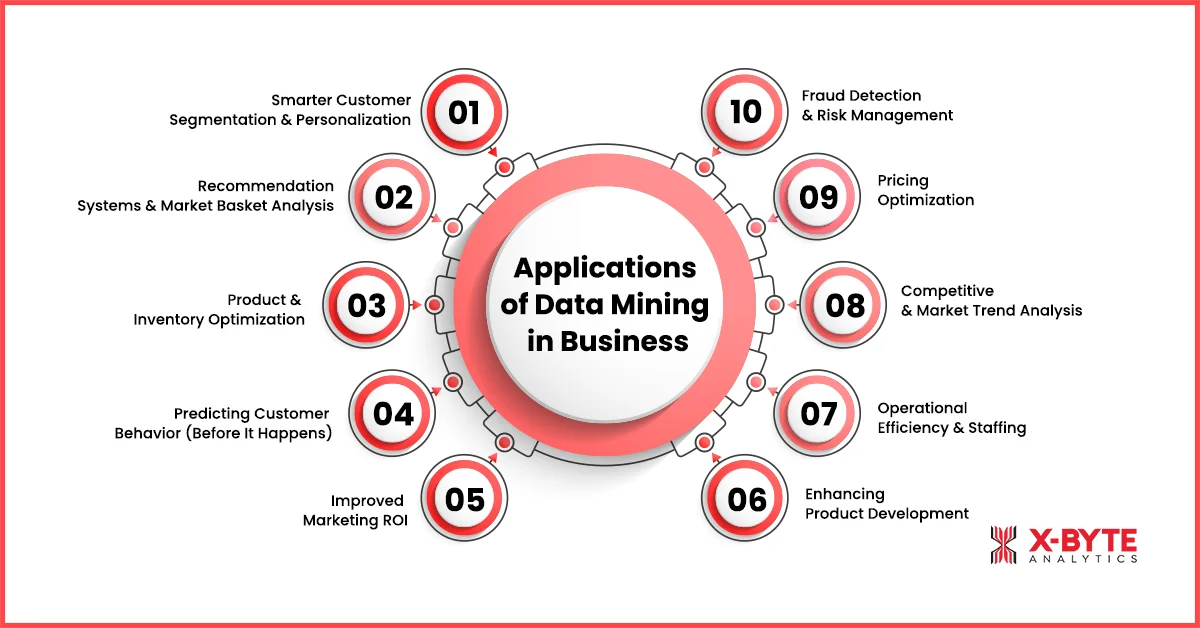
1. Smarter Customer Segmentation & Personalization
Businesses use data mining techniques to understand customer behavior at a deeper level, not through assumptions, but through actual patterns in purchases, website activity, and engagement.
When you see that one segment responds instantly to flash deals while another prefers long-form educational content, you can tailor your messaging accordingly. That’s how brands turn one-size-fits-all marketing into personalized experiences that feel intentional.
2. Recommendation Systems & Market Basket Analysis
Data mining helps businesses understand which products customers frequently buy together or which content they are likely to interact with next. This insight powers intelligent recommendations—like Netflix suggesting shows or Amazon recommending complementary items during checkout.
It increases cross-selling, improves personalization, and boosts average order value without aggressive advertising.
3. Product & Inventory Optimization
One of the biggest applications of data mining is forecasting demand with accuracy & inventory planning accordingly.
When you notice through data that specific product categories spike during certain triggers, like weather changes or social trends, you can prepare stock, staff, and campaigns ahead of time. This prevents stockouts, overstocking, and last-minute firefighting.
4. Predicting Customer Behavior (Before It Happens)
Every business has invisible signals that customers give before they leave, slower engagement, reduced repeat purchases, and more support tickets. Data mining tools spot these early so you can act fast.
For instance, if your high-value customers suddenly stop interacting with your emails and app notifications, that’s a churn signal. You can proactively re-engage them before revenue slips.
5. Improved Marketing ROI
Instead of running campaigns everywhere, data mining identifies exactly which channels, audience groups, ad creatives, or content themes actually drive conversions.
If your data shows TikTok traffic converts 3x better than Instagram for a specific audience, you instantly know where to double down. This is how leaders turn marketing from spray and pray to predictable ROI.
6. Fraud Detection & Risk Management
Businesses dealing with transactions, bookings, or financial data rely on data mining to catch unusual patterns, like repeated refund requests from the same cluster of users or sudden spikes in high-value orders at odd hours.
It works like an always-awake watchdog, keeping your platform safe without slowing down operations.
7. Pricing Optimization
Data mining highlights the real relationship between pricing, demand, customer behavior, and competitor movement. Instead of randomly adjusting prices, leaders use data mining to see which pricing tiers convert, which discounts bring quality customers, and which offers drive only one-time buyers.
When the data tells you that a small price drop in a niche product leads to a big revenue jump, you know your pricing strategy is working.
8. Competitive & Market Trend Analysis
By analyzing industry data, search behavior, consumer sentiment, and competitor activities, data mining helps businesses identify trends early and stay ahead of the market.
It predicts emerging demand, reveals gaps competitors are missing, and supports better strategic planning—helping decision-makers innovate rather than react.
9. Operational Efficiency & Staffing
One of the most underrated applications of data mining is its ability to streamline staffing. It helps you understand peak hours, slow hours, customer flow patterns, and service-time trends, so you always schedule the right number of people at the right time. This means your team stays productive, your labor costs stay controlled, and your customers never feel ignored.
10. Enhancing Product Development
Data mining shows what users actually do, not just what they say. You can identify which features customers use repeatedly, which ones they ignore, and what patterns appear right before a user upgrades or churns. This helps product teams build confidently and fix what’s slowing growth.
Starbucks’ Location Intelligence To Achieve Profitability Within 18 Months!
Starbucks uses geospatial data, foot-traffic flows, population density, purchase behavior, and competitor mapping to predict which locations will be profitable. Their internal tool, Atlas, mines location-based data to project revenue before the store is even built.
Results:
- A higher location success rate, with fewer than 5% of new stores underperforming in the first year.
- Average new store achieves profitability within 18 months, faster than the industry norm.
- Location intelligence improved expansion planning accuracy by 30–40%.
Key Differences Between Data Mining and Data Analytics
Data mining vs data analytics often get mixed up, but they play very different roles in how modern businesses understand and use their data.
While both work together to enable smarter, data-driven decisions, data mining focuses on discovering hidden patterns and insights, whereas data analytics focuses on interpreting those findings and turning them into strategic actions.
Let’s explore the key differences between data mining and data analytics to understand their roles more clearly.
| Category | Data Mining | Data Analytics |
| Primary Focus | Discovers hidden patterns, correlations, and trends in large datasets. | Interprets data to answer specific questions and support decisions. |
| Core Goal | Reveal unknown insights. | Explain what data analytics means and what actions to take. |
| Key Question | What patterns exist? | Why did this happen? Or what should we do next? |
| Approach | Uses algorithms, models, and data mining techniques to explore data. | Uses statistical analysis, dashboards, reports, and business intelligence. |
| Data Mining Process Role | Falls under the exploration and pattern discovery stage. | Falls under the analysis, interpretation, and decision-making stage. |
| Output | Patterns, clusters, predictions, associations. | Insights, explanations, metrics, recommendations. |
| Use Cases | Market basket analysis, customer segmentation, anomaly detection. | Sales forecasting, performance measurement, campaign analysis. |
| Business Benefits | Helps uncover opportunities and blind spots you didn’t know existed. | Helps teams make informed decisions and measure business outcomes. |
How X-Byte Analytics Helps Enterprises with Data Mining?
By now, you’ve seen how powerful data mining can be, spotting patterns you can’t see manually, predicting customer behavior, fixing operational leaks, and helping your business move with clarity instead of guesswork. But, actually implementing data mining across large, scattered, complex data systems isn’t easy.
That’s where X-Byte Analytics comes in.
At X-Byte Analytics, we help businesses bridge that gap. Our team works closely with you to understand your business goals and turn raw data into actionable intelligence through our expert data analytics consulting and enterprise-grade data mining solutions.
Whether you want to improve customer experience, scale revenue, optimize operations, or build predictive capabilities, our enterprise-grade data mining and data analytics solutions are all you need.
To know more about how data mining can be a transformation, more about us, and how we can help you, book a free consultation right away.
Conclusion
If there’s one thing modern business leaders agree on, it’s this: your decisions are only as strong as the data behind them. And that’s exactly where the real power of data mining shows up.
It takes the chaos of daily operations, customer behavior, marketing performance, product trends, everything, and turns it into clarity you can actually use. Whether you want to understand your customers better, streamline the way your team works, or unlock hidden opportunities sitting quietly in your system, data mining gives you the competitive edge to move faster, smarter, and with real precision.
And if you’re ready to turn insights into outcomes, X-Byte Analytics is here to help with expert guidance, powerful tools, and end-to-end data mining solutions designed for growth. Book a free consultation call today and start building the future with data-driven decisions.