
Key Highlights:
- Generative AI in data analytics simplifies how businesses interact with data by enabling natural-language queries, automated insights, and easier decision-making.
- The benefits of generative AI in data analytics include quicker insight discovery, improved data clarity, reduced repetitive analytical work, and stronger day-to-day decision support.
- Modern AI data analytics tools and generative AI dashboards are making analytics more accessible across teams, strengthening generative AI in data intelligence and business intelligence.
Introduction
Data analytics has always helped businesses understand what’s happening, but turning data into meaningful insights hasn’t always been easy. Reports take time to build, dashboards can feel complex, and valuable data often goes underused.
But we are living in the AI era, where generative AI in data analytics is transforming how businesses work with data. Instead of working through layers of tools, reports and numbers, teams can interact with data more naturally and intuitively way.
The generative AI in the data analytics market is expected to grow at a 35.5% CAGR between 2024 and 2029, underscoring strong business interest in leveraging gen AI for deeper insights and automation.
At a basic level, generative AI for data analytics helps turn raw data into clear answers.
- You can ask questions in simple language,
- get quick summaries,
- and spot patterns without needing deep technical skills.
When Gen AI and data analytics come together, analytics becomes less about manual effort and more about understanding what data is actually saying.
If you’ve ever felt that your data has more to say, but your tools make it hard to hear, this blog is for you. Read on to explore how generative AI in data analytics simplifies decision-making, unlocks real business value, and shifts analytics from working against you to working with you.
What is Generative AI in Data Analytics?
In simple terms, generative AI in data analytics helps businesses understand data without requiring technical expertise. Instead of manually building reports or reading complex dashboards, you can simply ask questions and get clear answers. Generative AI services looks at your data, finds patterns, and explains what’s happening in plain language, just like a smart assistant for your data.
According to Gartner, generative AI is transforming analytics by making insights accessible to non-technical users. Gartner predicts that by 2026, over 50% of analytics interactions will use natural language powered by generative AI, reducing the need for manual analysis and complex dashboards.
Generative AI doesn’t replace traditional analytics. Instead, it enhances it by summarizing insights, highlighting trends, and suggesting what to explore next, helping users move faster from data to understanding.
Let’s understand with a simple example:
Let’s say you run an online business and want to know why sales dropped last month.
Without generative AI: You open multiple reports, compare charts, and spend hours analyzing data to figure out what changed.
With generative AI: You ask: Why did sales drop last month?
The AI checks your data and replies with something like: Sales declined due to lower website traffic and higher product returns during the last two weeks. You get the insight instantly, no deep analysis required.
What is the Role of Generative AI in Data Analytics?
The role of generative AI for data analytics is to simplify how businesses work with data and turn insights into something everyone can understand and act on.
Here’s how generative AI plays a key role:
- Makes data easier to understand
Generative AI explains insights in simple language, so even non-technical users can understand what the data is saying. - Reduces manual analysis work
It automates tasks like data exploration, summarizing trends, and creating reports, saving time and effort. - Helps uncover hidden patterns
Generative AI can spot trends, anomalies, and relationships in large datasets that may be missed in traditional analysis. - Supports faster decision-making
By delivering quick, clear insights, teams can make informed decisions without waiting for lengthy reports. - Improves data accessibility across teams
Anyone can ask questions and get answers, making analytics useful beyond data and IT teams.
In short, generative AI for data analytics bridges the gap between complex data and everyday business decisions, helping businesses move from data overload to data clarity.
What are The Benefits of Generative AI in Data Analytics?
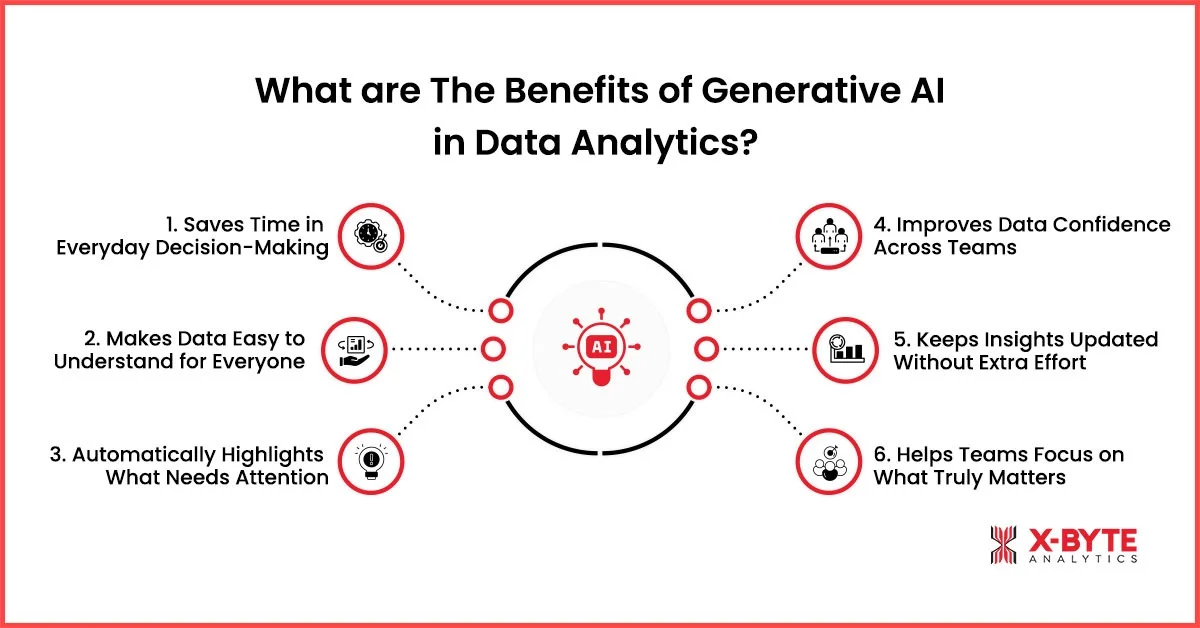
Generative AI doesn’t sit on the sidelines; it quietly becomes part of everyday business work. Here’s how it works and the benefits of generative AI in data analytics, not just one day, but every day.
1. Saves Time in Everyday Decision-Making
In day-to-day business life, time is often lost waiting for reports, updates, or someone to check the data. Generative AI in Data Intelligence changes this by giving instant answers. Teams can ask simple questions and immediately understand what’s happening without switching tools or digging through dashboards.
By 2026, over 50% of analytics interactions will be powered by natural language AI, significantly reducing the time spent on manual reporting and analysis.
For example, a team reviewing daily performance doesn’t need to open multiple reports. They ask a quick question, get a summary, and move forward faster, saving hours every week.
2. Makes Data Easy to Understand for Everyone
One of the biggest barriers to using data daily is complexity. McKinsey highlights that generative AI helps organizations turn complex data into simple, plain human language.
Instead of charts that need interpretation, teams get clear explanations of what the numbers mean and why they matter. This benefit of generative AI in data analytics
helps more people confidently use data in their everyday decisions.
3. Automatically Highlights What Needs Attention
In daily operations, important signals are often missed because no one has time to look closely at the data. Generative AI continuously scans information and brings attention to changes, trends, or unusual activity automatically.
Salesforce reports that AI-powered analytics helps businesses surface insights faster and identify trends earlier, improving responsiveness in everyday workflows.
4. Improves Data Confidence Across Teams
In everyday work, hesitation often comes from uncertainty; people aren’t sure if the data is accurate or how much they can trust it. One of the benefits of generative AI in data analytics helps by consistently explaining insights, showing context, and answering follow-up questions instantly.
PwC found that organizations using generative AI in Data Intelligence report higher confidence in data-led decisions, directly improving decision quality.
Over time, this builds confidence in data, so teams rely on it more naturally instead of second-guessing numbers.
5. Keeps Insights Updated Without Extra Effort
Data changes constantly, but insights often don’t. Generative AI continuously works with fresh data and updates summaries automatically.
IBM reports that AI-powered analytics enables near real-time insight updates, helping businesses stay aligned with rapidly changing data.
This means teams aren’t working with outdated numbers during their daily tasks. Everyone stays aligned without needing constant manual refreshes.
6. Helps Teams Focus on What Truly Matters
Daily work is often noisy, too many metrics, too many dashboards, too little clarity. But with the benefits of generative AI in data analytics, businesses can cut through the noise by summarizing what actually matters right now.
According to McKinsey, AI-driven analytics helps organizations shift focus from monitoring data to acting on the most relevant insights, improving daily execution.
Instead of overwhelming teams with data, it prioritizes insights that need attention.
Challenges in Implementing Generative AI for Data Analytics and How to Overcome Them?
Generative AI brings real value to data analytics, but adopting it isn’t always seamless. Businesses often face practical challenges in the early stages. The good news is that most of these obstacles are manageable with the right strategy and expectations.
Below are the most common challenges businesses encounter when adopting generative AI in data analytics, along with clear, actionable ways to overcome them.
1. Poor Data Quality and Readiness
Generative AI is only as good as the data it works with. If data is incomplete, outdated, or scattered across systems, AI-generated insights can be misleading or inconsistent.
Gartner highlights that poor data quality costs organizations an average of $12.9 million per year, making it one of the biggest barriers to effective analytics and AI adoption.
How to overcome it: Businesses don’t need perfect data, but they do need organized and reliable data. Start by cleaning core datasets, setting basic data standards, and ensuring key data sources are consistent. Improving data readiness step by step creates a strong foundation for meaningful AI-driven insights.
2. Lack of Trust in AI-Generated Insights
Even when AI performs well, trust can be a challenge. McKinsey identifies lack of trust and understanding as one of the top barriers to AI adoption. Teams may hesitate to rely on generative AI in data intelligence if they don’t understand how insights are produced.
How to overcome it: Transparency is essential. Generative AI data analytics tools should explain the “why” behind insights, not just the outcome. When users can ask follow-up questions and see reasoning in plain language, confidence builds naturally. Start with low-risk use cases and expand gradually to strengthen trust over time.
3. Skills Gap and Change Resistance
Many teams worry they need advanced technical or AI expertise to use generative AI tools. PwC reports that nearly 50% of employees are concerned about using AI due to skills gaps. This fear often leads to resistance, with employees sticking to familiar workflows instead of embracing new generative AI Tools for Data Analytics.
How to overcome it: The goal of generative AI is to reduce complexity, not add to it. Businesses should focus on AI data analytics tools that use natural language and fit into existing workflows. Simple onboarding, hands-on usage, and clear communication about how AI supports, not replaces, people can ease resistance quickly.
4. Data Privacy, Security, and Compliance Concerns
One of the biggest worries businesses face is what happens to their data once they introduce generative AI. Teams question whether sensitive data stays secure, how systems process it, and whether it meets compliance requirements. These concerns often slow adoption, especially when teams use data daily across multiple workflows.
How to overcome it: Start by defining clear data governance rules. Choose AI systems that provide strong access controls, built-in data masking, and full visibility into how they handle data. Restrict AI access to only the datasets teams actually need, and review usage regularly. These steps build trust, protect sensitive information, and keep daily operations secure.
5. Integration with Existing Tools and Workflows
McKinsey reports that poor integration is one of the top reasons AI initiatives fail to scale. Teams lose momentum when they switch tools or repeat the same work, and everyday productivity takes a hit. Over time, this friction reduces adoption and limits the value AI can deliver.
How to overcome it: Select generative AI Tools for Data Analytics that integrate directly with your current data sources and workflows. Leveraging Generative AI integration services ensures that teams can access AI insights within the systems they already use. When generative AI integrates naturally into existing processes, teams adopt it faster and use it consistently without feeling overwhelmed.
6. Managing Expectations and Overreliance on AI
Some teams expect generative AI to deliver perfect insights instantly. When results don’t meet expectations, trust drops. On the other hand, overreliance on AI without human judgment can lead to poor decisions in daily business situations.
Gartner warns that overreliance on AI without human oversight can increase decision risk.
How to overcome it: Position generative AI in Data Intelligence as a decision-support tool, not a decision-maker. Encourage teams to combine AI insights with human context and experience. Clear guidelines on when and how to use AI help balance speed with responsibility.
Popular Generative AI Tools for Data Analytics
As generative AI in data analytics matures, several platforms stand out for making data exploration more intuitive, conversational, and actionable. These tools combine traditional analytics with AI-driven insights, helping businesses move faster from data to decisions.
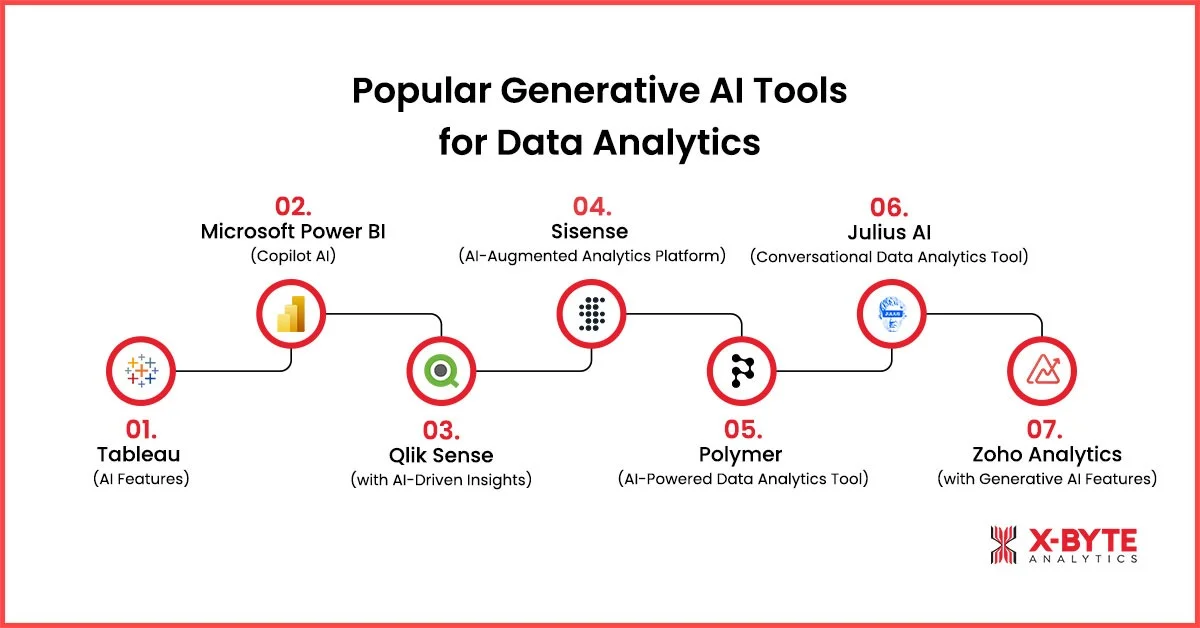
Below are some of the most popular generative AI tools for data analytics in 2026, along with when to use them and how they’re priced.
1. Tableau + AI Features
Rating: 4.6/5 – Best-in-class visualization with strong AI support
Tableau remains one of the most widely used analytics platforms, and its integrated AI capabilities make it even more powerful. It allows users to ask questions in plain language, automatically generate insights, and build interactive generative AI dashboards that explain trends instead of just showing them. This makes analytics more intuitive and accessible.
When to Choose: Choose Tableau if your focus is on visual storytelling, interactive dashboards, and intuitive data exploration powered by generative AI.
Pricing (2026):
- Creator: ~$75/user/month
- Explorer: ~$42/user/month
- Viewer: ~$15/user/month
(Requires annual contracts; enterprise bundles available)
2. Microsoft Power BI + Copilot AI
Rating: 4.5/5 – Excellent AI-enhanced analytics with strong integration
Microsoft Power BI integrates generative AI through Copilot, making it easier to explore data, summarize insights, and create generative AI dashboards using natural language. It turns traditional reports into conversational analytics experiences, supporting generative AI in business intelligence workflows.
When to Choose: Choose Power BI if your organization already uses Microsoft 365, Azure, or the broader Microsoft ecosystem and wants AI-powered analytics embedded into existing workflows.
Pricing (2026):
- Free tier available
- Pro: ~$14/user/month
- Premium Per User: ~$24/user/month
- Capacity/Enterprise: Custom pricing
3. Qlik Sense (with AI-Driven Insights)
Rating: 4.4/5 – Smart associative analytics with AI support
Qlik Sense uses AI-driven and associative analytics to automatically surface patterns, relationships, and anomalies across datasets. Its AI capabilities enhance generative AI analytics by helping users explore data freely and uncover insights without predefined queries.
When to Choose: Choose Qlik Sense deep exploratory analysis, AI-assisted pattern detection, and flexible data discovery powered by Gen AI and Data Analytics.
Pricing:
- Starter: ~$200/month – suitable for small teams or pilots
- Standard: ~$825/month – supports more users and data capacity.
- Premium: ~$2,750/month – advanced features and larger datasets.
- Enterprise: Custom pricing – tailored to large team needs and complex analytics environments.
4. Sisense (AI-Augmented Analytics Platform)
Rating: 4.3/5 – Generative AI that simplifies complex analytics
Sisense blends smart AI capabilities into its analytics platform so businesses can translate complex datasets into clear insights and conversational analytics. It enables conversational analytics, automated insight generation, and smart modeling, making it easier to build and understand generative AI dashboards across teams.
When to Choose: Choose Sisense when you need generative AI that accelerates modeling, exploration, and storytelling, especially if you plan to embed analytics into custom workflows or apps.
Pricing (2026):
- Small teams: $10,000/year (≈ $833/month) for basic analytics
- Mid-to-large Developments: $21,000–$60,000+ per year, depending on scope, data volume, and features.
5. Polymer (AI-Powered Data Analytics Tool)
Rating: 4.5/5 – Generative AI that makes analytics simple and intuitive
Polymer is a modern AI data analytics tool that turns raw data into interactive, generative AI dashboards without heavy setup. It uses generative AI for data analytics to automatically analyze datasets, highlight patterns, and present insights in a clean, easy-to-understand format. Users don’t need technical expertise to explore data or build reports.
When to choose it: Choose Polymer if you want fast, no-code analytics and generative AI dashboards that simplify everyday reporting and decision-making.
Pricing:
- Starter: ~$29 per user/month – ideal for small teams just beginning with AI analytics.
- Professional: ~$69 per user/month – adds more advanced dashboards and AI insights.
- Enterprise: Custom pricing – tailored for larger teams and secure data governance.
6. Julius AI (Conversational Data Analytics Tool)
Rating: 4.3/5 – Conversational generative AI that turns questions into insights
Julius AI focuses on conversational analytics. It allows users to upload datasets and ask questions in plain language, instantly generating explanations, summaries, and visualizations. This makes generative AI analytics feel like a conversation rather than a technical task.
When to choose it: Choose Julius AI if your goal is quick analysis, data exploration, and insight generation without complex dashboards or BI setup.
Pricing:
- Basic: ~$25 per user/month, good for individual analysts or small teams.
- Team: ~$59 per user/month – more query limits, collaboration features, and data connectors.
- Enterprise: Custom – larger dataset support and enhanced security options.
7. Zoho Analytics (with Generative AI Features)
Rating: 4.4/5 – Generative AI in business intelligence that enhances everyday decision-making
Zoho Analytics combines traditional BI with generative AI in business intelligence to help users analyze data, generate reports, and ask questions using natural language. Its AI assistant helps automate insight discovery and supports building smart, generative AI dashboards.
When to choose it: Choose Zoho Analytics if you want an affordable, scalable solution that brings Generative AI Tools for Data Analytics into everyday business workflows.
Pricing:
- Basic: ~$25 per user/month – good for individual analysts or small teams.
- Team: ~$59 per user/month – more query limits, collaboration features, and data connectors.
- Enterprise: Custom – larger dataset support and enhanced security options.
Future Trends in Gen AI and Data Analytics that you Should Know in 2026 & Beyond!
1. Analytics Will Become Fully Conversational
In the future, data analysis will feel more like a conversation than a technical task. Instead of navigating dashboards or writing queries, teams will simply ask questions and receive clear, context-aware answers. Generative AI will understand follow-up questions, refine insights, and explain results in plain language.
What this means for businesses: Analytics will fit naturally into daily meetings, planning sessions, and quick decision checks. More employees across teams will use data confidently without specialized training or technical support.
2. Embedded Analytics Will Become the Default
Generative AI will bring analytics directly into everyday tools and workflows. Teams won’t need to open separate analytics platforms; insights will appear where work already happens.
What this means for businesses: Analytics becomes frictionless. Teams stay focused, make faster decisions, and rely on data without interrupting their workflow.
3. From Insights to Recommendations (Not Just Reports)
Generative AI will move beyond explaining what happened to actively recommending what to do next. Instead of static insights, analytics systems will suggest actions, highlight risks, and prioritize opportunities based on real-time data.
What this means for businesses: Teams won’t just see trends; they’ll get guidance according to the data and current market scenarios. This will reduce decision fatigue and help businesses respond faster in their day-to-day operations.
4. Real-Time, Always-On Analytics
Future analytics won’t wait for scheduled reports. Generative AI will continuously analyze live data and update insights automatically. Generative AI dashboards will evolve in real time, keeping teams aligned with what’s happening right now.
What this means for businesses: Decisions will rely on current, not outdated, information. Teams will spot changes early and adjust quickly, making analytics a constant support system rather than an occasional tool.
5. Analytics Will Become More Personalized
Generative AI will adapt insights based on roles, goals, and daily priorities. Instead of one dashboard for everyone, analytics will adjust automatically, showing the most relevant insights to each team or individual.
What this means for businesses: People will see what matters to them instantly. This reduces noise, improves focus, and makes analytics more useful in everyday work.
6. Responsible and Explainable AI Will Take Center Stage
As generative AI becomes more embedded in analytics, businesses will demand greater transparency and control. Future AI data analytics tools will clearly explain how insights are generated and allow teams to review, validate, and trust AI outputs.
What this means for businesses: Stronger trust in AI-driven insights will lead to wider adoption. Teams will feel confident using generative AI in data intelligence while maintaining human oversight.
To Wrap!
Generative AI is reshaping big data analytics, but the shift is not about replacing existing systems-it’s about making data easier to use, understand, and act on every day.
Businesses that approach generative AI thoughtfully can turn analytics into a true decision-support layer, rather than just a reporting function. Success requires the right strategy, data readiness, and practical implementation.
Of course, making this transition work smoothly takes the right mix of strategy, data readiness, and practical implementation. That’s where having an experienced analytics partner can quietly make a difference.
At X-Byte Analytics, we help businesses navigate this shift with a focus on real outcomes, whether that’s through a generative AI consulting service, a data analytics consulting service, or hands-on support with generative AI integration. Our approach to AI consulting and AI for data analytics centers on making AI useful in day-to-day business decisions, not just technically impressive. Connect with our data consultants today to explore how generative AI can transform your analytics and decision-making.