

Key Highlights:
- Step-by-Step Enterprise Framework: A complete guide to designing, implementing, and scaling an enterprise-grade data integration framework aligned with business goals.
- Cloud, AI & Real-Time Integration: Covers modern architectures, AI-driven automation, real-time data streaming, and cloud-native tools for future-ready data integration.
- Governance, Security & Scalability: Emphasizes data quality, compliance, security, and scalable design to support growing enterprise data volumes and evolving needs.
Introduction
In today’s data-driven world, businesses generate massive amounts of data from a wide range of sources. The ability to efficiently manage and integrate this data is critical for making informed decisions and staying competitive. One of the key components of this process is a scalable enterprise data integration framework, often supported by reliable enterprise data integration services that ensure data flows seamlessly across systems. This guide will walk you through how to build a robust, scalable system that allows your enterprise to manage vast datasets while maintaining data consistency, quality, and security.
What Is a Scalable Data Integration Framework?
A scalable data integration framework is a structured system designed to combine data from disparate sources and make it accessible for analysis and decision-making. The framework enables enterprises to handle growing data volumes-often in real time-by integrating multiple applications, data repositories, and external systems.
Scalability is essential because business operations and data requirements continuously evolve. A well-designed data integration architecture supports flexibility, efficiency, and long-term growth. It can scale horizontally or vertically based on enterprise needs, allowing organizations to process increasing data workloads without compromising performance or reliability.
The Strategic Importance of Data Integration for Enterprises
A data integration architecture is the backbone of data-driven decision-making. For enterprises to remain competitive, they need to integrate data across various departments-finance, sales, marketing, and operations-and leverage it in real-time. With a cloud data integration framework, businesses can break down silos, gain more meaningful insights, and make faster, more informed decisions.
Key benefits include:
- Improved operational efficiency: With integrated data, teams can eliminate manual processes and automate workflows.
- Data-driven insights: Unified data leads to more accurate reports, predictive analytics, and business intelligence.
- Flexibility and scalability: A scalable integration framework supports growth, enabling businesses to add new data sources and processing capabilities as needed.
- Enhanced Collaboration Across Teams: Integrated data fosters better communication and alignment across departments, improving teamwork and decision-making.
- Improved Customer Experience: A unified data view enables personalized marketing and support, enhancing customer satisfaction and loyalty.
Enterprise Data integration services play a pivotal role in achieving these benefits, ensuring that data flows seamlessly across an organization to unlock its full potential.
Step-by-Step Process to Build a Scalable Enterprise Data Integration Framework
Building a scalable enterprise data integration framework requires a structured, goal-driven approach that balances business objectives, technology choices, and long-term scalability. Rather than treating data integration as a one-time technical task, enterprises must view it as an evolving capability that supports real-time insights, operational efficiency, and data-driven decision-making. The following steps outline a practical, end-to-end process-from defining business goals to continuous optimization-ensuring your data integration framework remains reliable, secure, and future-ready as data volumes and complexity grow.
Step 1: Setting Business Goals for Your Data Integration Framework
Before building a scalable data integration framework, it’s important to align the framework with your business strategy. Start by defining clear objectives for your data integration project. These might include:
- Improving data quality and consistency
- Enabling real-time decision-making
- Automating data transformation and reporting
- Reducing data silos and improving collaboration across departments
Key Performance Indicators (KPIs) should be established to track the success of your framework. These could include data processing speed, the number of data sources integrated, and error rates.
By aligning the framework with business goals, you ensure that the integration is not just a technical solution, but a strategic enabler for business growth.
Step 2: Designing the Data Architecture for Scalability
Designing an effective data integration architecture is the foundation of any successful integration framework. There are two primary approaches to consider:
- Batch processing: Ideal for non-time-sensitive data processing. Suitable for large datasets that don’t need immediate processing.
- Real-time processing: Enables instant access to data and insights, which is crucial for businesses needing up-to-the-minute information.
Next, decide whether your architecture will be cloud-based or on-premise. Cloud data integration frameworks offer scalability, flexibility, and ease of use, especially for enterprises moving towards hybrid environments. On the other hand, on-premise solutions may provide more control but can be less flexible as your data grows.
Consider these components in your design:
- Data connectors: Tools that link your enterprise applications and databases to the integration platform.
- ETL processes (Extract, Transform, Load): Automation of data transformation and loading into central repositories.
- Data governance: Ensure data is clean, accurate, and compliant with security and regulatory standards.
Step 3: Selecting the Right Tools & Technologies
Choosing the right tools for building your data integration framework is critical. Popular tools for scalable enterprise data integration include:
- Informatica PowerCenter: Comprehensive tool for ETL, data governance, and cloud integration.
- MuleSoft Anypoint Platform: API-led integration that supports scalable architectures.
- Talend: Open-source tool for data integration with cloud capabilities.
- Microsoft Azure Data Factory: A cloud-native ETL tool with advanced features for automating data pipelines.
Consider your enterprise’s needs when selecting tools. If your business requires automation and real-time data integration, tools with AI-powered data transformation, like Fivetran or SnapLogic, can provide significant advantages.
Additionally, ensure your tools support AI-driven data integration, which automates processes like data mapping and error correction, reducing the need for manual intervention and improving the speed of integration.
Step 4: Implementing Data Governance & Quality Control
Once the data architecture and tools are chosen, it’s time to focus on data governance and quality control. A cloud data integration framework should include policies and mechanisms to ensure the data is accurate, consistent, and compliant with regulations.
Key steps include:
- Data lineage tracking: Implement tools that trace the flow of data throughout the system, ensuring visibility and transparency.
- Data quality rules: Define and enforce rules for data validation, completeness, and accuracy.
- Compliance protocols: Ensure the integration adheres to GDPR, CCPA, and other relevant standards.
By implementing data governance early on, enterprises can ensure that the integration framework provides trustworthy, high-quality data for decision-making.
Step 5: Ensuring Security and Compliance in the Framework
With increasing concerns over data breaches and regulatory compliance, data security and compliance should be integral parts of your data integration architecture. Design your framework with secure data pipelines, end-to-end encryption, and role-based access controls.
Additionally, ensure that the integration framework complies with industry standards like GDPR, HIPAA, or CCPA. Establish audit trails to track data access and modifications, which can help with compliance and troubleshooting.
Step 6: Scaling the Data Integration Framework
As your business grows, your data integration framework must scale accordingly. To build a truly scalable data integration framework, design it with elasticity in mind. Consider the following:
- Horizontal scaling: Add more processing power as the volume of data increases.
- Cloud scalability: Utilize cloud resources to automatically adjust to fluctuating data needs.
- Fault-tolerant systems: Design for system resilience with automated error handling and self-healing mechanisms to avoid interruptions.
Step 7: Monitoring & Optimizing the Integration Framework
After the framework is up and running, the next step is continuous monitoring and optimization. Use real-time monitoring tools to track key metrics such as data throughput, system performance, and error rates.
Optimize the system by:
- Identifying bottlenecks and optimizing data pipelines.
- Upgrading tools as needed to support new data formats or real-time streaming.
- Automating error detection and recovery mechanisms to minimize downtime.
Partner With X-Byte Analytics To Unlock The Full Potential Of Your Enterprise Data Integration Services Today!
Real-World Examples of Scalable Data Integration Frameworks
Several large enterprises have successfully implemented scalable data integration frameworks, achieving substantial operational improvements and enhanced decision-making. These real-world examples demonstrate the tangible benefits of data integration and how it enables businesses to break down data silos, improve operational efficiency, and provide better customer service.
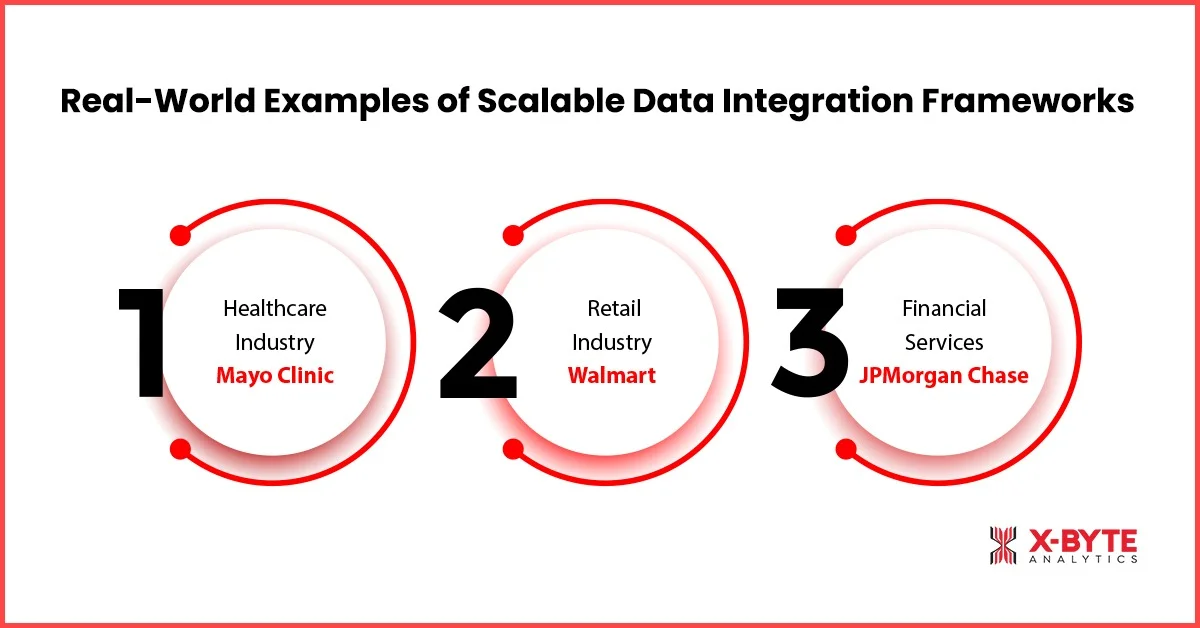
1. Healthcare Industry: Mayo Clinic
The Mayo Clinic, a leading healthcare provider, uses a cloud-based data integration framework to manage patient records across its various departments. This integration allows real-time access to patient data, enabling healthcare professionals to make faster, more informed decisions. For example, when a patient’s test results are uploaded into the system, the entire care team-across different locations-can access it instantly, facilitating seamless collaboration.
Key Benefit: Real-time access to patient data improves patient care, reduces wait times, and ensures better outcomes.
2. Retail Industry: Walmart
Walmart, one of the world’s largest retailers, uses real-time data integration to track inventory levels across its vast network of stores. With a cloud-based data integration framework, Walmart can monitor stock levels and sales trends in real-time, optimizing its supply chain operations and minimizing out-of-stock situations. This allows the company to respond to shifts in consumer demand more quickly, ensuring products are always available.
Key Benefit: Real-time inventory management enhances supply chain efficiency and improves stock availability.
3. Financial Services: JPMorgan Chase
JPMorgan Chase leverages an enterprise-scale data integration framework to pull together data from various departments like risk management, customer service, and trading to get a single view of operations. By using cloud and on-premise integration solutions, they improve customer experience and reduce risk through timely data insights.
Key Benefit: Unified access to financial data across departments enhances decision-making and reduces operational risks.
Future Trends: AI-Driven & Streaming Data Integration
The future of enterprise data integration services is being shaped by emerging technologies, particularly in AI-driven data integration and real-time streaming data architectures. As businesses face increasing volumes of data, the need for faster, more agile integration solutions is growing. These advancements are expected to significantly reduce latency, improve performance, and enable businesses to make more informed decisions quickly.
Key Trends in Future Data Integration:
1. AI-Driven Data Integration: AI-powered tools will automate data mapping, cleansing, and transformation. AI will also identify patterns and anomalies within data to improve decision-making.
2. Real-Time Streaming Data: Real-time data processing will be a game-changer for industries like retail, finance, and healthcare, where businesses need up-to-the-minute information for decision-making.
3. Edge Computing: It will enable data processing closer to the source (e.g., IoT devices, remote locations), reducing latency and bandwidth issues.
4. 5G Networks: With the adoption of 5G, enterprises will experience much faster data transfer rates, enabling quicker data integration and improved performance in real-time analytics.
5. Cloud-Native Integration Platforms: Cloud-based data integration platforms are evolving to support multi-cloud environments. These platforms enable businesses to integrate data across different cloud providers seamlessly.
6. Increased Automation & Self-Healing Systems: The future of data integration will involve greater automation, where data systems can self-monitor, identify issues, and self-correct without human intervention.
The AI-driven and streaming data trends are poised to revolutionize how enterprises integrate and utilize data, enabling faster decision-making, more intelligent insights, and more efficient operations.
Conclusion: Building a Future-Ready Enterprise Data Integration Framework
Building a scalable enterprise data integration framework is essential for businesses to remain competitive in today’s data-driven world. It ensures seamless data integration, quality, security, and real-time insights while supporting future growth.
At X-Byte Analytics, we specialize in designing custom data integration frameworks tailored to your business needs. We leverage cutting-edge technologies to ensure your framework is future-ready and scalable.
Our expertise in Power BI development dashboards, predictive analytics, and AI-based insights helps unlock actionable insights, automate processes, and drive growth. Let us empower your business to thrive in the evolving digital landscape.