

Quick Summary
- E-commerce analytics helps businesses convert customer and sales data into actionable revenue insights
- Companies using structured e-commerce data analytics see measurable improvements in conversion rates, retention, and profitability
- Unified dashboards enable leadership teams to track performance, identify risks, and act faster with confidence
In today’s competitive digital economy, growth is no longer driven by intuition or isolated reports. Successful online businesses rely on e-commerce analytics to understand customers, optimize performance, and unlock sustainable revenue growth. Every click, view, cart action, and purchase tells a story-and analytics is what turns that story into smarter decisions.
The scale of global ecommerce continues to expand rapidly. At the same time, the e-commerce analytics market itself is booming: it’s expected to be worth approximately USD 25.72 billion in 2026 and grow at a strong compound annual growth rate (CAGR) of 17.7 % through 2032, signaling increasing adoption of analytics solutions among ecommerce brands.
This guide explains what e-commerce data analytics is, how it works, and how businesses use customer data to increase ecommerce revenue in clear, practical terms that business leaders can actually apply.
What Is E-Commerce Analytics?
E-commerce analytics is the process of collecting, analyzing, and interpreting data from online sales channels to understand customer behavior, sales performance, and business outcomes.
At a basic level, it answers questions like:
- Where are customers coming from?
- What products do they engage with?
- Why do some visitors convert while others drop off?
- Which efforts actually drive revenue?
Unlike basic reports that show “what happened,” analytics focuses on why it happened and what to do next. This shift-from reporting to insight-is what separates growing ecommerce brands from stagnant ones.
Partner With X-Byte Analytics To Accelerate Your E-Commerce Analytics Service Strategy And Gain Competitive Advantage.
Why E-Commerce Analytics Matters for Revenue Growth
Modern ecommerce businesses generate massive volumes of customer, sales, and marketing data, but without analytics, this data remains untapped potential. When analyzed correctly, it reveals clear patterns in customer behavior, purchase intent, and performance gaps-turning raw data into a scalable revenue growth engine.
E-commerce analytics enables businesses to move from reactive decisions to proactive, insight-driven strategies that directly impact profitability.
Key revenue-driving benefits include:
- Full Customer Journey Visibility: Track every interaction from first visit to repeat purchase to identify drop-offs, friction points, and hidden revenue opportunities.
- Faster, Data-Backed Decisions: Replace assumptions with real-time insights for pricing, promotions, inventory planning, and campaign optimization.
- Reduced Revenue Leakage: Detect funnel inefficiencies, low-margin products, and underperforming channels before losses compound at scale.
- Improved Customer Retention & Loyalty: Use behavioral insights to personalize experiences, increase repeat purchases, and grow customer lifetime value.
- Smarter Resource Allocation: Focus time, budget, and effort on high-impact products, channels, and customer segments that drive sustainable returns.
Core Data Sources Used in E-Commerce Analytics
Moderne-commerce data analytics relies on integrating data from every customer touchpoint to create a complete, accurate picture of business performance. When data flows from multiple systems into a unified view, teams gain clarity, consistency, and confidence in their decisions.:
- Website and app behavior data
- Sales and transaction data
- Marketing and advertising performance data
- Customer and CRM data
- Inventory, fulfillment, and operational data
When these sources operate in silos, decision-making slows down. Analytics unifies them into a single, reliable source of truth, enabling faster decisions and smarter growth strategies.
Key E-Commerce Metrics That Directly Impact Revenue
Tracking the right e-commerce metrics ensures teams focus on actions that drive real business results, not vanity numbers. By monitoring conversion, revenue, and marketing performance metrics together, businesses can clearly see what influences sales and profitability. These insights help leaders prioritize improvements that directly impact revenue growth.
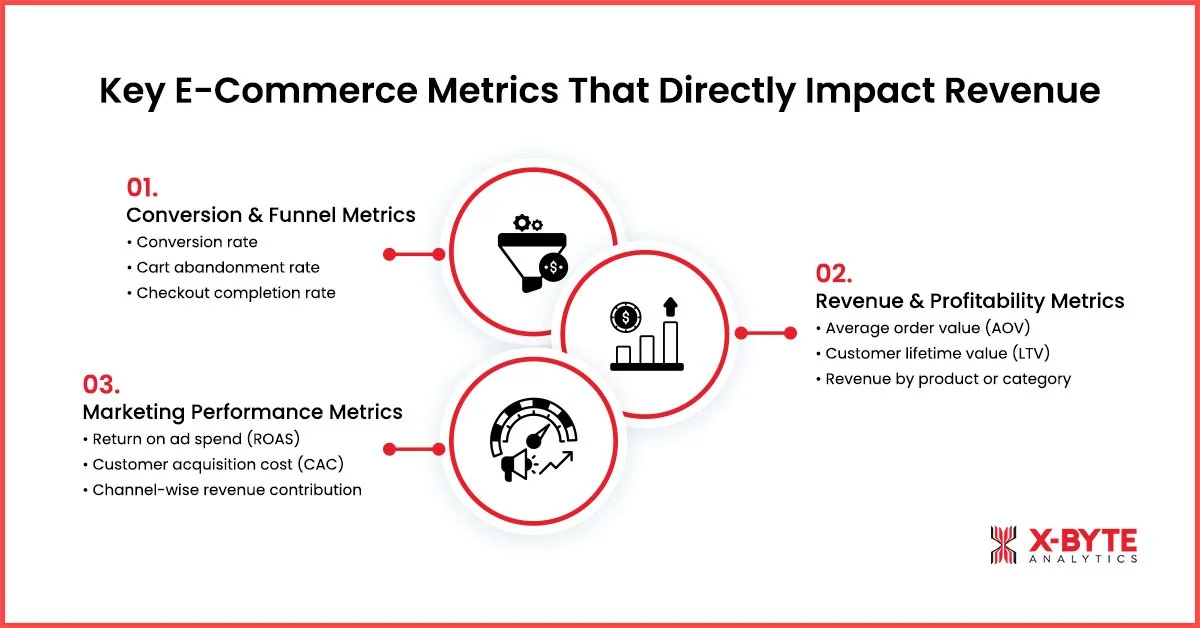
Conversion & Funnel Metrics
- Conversion rate
- Cart abandonment rate
- Checkout completion rate
These conversion funnel metrics reveal friction points that directly affect sales volume.
Revenue & Profitability Metrics
- Average order value (AOV)
- Customer lifetime value (LTV)
- Revenue by product or category
Understanding customer lifetime value (LTV) helps businesses shift from short-term sales to long-term profitability.
Marketing Performance Metrics
- Return on ad spend (ROAS)
- Customer acquisition cost (CAC)
- Channel-wise revenue contribution
Strong marketing ROI tracking ensures budgets are allocated to channels that actually generate profit.
How E-Commerce Data Analytics Improves Sales Outcomes?
E-commerce Sales data analytics transforms raw customer and sales data into insights that guide smarter business actions. By analyzing behavior patterns, performance trends, and demand signals, teams can optimize pricing, personalization, and operations. This approach enables consistent improvements in conversions, retention, and overall sales performance.
1. Smarter Pricing & Promotion Decisions
By analyzing historical sales and customer response, teams identify which discounts drive volume and which simply erode margins.
2. Personalized Customer Experiences
Customer behavior analysis enables personalized recommendations, targeted offers, and tailored messaging that increases engagement and conversions.
3. Inventory & Demand Optimization
Analytics helps forecast demand accurately, preventing overstock, stockouts, and lost sales.
4. Improved Retention & Repeat Purchases
Retention-focused insights improve post-purchase engagement, loyalty programs, and repeat buying cycles, key to predictable growth.
5. Smarter Channel & Campaign Optimization
E-commerce data analytics reveals which marketing channels and campaigns contribute most to conversions and revenue. This allows teams to focus budgets on high-performing efforts while reducing wasted spend.
6. Faster Decision-Making with Real-Time Insights
Real-time analytics enables teams to respond quickly to changes in customer behavior and demand trends. Faster insights help businesses act on opportunities and prevent potential revenue losses.
This is how e-commerce analytics improves sales beyond surface-level reporting.
E-Commerce Analytics vs Basic Reporting
Many businesses believe they’re “doing analytics” when they’re only reviewing reports. The difference is critical.
- Basic reporting shows static numbers after the fact
- E-commerce analytics delivers real-time insights and forward-looking recommendations
- Reports answer what happened; analytics explains why and what to do next
To enable this level of intelligence, a modern e-commerce analytics setup is designed for clarity, speed, and action, not complexity. It typically includes:
- A centralized data model that unifies data from all sources
- Automated data pipelines to eliminate manual reporting and errors
- Real-time dashboards that support faster, data-driven decisions
- Role-based views tailored for leadership, marketing, and operations teams
A well-designed e-commerce analytics dashboard ensures every stakeholder sees the metrics that matter most to their role-turning raw data into timely, actionable insight across the organization.
Common Challenges Businesses Face Without Proper Analytics
Without a structured analytics setup, businesses face numerous inefficiencies that hinder decision-making and growth. Common issues include conflicting numbers across different tools, delayed or manual reporting, and a lack of clarity on revenue drivers. As businesses scale, these challenges intensify, making analytics not a luxury but a necessity for smooth, data-driven operations.
Key Challenges:
- Conflicting numbers across different tools and platforms
- Delayed or manual reporting that increases turnaround time
- Lack of clarity on key revenue drivers, impacting decision-making
- Reliance on partial, outdated, or incomplete data for decisions
- Difficulty in scaling analytics with business growth
- Missed opportunities to act on real-time insights
- Increased risk of inefficiencies and operational bottlenecks
How Analytics Teams Use Insights to Drive Growth
Analytics empowers various teams across the organization, providing valuable insights that drive growth and efficiency. Marketing teams leverage analytics to optimize campaigns, improving ROI. Leadership teams gain deeper revenue performance insights and growth trends to make informed decisions. Operations teams use data to enhance fulfillment efficiency and streamline inventory planning, ensuring better overall performance and cost-effectiveness.
- Marketing teams use analytics to optimize campaigns and improve ROI
- Leadership teams track revenue performance and identify growth trends
- Operations teams use insights to improve fulfillment and inventory planning
- Data supports cross-functional collaboration for better outcomes
- Real-time insights help teams make proactive, data-driven decisions
- Enables alignment between various departments with a shared understanding of business metrics
- Promotes agile, efficient business practices, reducing waste and inefficiencies
Choosing the Right E-Commerce Analytics Partner
The effectiveness of analytics depends heavily on its implementation. When selecting an analytics partner or platform, businesses should prioritize those with experience in e-commerce-specific data models and a strong understanding of business intelligence, dashboards, and automation. A good partner will help businesses scale their analytics efforts, offering actionable insights that drive business outcomes, rather than just focusing on tools alone.
1. E-Commerce-Specific Data Models: Experience with e-commerce-specific data models and analytics needs to ensure relevancy and accuracy.
2. Scalability with Growing Data: Ability to handle and scale with increasing data volumes as the business expands.
3. Expertise in Business Intelligence (BI): Strong understanding of business intelligence, dashboards, and automation tools to deliver comprehensive insights.
4. Focus on Business Outcomes: Focus on actionable insights and business outcomes, rather than just providing tool-based features.
5. Customization Based on Business Requirements: Ability to customize analytics solutions to meet the unique needs and goals of the business.
6. Proven Track Record: A proven track record in delivering impactful, data-driven decisions that result in measurable business improvements.
7. Seamless System Integration: Seamless integration with existing systems to ensure minimal disruption and maximum efficiency.
Supercharge Your E-Commerce Analytics Service With X-Byte Analytics And Turn Data Into Powerful Business Insights.
Final Thoughts: From Data to Revenue Growth
E-commerce success today hinges on how well businesses convert data into actionable insights. By leveraging analytics, companies can unlock a deeper understanding of customer behavior, identify growth opportunities, and fine-tune their strategies. This shift from basic reporting to real-time analytics is essential for gaining a competitive edge in the digital marketplace.
When used effectively, analytics becomes a powerful tool for driving revenue growth. It moves beyond just tracking metrics and transforms decision-making, allowing businesses to act quickly and efficiently. Ultimately, analytics is not just a reporting function, it’s a strategic asset that fuels smarter decisions, faster execution, and long-term success.