
Key Highlights:
- The Databricks Data Intelligence Platform unifies data engineering, analytics, AI, and governance into one foundation.
- With native integrations with OpenAI and Google Gemini built into Databricks, enterprises can run frontier AI models directly on their own governed data.
- Organizations using the Databricks analytics platform report reducing time-to-insight by up to 80%, turning multi-day pipeline builds into hours and overnight reports into real-time answers.
In early 2024, a Fortune 500 retailer nearly collapsed under the weight of its own data. Seventeen siloed systems. Four incompatible analytics tools. And a 72-hour lag between customer behavior and business response. That gap wasn’t just operational, it was expensive.
Then, they deployed Databricks Data Intelligence Platform, and query latency dropped 94%. Time-to-insight shrank from days to minutes. The CFO called it the most defensible $47 million the company had ever spent, and the data team finally had a foundation they could build on.
That story is not unusual anymore. Across industries, enterprises are hitting the same wall. Too much data. Too many tools. Too little intelligence connecting it all.
The ones breaking through are not doing it with more dashboards or bigger data teams. They are doing it with a fundamentally different foundation.
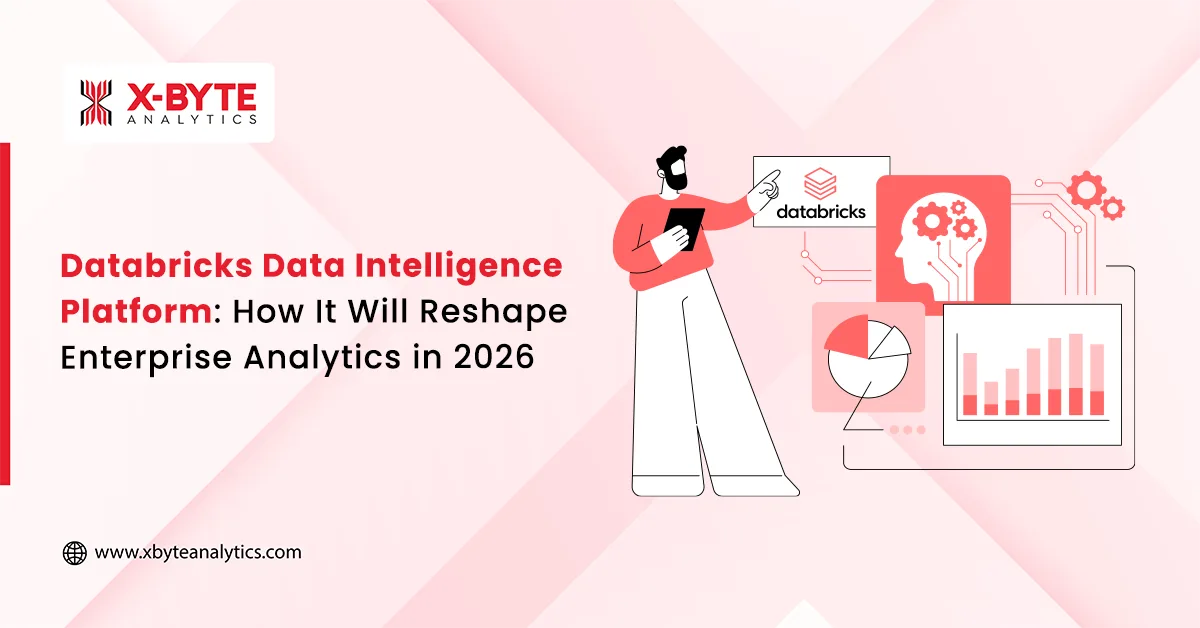
That is exactly what the Databricks Data Intelligence Platform provides.
If you also want to learn more about Databricks Data Intelligence Platform, why it matters in 2026, the benefits of the Databricks platform, Databricks analytics use cases, and more? Then this blog is for you.
Why Data Intelligence Matters in 2026?
For the last decade, enterprises invested heavily in collecting data. They built data lakes, hired data engineers, and deployed BI tools. The assumption was simple: more data meant better decisions.
But it did not work out that way.
Most organizations ended up with more data and less clarity.
- Pipelines that broke silently.
- Dashboards nobody trusted.
- AI pilots that never made it to production.
The data was there. The intelligence was not.
2026 is the year that the gap became impossible to ignore, because AI has moved from a side project into the core of how enterprises operate.
This shift makes data intelligence critical for several reasons:
- Business moves faster, and decisions cannot wait for weekly reports
- AI is now part of daily operations, and bad data means bad AI decisions
- Customers expect personalized, real-time experiences that disconnected data simply cannot support
- Regulations are tightening, and businesses need to know exactly where their data comes from
The Databricks Data Intelligence Platform addresses all of this in one place, giving enterprises the speed, accuracy, and trust they need to make data work for the business, not against it.
But Why Databricks?
Most enterprise data platforms solve one problem well, warehousing, or ML, or governance, and then bolt everything else on top.
Databricks was built differently. At its core is the lakehouse architecture: a single, open foundation that handles data engineering, machine learning, business intelligence, and AI governance without forcing teams to stitch together five different tools to get there.
Today, Databricks is used by more than 20,000 organizations worldwide, including companies like Mastercard, AT&T, Unilever, and Bayer, as well as over 60% of Fortune 500 enterprises
More recently, Databricks announced a $100 million partnership with OpenAI, bringing advanced AI capabilities directly into the platform. This allows enterprises to run frontier AI models on their own data without moving it across systems, reducing complexity, improving security, and minimizing compliance risks.
Turn Your Enterprise Data Into Actionable Intelligence With Databricks and Start Driving Faster, More Confident Decisions.
Key Features of the Databricks Data Intelligence Platform
1. Unity Catalog — One Place to Govern Everything
Most enterprises operate with multiple tools, fragmented governance policies, and inconsistent data definitions. Unity Catalog eliminates that complexity by providing a single governance layer for all data, models, and dashboards across clouds and teams.
Why does it matter? With this, teams can get a single source of truth. Compliance audits will be faster. And when something goes wrong in a pipeline, you can trace exactly where the data came from and what touched it along the way.
For example, a global pharmaceutical company replaced HIPAA compliance reconciliation across six separate systems with a single Unity Catalog setup, cutting their audit preparation time from three weeks to two days.
2. Databricks SQL — Answers Without the Wait
Analysts want answers, not infrastructure lessons. So, for business teams, Databricks offers Databricks SQL, a powerful analytics engine designed for large-scale queries and business intelligence workloads.
It allows analysts to run complex SQL queries on massive datasets while connecting easily with BI tools used across the organization.
Why it matters: With this, even non-technical teams can easily extract insights from large datasets, strengthening the role of the enterprise data intelligence platform across the organization.
Example: A marketing team can analyze campaign performance across billions of customer interactions and quickly identify which channels drive the highest conversions.
3. Delta Lake — Pipelines That Don’t Break at 3 AM
Modern analytics depends on reliable, high-quality data pipelines. The Databricks Data Intelligence Platform uses Delta Lake to ensure data remains consistent, accurate, and production-ready.
Why does it matter? Traditional data lakes often struggle with broken pipelines, inconsistent schemas, and unreliable datasets. Delta Lake introduces features like ACID transactions, schema enforcement, and version control to maintain data integrity.
Example: A logistics company running Delta Lake eliminated 94% of their manual pipeline intervention incidents within the first quarter of deployment, freeing their data engineering team to focus on new capabilities instead of firefighting.
4. Mosaic AI — AI That Actually Makes It to Production
Most enterprises are not struggling to build AI models. They are struggling to deploy them reliably, at scale, connected to live business data, with governance that satisfies legal and compliance teams. Mosaic AI handles the entire journey inside one governed environment, model training, fine-tuning, deployment, and ongoing monitoring.
Why does it matter? Businesses can build production-grade AI applications such as chatbots, recommendation engines, and intelligent assistants directly on their business data.
Example: A global support team can build an AI assistant that analyzes internal documentation, customer tickets, and knowledge bases to generate accurate responses for customer queries. The assistant continuously improves as it learns from new data.
5. AutoML and AI Assistance — For Teams Without a Deep Bench
Not every enterprise has a large data science team, and Databricks helps with that as well. AutoML automatically builds, evaluates, and explains models, giving smaller teams the ability to run serious predictive analytics without needing a specialist. An AI assistant helps data engineers write, debug, and optimize code in real time, catching errors and suggesting improvements as they work.
Why does it matter? Because talent is the real bottleneck for most enterprises, not technology. Databricks is deliberately designed to make a team of five do the work that previously required twenty.
Example: A company can build several risk assessment models, compare their performance, and deploy the most accurate one for evaluation.
6. Structured Streaming — Act Now, Not Tomorrow Morning
Batch reports made sense when decisions moved slowly. In 2026, they are a liability. Structured Streaming inside the Databricks Data Intelligence Platform processes live data with the same reliability as traditional batch pipelines in real time, the moment it arrives.
And because it runs natively inside the Databricks Data Intelligence Platform, the streaming data is governed, traceable, and queryable alongside all other data without any additional tooling.
Why does it matter?
A fintech company now detects and flags fraudulent transactions in under 200 milliseconds, not after the nightly run, but the moment the transaction occurs, reducing fraud losses by 34% in the first six months.
Benefits of the Databricks Data Intelligence Platform
When organizations talk about becoming data-driven, what they really mean is this: they want clarity. Not just more dashboards, not just more reports, but insights they can trust and act on. Here are the key benefits organizations experience when they adopt the Databricks Data Intelligence Platform.
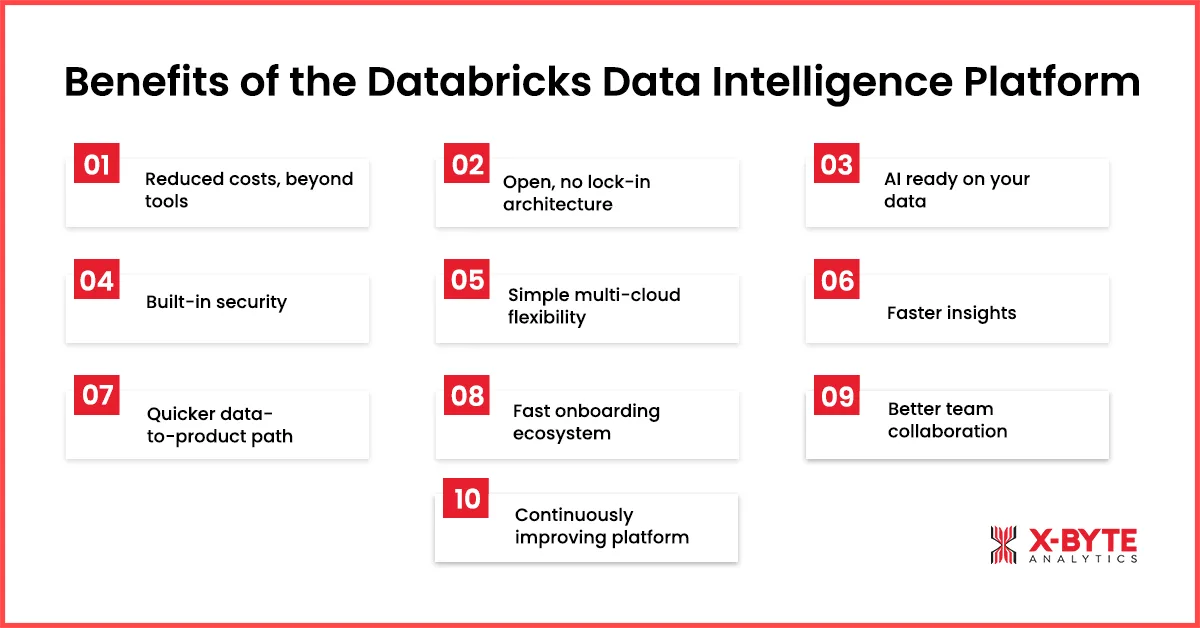
1. Reduced Costs, Not Just Consolidated Tools
Running separate systems for storage, analytics, and AI costs more than most enterprises realize, not just in licensing fees, but in the engineering hours spent keeping everything in sync.
The Databricks Data Intelligence Platform replaces that sprawl with one unified foundation. One team, one platform, one bill, doing the work that previously required multiple specialized groups and twice the budget.
2. Open Architecture That Does Not Lock You In
Most enterprise platforms make it quietly difficult to leave. Databricks takes the opposite approach. Built on open-source foundations including Apache Spark, Delta Lake, and MLflow, it works with the tools organizations already use and gives them full control over their own data.
No vendor lock-in. No forced migrations. Just a platform that fits into the existing environment without taking it hostage.
3. AI That Is Ready to Run on Your Data Today
Most enterprises spend months trying to connect AI tools to their data. With Databricks AI analytics, that work is already done. Native integrations with OpenAI and Google Gemini mean organizations can run frontier AI models directly on their own governed data, using SQL and Python they already know, under the same governance layer everything else runs on.
The AI is ready. The data is ready. The only thing left is using it.
4. Security Built In, Not Patched On
Security is not an add-on inside the Databricks Data Intelligence Platform; it is part of the foundation. Access controls, audit trails, and data lineage tracking are built into the core, not bolted on after the fact.
Databricks maintains compliance with SOC 2 Type II, ISO 27001, HIPAA, FedRAMP, and GDPR, so regulated industries get a governed environment they can trust without building a separate compliance stack alongside it.
5. Multi-Cloud Flexibility Without Multi-Cloud Complexity
Most enterprises run workloads across AWS, Azure, and Google Cloud and keeping data consistent across all three is one of the most expensive operational headaches they face.
Databricks runs natively on all three, so organizations work where their data already lives without rebuilding pipelines or rewriting governance policies for each environment. One platform. Every cloud. One set of rules.
6. Faster Time to Insight, Not Just Faster Queries
Speed inside the Databricks analytics platform is not just about how fast a query runs; it is about how quickly a question becomes an answer and an answer becomes a decision.
Organizations using Databricks report reducing time-to-insight by up to 80%, with pipelines that previously took days to build now taking hours. For businesses where timing is everything, retail, financial services, and logistics that speed changes how the entire organization operates.
7. A Shorter Path From Data to Product
The benefits of the Databricks platform go beyond internal analytics. Organizations use the same lakehouse foundation to build customer-facing products, embedded analytics, and AI-powered features without switching tools, rebuilding infrastructure, or starting from scratch.
The distance between a data insight and a shipped product feature gets dramatically shorter, and the team doing it stays the same size.
8. An Ecosystem That Gets Teams Up to Speed Fast
A platform is only as valuable as the team using it. Databricks comes with a comprehensive certification program, an active open-source community, and a partner ecosystem of over 700 technology and service partners.
Organizations are never starting from zero. Teams ramp up faster, problems get solved quicker, and the return on the platform investment shows up sooner.
9. Collaboration That Closes the Gap Between Teams
Data projects fail not just because of bad technology, but because data engineers, analysts, and data scientists work in separate tools with separate workflows. The Databricks data intelligence environment puts every team on the same platform, with shared notebooks, shared pipelines, and shared governance.
Projects that previously required weeks of back-and-forth coordination between teams now move in days, simply because everyone is working from the same place.
10. A Platform That Keeps Getting Better
Technology investments age fast. Databricks is one of the few platforms that consistently gets more capable over time rather than more complicated. Within a single year, Databricks releases over a hundred new features and builds on each one rather than abandoning them for the next thing.
The platform organizations adopt today are meaningfully more powerful than the ones from two years ago, and that trajectory shows no signs of slowing down.
How Databricks is Reshaping Enterprise Analytics in 2026
Enterprise analytics in 2026 is not an upgrade from what it was three years ago; it is a different game entirely.
AI has moved from experiment to infrastructure, real-time data has become the baseline expectation, and governance has landed in the boardroom. The Databricks Data Intelligence Platform is built precisely for this moment.
- AI is now inside the data stack, not beside it — Mosaic AI, native OpenAI, and Gemini integrations run on the same foundation as the data itself
- Real-time is the new baseline — Structured Streaming processes live data at enterprise scale without building separate infrastructure
- Governance is a business priority, not an IT one — Unity Catalog gives executives a single, auditable layer across every dataset, model, and dashboard
- The lakehouse replaced the warehouse — one unified foundation for storage, analytics, and AI instead of three separate systems talking to each other badly
- Smaller teams are doing bigger work — AutoML and AI assistance close the talent gap that held most enterprises back.
Transform Your Fragmented Data Systems Into a Unified Intelligence Platform That Powers Real-Time Decisions and Scalable AI.
Enterprise Use Cases of Databricks Data Intelligence
The Databricks Data Intelligence Platform is not built for one type of team or one type of problem. Enterprises use it across the entire data lifecycle, from raw ingestion to production AI.
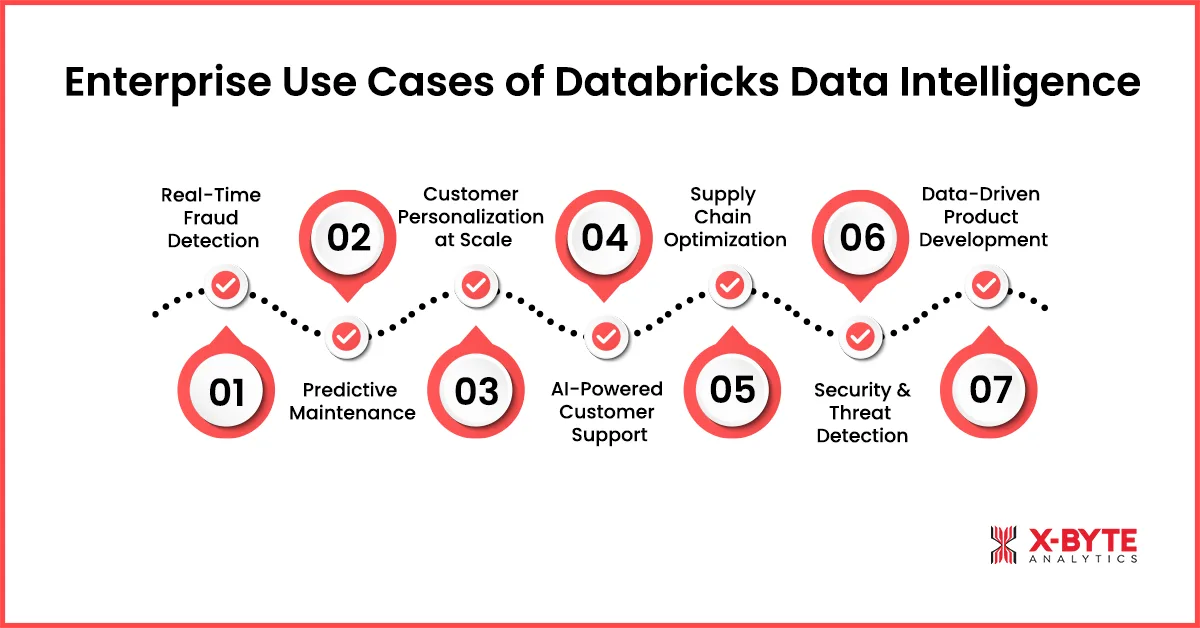
Here are the most common ones:
1. Real-Time Fraud Detection
Enterprises use Structured Streaming inside Databricks to monitor live transactions the moment they occur, flag suspicious activity instantly, and run the entire detection pipeline inside one governed environment, no separate infrastructure, no delays.
Example: Mastercard, the global payments network trusted by billions, uses Databricks to power real-time fraud detection and GenAI-assisted customer support, combining AI agents with human oversight while keeping governance unified across every team and partner.
2. Predictive Maintenance
Waiting for equipment to break is expensive. Operations teams use Mosaic AI inside Databricks to feed live sensor data into machine learning models that predict failures before they happen, cutting downtime, reducing repair costs, and keeping production lines running without building a separate ML stack.
Example: Siemens, the global industrial manufacturing and technology company, uses Databricks’ cloud platform to process real-time sensor data from manufacturing equipment, predicting failures before they occur, reducing unplanned downtime, and optimizing parts replacement across its plants.
3. Customer Personalization at Scale
Generic experiences drive customers away. Enterprises combine real-time streaming data with historical behavior inside Databricks to deliver personalized experiences automatically at scale and speed.
Example: Tonal, the AI-powered home fitness company known for its smart strength training system, uses Databricks to personalize every workout in real time, analyzing movement data instantly to recommend target ranges and deliver post-workout feedback automatically.
4. AI-Powered Customer Support
Support teams are using Databricks to build AI assistants trained on internal documentation, customer tickets, and knowledge bases, resolving queries faster, reducing agent workload, and keeping compliance teams fully informed through complete audit trails.
Example: Experian, the global financial data and credit reporting company trusted with the data of 1.1 billion people across 32 countries, used Databricks Mosaic AI to fine-tune a Llama 8B model and build Latte, a GenAI-powered email automation chatbot. It now handles over 35% of incoming customer emails autonomously, delivering an 8% lift in customer satisfaction scores, decreasing time from 86 hours to just 8 hours.
5. Supply Chain Optimization
Disconnected supply chain data costs money. Enterprises use the Databricks lakehouse platform to connect data across regions, vendors, and logistics systems in one place, running real-time analytics on inventory, demand signals, and delivery performance without stitching together multiple tools.
Example: Bosch, the global engineering and technology company, deployed Databricks as its core data platform, integrating its central data lakehouse with LLMs and dbt to drive operational excellence across complex supply chain processes spanning multiple regions.
6. Security and Threat Detection:
Security teams cannot afford to process threat data slowly. Databricks handles petabytes of log and security data in real time, detecting anomalies and triggering responses faster than any traditional security tool allows, all within a governed, auditable environment.
Example: Adobe, the global software company behind Creative Cloud and Experience Cloud, uses the Databricks security lakehouse for real-time threat detection across more than 10 petabytes of security data at a scale no traditional SIEM solution could handle.
7. Data-Driven Product Development:
Product teams move fastest when they are not waiting on IT to pull data from five different systems. Databricks gives product, engineering, and analytics teams a shared foundation, so insights reach the people who need them without weeks of coordination in between.
Example: P&G, the world’s largest consumer goods company behind brands like Tide, Gillette, and Pampers, implemented Unity Catalog to reduce data redundancy and improve governance, enabling faster product decisions across its global portfolio.
Conclusion
The data exists, but the intelligence layer that connects it all and turns it into insights that businesses can actually use is missing.
The Databricks Data Intelligence Platform is built for exactly that gap and is working as a complete enterprise data intelligence platform where data engineering, AI-powered data intelligence, analytics, and governance work together to ensure trusted, faster, and the same layer of truth.
And in 2026, it is the foundation separating the enterprises pulling ahead from those still catching up.
If you are ready to do the same, X-Byte Analytics can help you get there. Whether you are evaluating Databricks analytics use cases for your industry, looking to operationalize AI on your existing data stack, or exploring how Generative AI services can unlock new value from your data, our team brings the hands-on expertise to make it real, not just theoretical.
Book a free consultation with X-Byte Analytics and find out what the right Databricks data intelligence foundation looks like for your business.