
Enterprise Data Engineering Platform for Unified Business Intelligence & Advanced Analytics
- Home
- Case-Study
- Enterprise Data Engineering Platform for Unified Business Intelligence & Advanced Analytics
Project category
United States
6 Months
Ready To Turn Scattered Enterprise Data Into One Trusted Analytics Platform?

Project Overview
X-Byte Analytics built the platform through its Data Engineering Services to unify enterprise data across ERP, CRM, finance, inventory, procurement, and third-party systems.
A global manufacturing and distribution enterprise needed a centralized platform to automate reporting, improve data quality, and support advanced analytics. However, business data was scattered across disconnected systems, which made reports slow, manual, and inconsistent across departments.
To solve this challenge, X-Byte Analytics developed an enterprise data engineering and analytics modernization platform with automated data ingestion, ETL/ELT pipelines, data quality checks, data lake storage, warehouse modeling, and BI enablement.
Moreover, the platform created a single source of truth for sales, finance, inventory, procurement, production, and operational performance. As a result, teams gained faster reporting cycles, improved data accuracy, centralized visibility, and an AI-ready analytics foundation.
Result: The client reduced manual reporting effort, improved enterprise data consistency, and enabled faster data-driven decisions across departments.
Client Business Challenge
The client needed more than a reporting upgrade. They required a reliable enterprise data engineering platform that could support growing data volumes, multiple business systems, and faster decision-making across departments.
However, data was scattered across ERP, CRM, finance, inventory, procurement, distributor, and third-party applications. Because of this fragmentation, reports often showed different numbers for the same business metrics.
Key challenges included:
- Business data was distributed across multiple systems.
- Manual reporting required significant time and effort.
- Data inconsistencies created conflicting department-level reports.
- Leadership lacked real-time visibility into operational performance.
- Existing infrastructure could not scale with growing data volumes.
- Teams had limited access to trusted, analytics-ready datasets.
- Advanced analytics initiatives were delayed due to weak data foundations.
Because of these challenges, the enterprise needed a centralized data integration and warehousing platform that could improve trust, speed, scalability, and reporting accuracy.
Key KPIs Tracked
Our platform focused on the most critical technical, quality, analytics, and performance KPIs required for reliable enterprise reporting.
- Pipeline Success Rate: Tracks the percentage of data pipelines completed without errors or failures.
- Processing Throughput: Measures how much enterprise data the platform processes within a defined period.
- Refresh Frequency: Tracks how often business data is updated for reporting and analytics. ETL Execution Time: Monitors the time required to extract, transform, and load data.
- ETL Execution Time: Monitors the time required to extract, transform, and load data.
- Latency: Measures the delay between data generation and reporting availability.
- Accuracy Score: Evaluates the correctness of processed data across enterprise systems.
- Completeness Rate: Tracks whether required fields, records, and datasets are available for reporting.
- Validation Success Rate: Measures how many records pass quality and business rule checks.
- Reconciliation Accuracy: Compares source data with processed data to confirm reporting reliability.
- Warehouse Query Performance: Tracks how quickly users can retrieve data from the enterprise warehouse.
- Dashboard Refresh Time: Measures how fast BI dashboards update with the latest business data.
- System Availability: Tracks platform uptime to ensure reliable access to data and analytics.
- User Adoption Rate: Measures how actively teams use dashboards, reports, and analytics datasets.
Together, these KPIs gave technical teams and business leaders a clear view of data health, reporting efficiency, and enterprise performance.
Solution Offered: Enterprise Data Engineering Platform
X-Byte Analytics designed a scalable data engineering ecosystem to automate enterprise-wide data integration, transformation, governance, storage, and analytics delivery.
The objective was not only to centralize data. Instead, the goal was to help business teams access clean, trusted, and analytics-ready information without depending on manual reporting cycles.
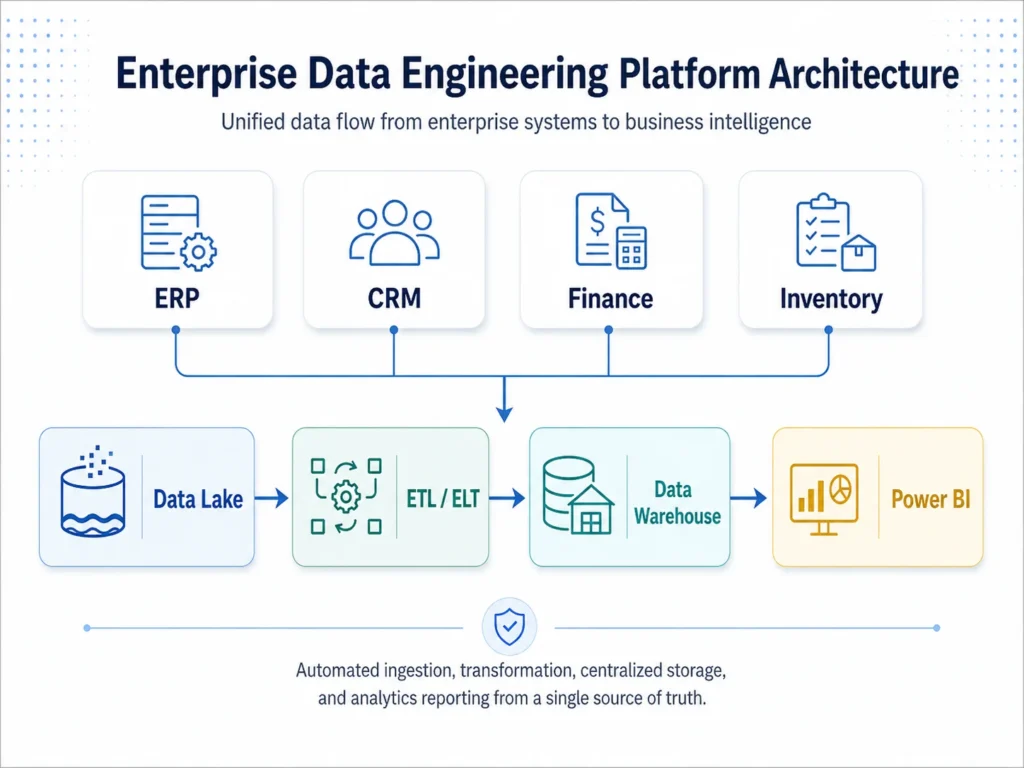
Multi-Source Data Integration
Data was integrated from ERP, CRM, finance, inventory, procurement, distributor portals, and third-party applications. In addition, automated connectors and ingestion pipelines were configured to reduce dependency on manual extraction.
The integration framework supported structured, semi-structured, and batch data sources. Therefore, the client could bring operational, financial, sales, inventory, and procurement data into one scalable data engineering environment.

Enterprise Data Lake Implementation
A centralized enterprise data lake was created to store raw and historical business data. This helped the organization preserve source-level data for auditing, reconciliation, and long-term analytics.
Moreover, the data lake supported high-volume ingestion from multiple systems. As a result, teams gained a flexible storage layer that could scale with future business needs, new data sources, and advanced analytics programs.

Data Transformation & Processing Layer
Scalable ETL/ELT pipelines were built for cleansing, enrichment, aggregation, and transformation. These workflows converted raw system data into standardized, analytics-ready datasets.
In addition, reusable transformation frameworks were created for future scalability. Consequently, new reporting requirements could be supported faster without rebuilding the entire data processing logic each time.

Data Quality & Governance Framework
Automated validation rules were implemented to monitor accuracy, completeness, schema compliance, duplicates, and reconciliation gaps. Therefore, data issues could be identified before they affected business reports.
The governance framework also included lineage tracking, business rules, ownership standards, and audit mechanisms. As a result, stakeholders gained more confidence in enterprise reporting and cross-functional analytics.

Enterprise Data Warehouse
A centralized data warehouse was developed to support reporting, dashboarding, and analytical workloads. Dimensional models and business data marts were designed around key enterprise functions.
Because of this architecture, business users could access curated datasets instead of raw, inconsistent system exports. In addition, optimized data models improved query performance and dashboard refresh speed.

Business Intelligence & Analytics Enablement
Curated datasets were delivered for dashboards, self-service reporting, executive analytics, and advanced analytics initiatives. Moreover, business teams could access standardized metrics across departments.
The platform also created a strong foundation for predictive analytics and AI use cases. Therefore, leadership teams could move from reactive reporting to more proactive enterprise decision-making.

Key Features of the Solution
Automated Data Ingestion
Scalable ETL/ELT Pipelines
Enterprise Data Lake
Data Warehouse Architecture
Data Quality Monitoring
Metadata & Data Governance
Real-Time & Batch Processing
Self-Service Analytics Enablement
Business Benefits of Enterprise Data Engineering Platform
This platform improved operational visibility, reporting speed, data quality, and analytics readiness through a modern enterprise data engineering architecture.
01
Centralized Data Visibility
02
Faster Reporting
Improved Data Quality
04
Better Decision Making
05
Scalable Data Infrastructure
Enhanced Analytics Readiness
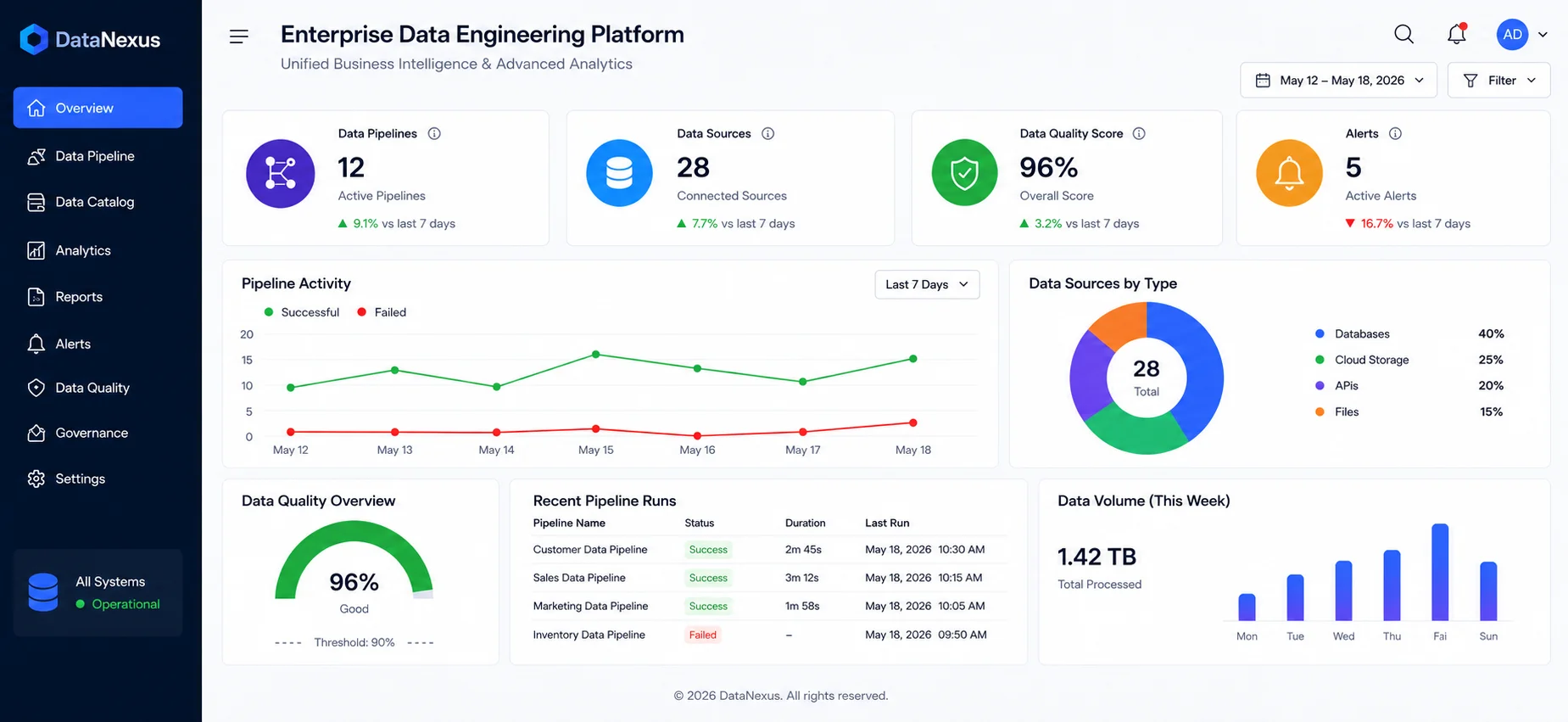
Who Gains Actionable Insights from This System?
Technology Stack Used

Azure Data Factory

Apache Spark

Python

Azure Data Lake Storage

Snowflake / Microsoft SQL Server

Microsoft Power BI

Azure DevOps
Results Achieved
The solution transformed fragmented enterprise data into a centralized analytics ecosystem. As a result, the client gained faster reporting, better data quality, improved operational visibility, and a stronger foundation for advanced analytics.
Key Results:
When Should Your Business Build a Similar Data Engineering Platform?
Your business should consider an enterprise data engineering platform if your teams still depend on manual spreadsheets, disconnected systems, or inconsistent reports. In addition, this type of platform is valuable when leadership needs one reliable source of truth for business decisions.
You should build a similar platform if:
- Your ERP, CRM, finance, and inventory systems are not connected.
- Your teams spend too much time preparing reports manually.
- Your business reports show conflicting numbers across departments.
- Your leadership team lacks real-time operational visibility.
- Your data warehouse cannot handle growing analytics needs.
- Your BI dashboards depend on inconsistent or outdated data.
- Your organization wants to prepare for AI or predictive analytics.
A modern data engineering platform becomes especially valuable when business growth depends on faster reporting, trusted data, and scalable analytics.
Build a Scalable Enterprise Data Engineering Platform Around Your Business KPIs
Need to unify ERP, CRM, finance, inventory, procurement, and operational data into one analytics-ready platform?
X-Byte Analytics helps enterprises build custom data engineering platforms for automated data integration, data warehousing, business intelligence, self-service analytics, and advanced decision-making.
Talk to our data engineering experts and build a platform tailored to your enterprise reporting, governance, and analytics goals.