
Key Features
- Understand the core concepts of business intelligence and data analytics and how both support faster, more accurate, and data-driven business decision-making.
- Explore a clear comparison of business intelligence vs data analytics, including their roles, use cases, and impact on identifying market trends and business performance.
- Gain insights into career opportunities and business value, helping organizations and professionals understand the importance of both BI and data analytics for smooth and scalable business operations.
In today’s competitive and data-driven economy, organizations depend on accurate insights to drive performance, improve efficiency, and maintain a strategic advantage. However, many businesses struggle to understand the distinction between business intelligence vs data analytics, often using the terms interchangeably despite their different purposes and outcomes.
Understanding the difference between data analytics and business intelligence is essential for building the right data strategy. While business intelligence focuses on reporting, monitoring, and performance visibility, data analytics goes deeper, exploring patterns, identifying root causes, and predicting future outcomes. Both approaches support decision-making, but they serve different roles within an organization’s data ecosystem.
This blog explains business intelligence and data analytics in detail, covering what is business intelligence, what is data analytics, their key differences, types, benefits, and tools. By the end, you will clearly understand when to use BI, when to apply analytics, and how combining both can strengthen operational and strategic decision-making.
What Is Data Analytics?
Data analytics is the process of examining raw data to uncover patterns, trends, and insights that support informed decision-making. It helps organizations move beyond assumptions by using structured analysis to improve performance, reduce risks, and drive strategic growth.
Businesses use data analytics to answer critical questions such as:
- Why did sales decline in a specific region?
- Which customer segments are most profitable?
- What factors influence churn or customer retention?
- How can operational costs be optimized?
Within the discussion of business intelligence vs data analytics, analytics plays a deeper role by identifying root causes and predicting future outcomes, enabling proactive and data-driven business strategies.
What Is Business Intelligence?
Business Intelligence (BI) refers to the processes, technologies, and tools used to collect, organize, and present structured business data for reporting and performance monitoring. If you’re asking “What is business intelligence?”, it is primarily focused on delivering clear, consistent visibility into business operations through dashboards, reports, and KPI tracking.
Unlike deeper analytical exploration, BI concentrates on summarizing historical and current data to help managers and executives understand what is happening across the organization. It ensures stakeholders have access to standardized metrics, improving transparency and alignment across departments.
Common use cases of Business Intelligence include:
- Monitoring sales performance through dashboards
- Tracking KPIs across departments
- Generating executive summary reports
- Standardizing reporting processes organization-wide
In the comparison of business intelligence vs data analytics, BI plays a critical role in operational visibility, ensuring decision-makers have reliable and real-time insights to manage day-to-day performance effectively.
Business Intelligence vs Data Analytics: Key Differences
Understanding business intelligence vs data analytics is essential for selecting the right approach to support business decisions. While both rely on data to generate insights, they differ in focus, depth, and application.
Business Intelligence primarily answers “What happened?” and “What is happening now?” by providing structured reports, dashboards, and KPI tracking. Data analytics goes further by answering “Why did it happen?” and “What will happen next?” using advanced analysis, modeling, and forecasting techniques.
Below is a clear comparison highlighting the difference between data analytics and business intelligence:
| Aspect | Business Intelligence | Data Analytics |
| Primary Focus | Reporting and monitoring | Deep analysis and prediction |
| Type of Insight | Descriptive | Diagnostic, Predictive, Prescriptive |
| Data Handling | Mostly structured data | Structured and unstructured data |
| Key Question | What happened? | Why did it happen? What will happen next? |
| Users | Managers, Executives | Analysts, Data Scientists |
| Goal | Operational visibility | Strategic optimization |
In summary, Business Intelligence ensures visibility and consistency in reporting, while data analytics drives deeper insights and future-oriented decisions. Organizations that combine both gain a complete data strategy, balancing performance monitoring with predictive intelligence.
Types of Business Intelligence
Business Intelligence can be categorized based on how insights are delivered and used across different levels of an organization. Understanding the types of Business Intelligence helps businesses implement the right BI approach for operational, tactical, and strategic decision-making.
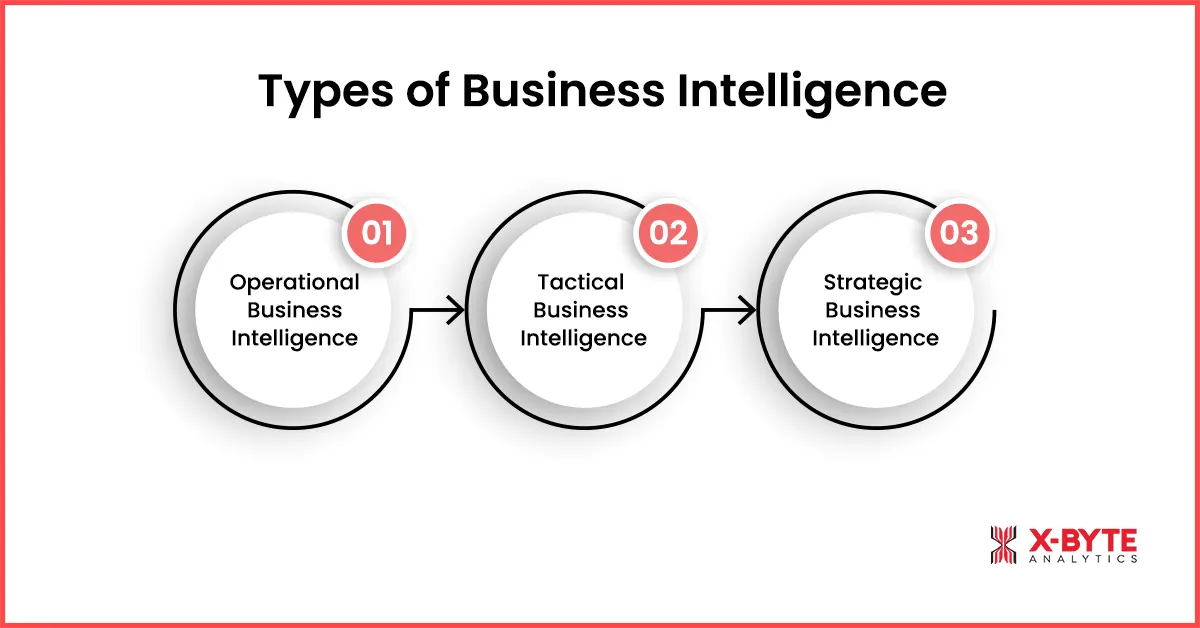
1. Operational Business Intelligence
Operational BI focuses on real-time or near real-time data to support daily business activities. It enables teams to monitor ongoing processes, track performance metrics, and respond quickly to operational issues. This type of BI is commonly used by frontline managers and operational teams who require immediate visibility.
2. Tactical Business Intelligence
Tactical BI supports short-term decision-making at the departmental level. It helps managers analyze team performance, optimize processes, and improve functional efficiency. Tactical BI bridges the gap between daily operations and long-term strategic planning.
3. Strategic Business Intelligence
Strategic BI provides high-level insights for executives and senior leadership. It focuses on long-term trends, growth metrics, and overall organizational performance. This type of BI supports strategic planning, goal tracking, and executive-level decision-making.
By implementing the right combination of BI types, organizations ensure that the right stakeholders receive the right level of insight, enhancing performance visibility and business alignment.
Turn Data Into Strategic Advantage With Smarter BI & Analytics Solutions
Types of Data Analytics
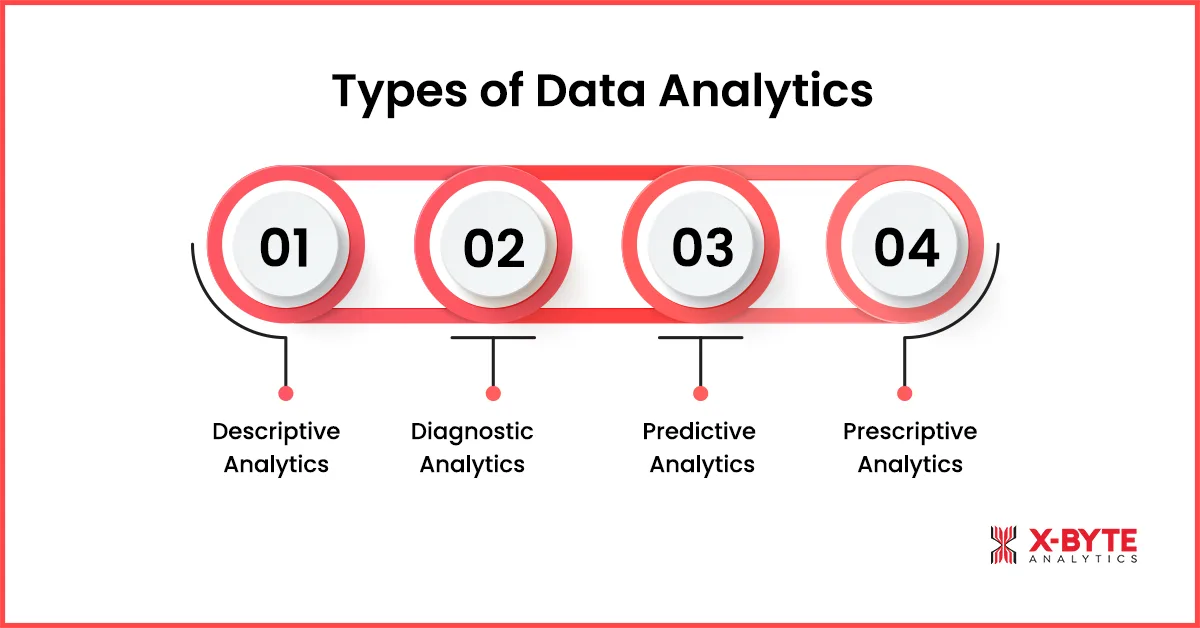
Data analytics is categorized based on the type of insights it delivers and the business questions it answers. Understanding the types of data analytics helps organizations apply the right analytical approach for performance improvement and strategic growth.
1. Descriptive Analytics
Descriptive analytics explains what happened by analyzing historical data. It summarizes trends, patterns, and past performance to provide a clear view of outcomes.
2. Diagnostic Analytics
Diagnostic analytics focuses on why something happened. It identifies root causes by examining correlations, relationships, and influencing factors within datasets.
3. Predictive Analytics
Predictive analytics uses historical data, statistical models, and machine learning techniques to forecast future outcomes. It helps organizations anticipate risks, demand, and emerging opportunities.
4. Prescriptive Analytics
Prescriptive analytics recommends actions by evaluating possible scenarios and outcomes. It guides decision-makers toward optimal solutions based on data-driven simulations.
Together, these types enable organizations to move from understanding past performance to predicting and shaping future results, highlighting a key distinction in the broader discussion of business intelligence vs data analytics.
Benefits of Data Analytics
Data analytics enables organizations to move beyond reporting and uncover deeper insights that drive strategic growth and competitive advantage. By analyzing patterns, behaviors, and predictive trends, analytics supports smarter planning and more confident decision-making.
Key Benefits of Data Analytics
- Improved Forecasting Accuracy: Predictive models help businesses anticipate demand, revenue trends, and market changes with greater precision.
- Deeper Customer Insights: Analytics uncovers customer behavior patterns, preferences, and segmentation opportunities to improve personalization and retention.
- Risk Identification and Mitigation: By detecting anomalies and emerging risks early, organizations can proactively prevent losses and operational disruptions.
- Process Optimization: Advanced analysis highlights inefficiencies and bottlenecks, enabling continuous improvement across operations.
- Competitive Advantage: Organizations that leverage analytics gain forward-looking insights that support innovation, faster adaptation, and data-driven strategy execution.
In the broader comparison of business intelligence vs data analytics, analytics provides the strategic depth needed for forecasting, optimization, and long-term growth planning.
Business Intelligence vs Data Analytics Tools
Selecting the right technology is critical when evaluating business intelligence vs data analytics. While both rely on data platforms, their tools are designed for different purposes, reporting and visualization versus advanced modeling and predictive analysis.
Business Intelligence Tools
Business Intelligence tools focus on dashboards, reporting, and data visualization. They help organizations track KPIs, monitor performance, and standardize reporting across departments.
Common capabilities include:
- Interactive dashboards and visual reports
- Automated data refresh and scheduled reporting
- KPI tracking and performance monitoring
- Self-service reporting for business users
Popular Business Intelligence tools include:
- Microsoft Power BI
- Tableau
- Qlik Sense
These tools are ideal for operational visibility, executive reporting, and standardized KPI tracking.
Data Analytics Tools
Data analytics tools are designed for deeper exploration, statistical analysis, and predictive modeling. They support advanced analytical techniques used by analysts and data scientists.
Common capabilities include:
- Statistical modeling and hypothesis testing
- Machine learning and predictive analytics
- Data mining and pattern detection
- Scenario analysis and optimization
Popular Data Analytics tools include:
- Python
- R
- Apache Spark
- SAS
These tools enable organizations to uncover hidden trends, build predictive models, and support data-driven strategic decision-making.
Choosing between BI and analytics tools depends on business goals, technical maturity, and the level of analytical depth required. Many modern enterprises integrate both to create a scalable and comprehensive data ecosystem.
Conclusion
Understanding business intelligence vs data analytics is essential for organizations aiming to maximize the value of their data. While Business Intelligence provides structured reporting and real-time performance visibility, data analytics delivers deeper insights, predictive capabilities, and strategic foresight. Together, they create a complete decision-support framework that strengthens operational efficiency and long-term growth.
Organizations that align BI and analytics with clear business goals gain better control over performance, improved forecasting accuracy, and stronger competitive positioning. The key is selecting the right approach, tools, and implementation strategy based on data maturity and decision requirements.
If you’re looking to implement or optimize BI and analytics within your organization, X-Byte Analytics helps businesses design scalable, insight-driven solutions tailored to their operational and strategic goals.Ready to turn your data into a measurable business impact? Connect with X-Byte Analytics today and build a smarter, data-driven future.